-
 Scientists Identify 45 Earth-Like Planets Beyond Our Solar System4 April 2026
 -
Artemis 2: Astronauts Aboard Orion Spacecraft Begin Journey Towards the Moon on Day 23 April 2026
-
iPhones in Deep Space: NASA Breaks Rules for Artemis 2 Crew; 5 Key Facts2 April 2026
-
Artemis II Launched: NASA’s First Crewed Mission in 50 Years Aims for the Moon2 April 2026
-
Artemis 2: NASA's Astronaut Moon Mission Explained in Five Points1 April 2026
- Home
- Science
- Science News
- Researchers Suggest Saturn's Titan Moon Formed in a Single High Energy Impact Event
Researchers Suggest Saturn's Titan Moon Formed in a Single High-Energy Impact Event
Titan formed after a massive collision between two moons 100–200 million years ago, as per researchers.
Written by Gadgets 360 Staff | Updated: 18 February 2026 21:00 IST
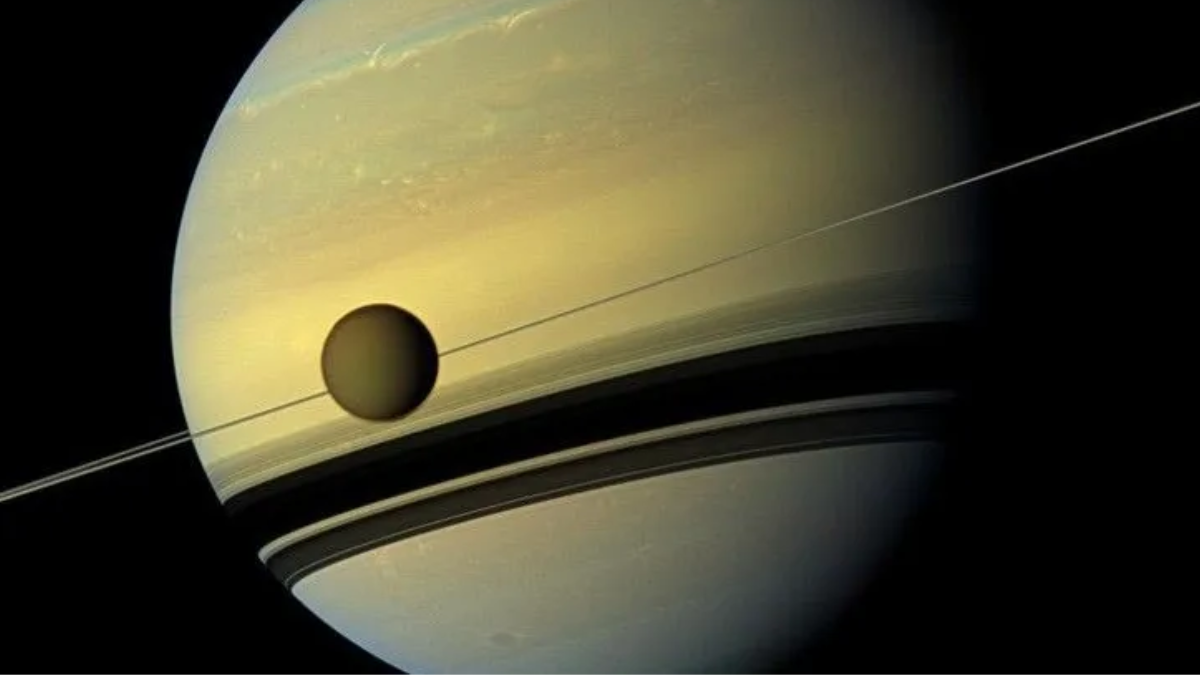
Photo Credit: NASA/JPL–Caltech/SSI
Saturn's famous rings and its biggest moon Titan, have a shared history of violent origins
Click Here to Add Gadgets360 As A Trusted Source


Advertisement
New research indicates that Saturn's famous rings and its biggest moon, Titan, have a shared history of violent origins. Titan probably developed through a collision between a “Proto-Titan” moon and a smaller moon that occurred 100 to 200 million years ago. The enormous impact created a new surface for Titan because it removed all of its ancient craters while sending material into space. The Cassini mission discovered that Saturn's rings have an unexpected age of approximately 100 million years, which indicates their formation resulted from this moon-collision event.
Titan's giant moon merger
According to the simulations, Saturn originally possessed an additional moon that eventually lost its stable orbital path. The majority of simulations demonstrate that this moon eventually crashed into Titan during the time period between 100 million and 200 million years ago.
The cataclysmic event “resurfaced Titan” by destroying ancient craters and opening pathways for gases to escape from its underground spaces. The impact changed Titan's orbit to a wider path with increased eccentricity.
The collision debris most likely formed into Hyperion, which exists as Saturn's unique sponge-shaped moon that maintains a 4:3 orbital resonance with Titan.
Birth of the rings
After Titan's violent birth, its new orbit destabilized smaller moons. Resonant tugs drove collisions among Saturn's inner satellites. Most fragments would recombine into moons, but ice debris scattered inward to form the rings.
This links the rings' ∼100-million-year age to Titan's moon-merger event. Independent NASA studies confirm the rings are young and likely formed when such moonlets were shattered.
Future missions like NASA's Dragonfly (arriving 2034) could test this model by searching Titan's surface for geological or chemical traces of the ancient collision.
Comments
Get your daily dose of tech news, reviews, and insights, in under 80 characters on Gadgets 360 Turbo. Connect with fellow tech lovers on our Forum. Follow us on X, Facebook, WhatsApp, Threads and Google News for instant updates. Catch all the action on our YouTube channel.
Related Stories


Advertisement
Follow Us




-
05:05
Goboult Mustang Racer Smartwatch Review: Should You Get This Mustang Smartwatch? -
04:58
OnePlus Nord Buds 4 Pro Review: Specs, Sound Quality, ANC, and Battery Backup Tested -
02:29
[Sponsored] Samsung Galaxy S26 Ultra First Look: AI Smartphone for Creators, Gaming & Productivity -
04:25
Vivo X200T Review - Full Camera, Gaming & Battery Test | Worth Buying? -
28:31
The Future of Productivity: Logitech's Anatoliy Polyanker On AI, Hybrid Work, And India's Tech Boom
-
Redmi 15A 5G की सेल शुरू, जानें कितने में मिल रहा 6300mAh बैटरी वाला फोन
-
7300mAh बैटरी, 50MP कैमरा वाले OnePlus फोन पर बंपर डिस्काउंट, जानें
-
Zepto बेच रहा 24 हजार रुपये सस्ता iPhone 17 Pro Max, सबसे तगड़ा डिस्काउंट
-
3 हफ्तों तक चलने वाली Honor Watch X5i स्मार्टवॉच लॉन्च, 60Hz AMOLED डिस्प्ले, जानें कीमत
Advertisement
Popular on Gadgets
- Samsung Galaxy Unpacked 2026
- iPhone 17 Pro Max
- ChatGPT
- iOS 26
- Laptop Under 50000
- Smartwatch Under 10000
- Apple Vision Pro
- Oneplus 12
- OnePlus Nord CE 3 Lite 5G
- iPhone 13
- Xiaomi 14 Pro
- Oppo Find N3
- Tecno Spark Go (2023)
- Realme V30
- Best Phones Under 25000
- Samsung Galaxy S24 Series
- Cryptocurrency
- iQoo 12
- Samsung Galaxy S24 Ultra
- Giottus
- Samsung Galaxy Z Flip 5
- Apple 'Scary Fast'
- Housefull 5
- GoPro Hero 12 Black Review
- Invincible Season 2
- JioGlass
- HD Ready TV
- Latest Mobile Phones
- Compare Phones
Latest Gadgets
- Honor Play 80
- Nord 6
- Honor X80i
- Honor Play 80 Pro
- Redmi Note 15 SE 5G
- Redmi A7 Pro
- OPPO K15 Pro
- OPPO K15 Pro+
- Xiaomi Book Pro 14
- MacBook Neo
- Vivo Pad 6 Pro
- Lenovo Legion Y700 Gen 5
- boAt Valour Watch 1R
- Xiaomi Watch S5
- Xiaomi QLED TV X Pro 75
- Haier H5E Series
- Asus ROG Ally
- Nintendo Switch Lite
- Haier 1.6 Ton 5 Star Inverter Split AC (HSU19G-MZAID5BN-INV)
- Haier 1.6 Ton 5 Star Inverter Split AC (HSU19G-MZAIM5BN-INV)

- About Us
- Sitemaps
- Feedback
- Archives
- Contact Us
- RSS
- Advertise
- Career
- Privacy Policy
- Ethics
- Editorial Policy
- Terms & Conditions
- Complaint Redressal
Download Our Apps
Available in Hindi
© Copyright Red Pixels Ventures Limited 2026. All rights reserved.