-
 James Webb Telescope Captures Rare Infrared Footprints of Io and Ganymede Inside Jupiter’s Auroras11 March 2026
 -
Jupiter Resumes Direct Motion This March as the Gas Giant Hits Peak Visibility for 2026 Skywatchers10 March 2026
-
NASA Juno Mission Uncovers Subtle Geometric Shifts That Challenge Existing Models of the Jovian Interior14 February 2026
-
NASA Finds a Crucial Life-Building Chemical on Jupiter’s Moon31 January 2026
-
Wolf Moon Supermoon 2026: Rare January Full Moon Near Perihelion Lights Up the Sky2 January 2026
- Home
- Science
- Science News
- Scientists Reveal Why Jupiter and Saturn’s Polar Weather Looks So Different
Scientists Reveal Why Jupiter and Saturn’s Polar Weather Looks So Different
Scientists studying Jupiter and Saturn’s polar storms suggest their dramatic differences arise from deep interior properties. Simulations show that “harder” or “softer” gas layers beneath the storms may control whether one massive vortex forms or many smaller ones persist.
Written by Gadgets 360 Staff | Updated: 23 January 2026 21:40 IST
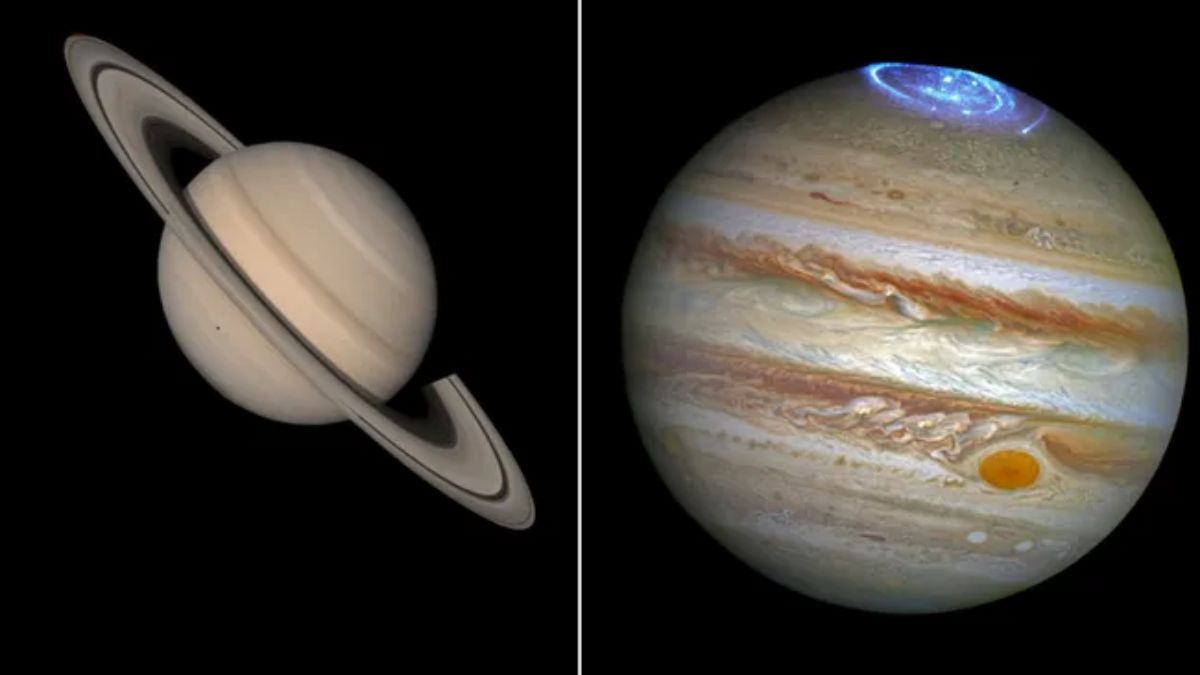
Photo Credit: NASA/JP/ESA/J. Nichols (University of Leicester)
(Left) the ringed gas giant Saturn (Right) Jupiter as seen by Hubble with a glowing polar vortex.
Click Here to Add Gadgets360 As A Trusted Source


Advertisement
For years, scientists have been trying to explain why Jupiter and Saturn, two planets that are so similar in terms of their size and composition, could have such vastly different polar weather. Saturn's north pole features one gigantic hexagonal storm, while Jupiter's has a big central cyclone with eight smaller ones around it. Now, researchers think this difference may come down to each planet's interior: differences in how "hard" or "soft" the deep gas is could determine whether one storm dominates or multiple form.
Polar vortices and surface weather
According to observations from Cassini, Saturn's north pole is capped by a single massive storm in a distinctive hexagon shape. Juno's images of Jupiter revealed a very different pattern: one large cyclone at the pole surrounded by eight smaller vortices. Each of Jupiter's polar storms spans about 3,000 miles across, whereas Saturn's lone vortex stretches about 18,000 miles wide. This stark contrast has puzzled scientists, since both planets are similar in size and composition.
Clues to planetary interiors
MIT researchers simulated the fluid dynamics of polar storms on these planets. They concluded that the type of gas present at the bottom of a whirlpool is crucial, with a “soft” (less dense) bottom hindering the growth of a storm, leading to multiple whirlpools originating (like Jupiter), while a “harder” (denser) bottom means a prominent solo storm (like Saturn). According to an MIT researcher, Wanying Kang, “one possible scenario could be that Saturn has a harder bottom than Jupiter,” which would suggest an internally lighter Jupiter than Saturn, perhaps due to a greater abundance of heavier elements.
Comments
Get your daily dose of tech news, reviews, and insights, in under 80 characters on Gadgets 360 Turbo. Connect with fellow tech lovers on our Forum. Follow us on X, Facebook, WhatsApp, Threads and Google News for instant updates. Catch all the action on our YouTube channel.
Further reading:
JUPITER, Saturn, Gas giants, Planetary Science, polar storms, Cassini, Juno, MIT research, planetary interiors
Related Stories



Advertisement
Follow Us




-
05:05
Goboult Mustang Racer Smartwatch Review: Should You Get This Mustang Smartwatch? -
04:58
OnePlus Nord Buds 4 Pro Review: Specs, Sound Quality, ANC, and Battery Backup Tested -
02:29
[Sponsored] Samsung Galaxy S26 Ultra First Look: AI Smartphone for Creators, Gaming & Productivity -
04:25
Vivo X200T Review - Full Camera, Gaming & Battery Test | Worth Buying? -
28:31
The Future of Productivity: Logitech's Anatoliy Polyanker On AI, Hybrid Work, And India's Tech Boom
-
Redmi 15A 5G की सेल शुरू, जानें कितने में मिल रहा 6300mAh बैटरी वाला फोन
-
7300mAh बैटरी, 50MP कैमरा वाले OnePlus फोन पर बंपर डिस्काउंट, जानें
-
Zepto बेच रहा 24 हजार रुपये सस्ता iPhone 17 Pro Max, सबसे तगड़ा डिस्काउंट
-
iPhone 17 Pro Max खरीदें 47 हजार तक सस्ता! Apple की 50वीं वर्षगांठ पर धमाका ऑफर
-
महंगे हो रहे स्मार्टफोन! Xiaomi ने बताई असली वजह
Advertisement
Popular on Gadgets
- Samsung Galaxy Unpacked 2026
- iPhone 17 Pro Max
- ChatGPT
- iOS 26
- Laptop Under 50000
- Smartwatch Under 10000
- Apple Vision Pro
- Oneplus 12
- OnePlus Nord CE 3 Lite 5G
- iPhone 13
- Xiaomi 14 Pro
- Oppo Find N3
- Tecno Spark Go (2023)
- Realme V30
- Best Phones Under 25000
- Samsung Galaxy S24 Series
- Cryptocurrency
- iQoo 12
- Samsung Galaxy S24 Ultra
- Giottus
- Samsung Galaxy Z Flip 5
- Apple 'Scary Fast'
- Housefull 5
- GoPro Hero 12 Black Review
- Invincible Season 2
- JioGlass
- HD Ready TV
- Latest Mobile Phones
- Compare Phones
Latest Gadgets
- Honor Play 80
- Nord 6
- Honor X80i
- Honor Play 80 Pro
- Redmi Note 15 SE 5G
- Redmi A7 Pro
- OPPO K15 Pro
- OPPO K15 Pro+
- Xiaomi Book Pro 14
- MacBook Neo
- Vivo Pad 6 Pro
- Lenovo Legion Y700 Gen 5
- boAt Valour Watch 1R
- Xiaomi Watch S5
- Xiaomi QLED TV X Pro 75
- Haier H5E Series
- Asus ROG Ally
- Nintendo Switch Lite
- Haier 1.6 Ton 5 Star Inverter Split AC (HSU19G-MZAID5BN-INV)
- Haier 1.6 Ton 5 Star Inverter Split AC (HSU19G-MZAIM5BN-INV)

- About Us
- Sitemaps
- Feedback
- Archives
- Contact Us
- RSS
- Advertise
- Career
- Privacy Policy
- Ethics
- Editorial Policy
- Terms & Conditions
- Complaint Redressal
Download Our Apps
Available in Hindi
© Copyright Red Pixels Ventures Limited 2026. All rights reserved.