-
 Netflix Reportedly Offered $500 Million for Exclusive Film and TV Rights for Xbox IP Before Deal Fell Through26 October 2026
 -
Microsoft Rolls Out Standalone Cloud Playtime Packs to Xbox Insiders22 October 2026
-
Next-Generation Xbox Will Reportedly Launch in 2028, Could Cost Between $1,200 and $1,80021 October 2026
-
Microsoft Announces $50 Xbox Nano Controller, Launch Set for Next Month16 October 2026
-
Microsoft Maia 300 AI Chip Announced as Company Expands Its In-House AI Infrastructure13 October 2026
Microsoft Introduces Maia 200 Chipset for AI Inference, Will Power OpenAI’s GPT-5.2
Microsoft is also inviting developers and AI startups to explore model and workload optimisation with the new Maia 200 SDK.
Written by Akash Dutta, Edited by Ketan Pratap | Updated: 27 January 2026 13:57 IST
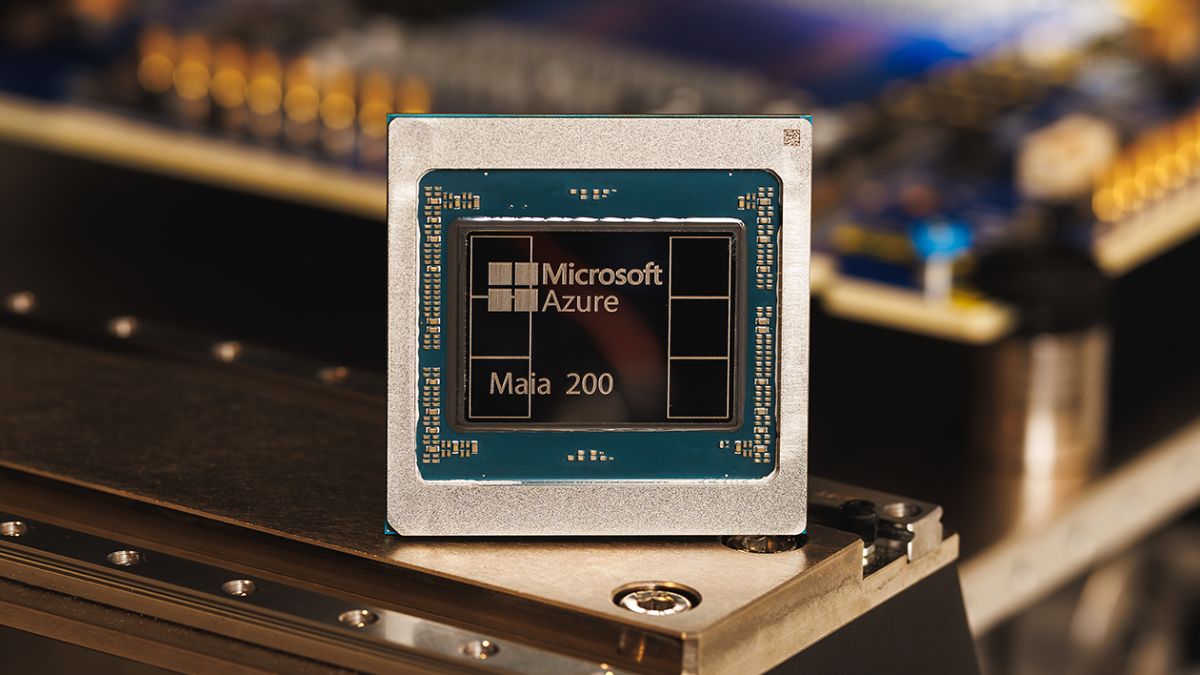
Photo Credit: Microsoft
Microsoft says Maia 200 can run the largest AI models in existence, with room for bigger future models
Click Here to Add Gadgets360 As A Trusted Source

Advertisement
Microsoft unveiled its newest artificial intelligence (AI) accelerator, Maia 200 chip, on Monday. It is a purpose-built chipset design for faster AI inference, and is said to cut the cost of running large language models (LLMs) at scale. The new enterprise-focused processor is the successor to the Maia 100, which was launched in 2023. The Maia 200 is currently being deployed in Microsoft's Azure cloud data centres, starting in the US. The company highlighted that its new chip will power the latest models, such as OpenAI's GPT 5.2.
Microsoft Unveils Maia 200 Chipset for AI Workloads
In a blog post, the Redmond-based tech giant announced and detailed its latest AI chipset. Maia 200 is built on Taiwan Semiconductor Manufacturing Corporation's (TSMC) 3nm process, and each chip contains more than 140 billion transistors. Microsoft said the chips will also feature a custom memory and communication architecture tailored specifically for inference workloads. The advanced design helps maximise the speed at which the chip can process data and keep AI models “fed” with information.
A key part of Maia 200's performance comes from its support for low-precision compute formats such as 4-bit (FP4) and 8-bit (FP8) operations. These formats allow AI models to generate responses more quickly and with lower energy use compared with traditional higher-precision computing. Microsoft said Maia 200 delivers in excess of 10 petaFLOPS (quadrillions of floating-point operations per second) in FP4 mode and over 5 petaFLOPS in FP8 mode, making it well-suited for modern LLMs and other AI systems that are used in real-time applications.
Maia 200 also includes 216GB of high-bandwidth memory (HBM3e) with 7TBps bandwidth and 272MB of on-chip SRAM. High-bandwidth memory lets the chip quickly access and move large amounts of data, which is a common bottleneck in AI workloads. The addition of on-chip SRAM helps reduce delays when models need frequent access to smaller, critical data sets, improving responsiveness for inference tasks.
At the system level, Microsoft has designed Maia 200 to scale efficiently across large clusters. Each chip supports 2.8TBps bi-directional bandwidth, and groups of up to 6,144 accelerators can be connected together using standard Ethernet networking. This scalable architecture allows data centre operators to deploy many Maia 200 chips in a rack or across nodes, increasing the throughput available for demanding AI services while keeping power use and costs under control.
One of the central goals behind Maia 200 is to improve performance per dollar, a key metric for inference infrastructure where organisations pay for both compute and energy. Microsoft said Maia 200 delivers around 30 percent better performance per dollar than the hardware the company currently uses in its fleet.
Microsoft is currently previewing a Maia software development kit (SDK) that includes tools such as a Triton compiler, PyTorch support, an optimised kernel library and low-level programming support, enabling developers to build and tune models for the Maia 200 platform.
Comments
Get your daily dose of tech news, reviews, and insights, in under 80 characters on Gadgets 360 Turbo. Connect with fellow tech lovers on our Forum. Follow us on X, Facebook, WhatsApp, Threads and Google News for instant updates. Catch all the action on our YouTube channel.
Related Stories




Advertisement
Follow Us




-
![[Sponsored] Galaxy Watch9 for Everyday Health Insights | Smarter Wellness Choices](https://www.gadgets360.com/static/desktop/images/spacer.png)
01:42
[Sponsored] Galaxy Watch9 for Everyday Health Insights | Smarter Wellness Choices -
01:15
[Sponsored] Galaxy Tab S10 Lite for Students: Notes, Solve Math and More -
04:17
[Sponsored] LG NANO 4K UHD AI TV NU885: Gemini Search, Dolby Atmos & 5 Years of Updates -
00:57
[Sponsored] Samsung Galaxy Z Fold8 My Fan Cam in Action: Find the Moment, Then Share It -
01:41
[Sponsored] What Do You Need To Know Before Your Next Run? | Samsung Galaxy Watch Ultra2
Advertisement
Popular on Gadgets
- Samsung Galaxy S26 Ultra
- Motorola Razr Fold
- ChatGPT
- OPPO Find N6
- Mobiles Under Rs. 40,000
- Vivo X300 Ultra
- Asus Zenbook S14
- iQOO 15
- Vivo X300 Pro
- Lenovo Yoga Slim 7i Aura Edition
- iQOO 15R
- Vivo X Fold 5
- Sony PlayStation 5
- HP OmniPad 12
- OnePlus Nord CE 6 Lite
- OnePlus Pad 4
- OPPO F33 Pro 5G
- Cryptocurrency
- HP OmniBook Ultra 14 (2026)
- iPhone 17
- Eureka Forbes AP 355 Room Air Purifier
- Latest Mobile Phones
- Compare Phones
Latest Gadgets
- HMD 2660 Flip Senior Edition
- Lava Aura Curve
- Poco X8s
- Samsung Galaxy F70 5G
- Tecno Spark 50S 5G
- Vivo Y600s Pro
- Vivo Y32 (2026)
- Infinix Smart 20 HD
- Lenovo Yoga 9n 2-in-1
- Lenovo Yoga Pro 9n
- Amazon Alexa Tablet 8
- Amazon Alexa Tablet 11
- Pebble Qore 2
- Amazfit T-Rex Dual Solar
- Toshiba 65-Inch 4K Ultra HD Smart Mini LED QLED TV (65Z670SP)
- Haier M70 Mini LED 65-inch
- Acer Predator Atlas 8
- Asus ROG Ally
- Blue Star 1.5 Ton 5 Star Inverter Split AC (IE518ZNURS)
- Blue Star 2 Ton 3 Star Inverter Window AC (WIE324L)

- About Us
- Sitemaps
- Feedback
- Archives
- Contact Us
- RSS
- Advertise
- Career
- Privacy Policy
- Ethics
- Editorial Policy
- Terms & Conditions
- Complaint Redressal
Download Our Apps
Available in Hindi
© Copyright Red Pixels Ventures Limited 2026. All rights reserved.