-
 ONMO+ 'Smart Console' Review: A Console-Like Cloud Gaming Experience for Casuals20 August 2026
 -
Nvidia's GeForce Now Cloud Gaming Service Launched in India With Up to 5K Gaming Support: Prices, Benefits14 July 2026
-
GeForce Now Explained: What Is It, Features, Subscription Plans and More17 April 2026
-
Nvidia GeForce Now With RTX 5080-Powered Cloud Gaming Hits Early Access in India16 April 2026
-
Nvidia Launches GeForce Now App for Select Amazon Fire TV Stick Models13 February 2026
- Home
- Games
- Games Reviews
- Nvidia GeForce Now Review: Cloud Gaming Excellence Comes With Caveats
Nvidia GeForce Now Review: Cloud Gaming Excellence Comes With Caveats
GeForce Now has arrived in India. Is it the cloud gaming service that fits your needs?
Written by Manas Mitul, Edited by David Delima | Updated: 21 April 2026 19:14 IST
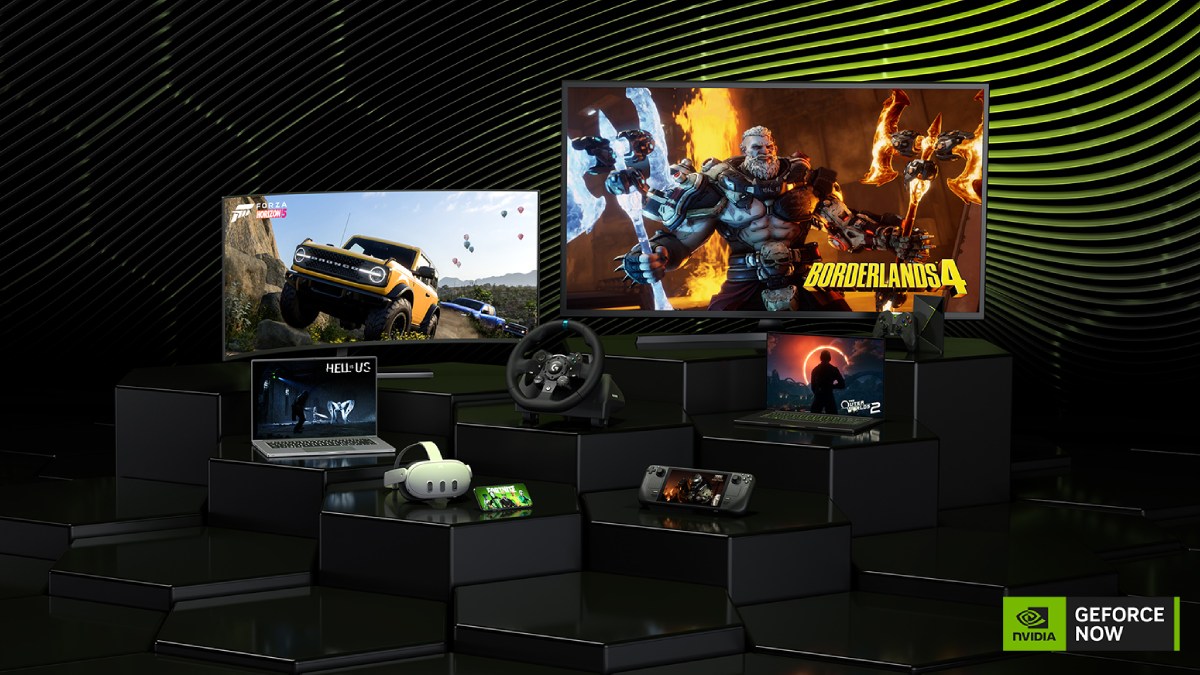
Photo Credit: Nvidia
Nvidia GeForce Now launched in early access in India on April 16
Click Here to Add Gadgets360 As A Trusted Source

Advertisement
When it comes to the growth of gaming in India, the medium has often found itself stumbling over two major hurdles: hardware and pricing. In a mobile-first market, high-end gaming PCs and home consoles like Xbox and PlayStation remain niche products, even if the gaming laptop segment has boomed. The cost of triple-A games, too, is a barrier. Most aren't willing to spend Rs. 5,000 on a single game, and free-to-play titles like PUBG Battlegrounds, Valorant and other mobile games are largely the most popular options.
Enter cloud gaming. Services that allow you to stream your games off the cloud without needing a gaming PC or console have been around for years, but are fairly recent in the Indian market. Reliance's JioGames Cloud service rolled out in beta in 2022, and Microsoft's Xbox Cloud Gaming finally arrived in India in November 2025. Now, Nvidia's cloud gaming service, GeForce Now, has launched in beta access in India, powered by the company's high-end GeForce RTX-class GPUs and promising up to 5K streaming at up to 120fps. This is the most high-end cloud streaming service among its peers, offering crisp image quality, ray-tracing support, and Nvidia's DLSS 4 multi-frame generation features — all running on GeForce RTX 5080-powered servers.
We've had a chance to try out GeForce Now, which connects to storefronts like Steam, Epic Games Store, Xbox Store, and others, and lets you stream your library of owned PC games directly from the cloud — at high-end settings without requiring high-end hardware. As per our testing on a Windows PC and a Mac, the service works pretty seamlessly. You can stream games over the internet and adjust resolution, graphics, DLSS frame generation features, and other settings freely. You can play the latest supported titles (GeForce Now currently supports over 4,500 games) without buying a PC that puts a dent in your savings account. And at reasonable subscription rates (Nvidia is offering 90-day passes starting at Rs. 999), GeForce now seems to be the best cloud gaming offering in India.
The wait is almost over — GeForce NOW launches this GFN Thursday, April 16 for early access in India.🎉📅 pic.twitter.com/jaa6QGl3VW
— 🌩️ NVIDIA GeForce NOW (@NVIDIAGFN) April 14, 2026
But then, as with any cloud streaming service, there are questions and concerns that are hard to ignore. GeForce Now eliminates the need for high-end hardware to run modern games — that is expanding access for players who perhaps can't afford a high-end PC. But while it addresses the hardware problem, it only solves the pricing problem partially. Sure, you don't need to buy a PC, but you still need to buy games. Unlike Xbox Cloud Gaming, which comes bundled with a Game Pass subscription and its library of free games, GeForce Now (GFN) only allows you to stream the games you own on PC storefronts like Steam and Epic Games Store. In essence, you're renting a virtual PC to play games you own.
That begs the question, who is GeForce Now for? Is it for people who already have a healthy library of titles on Steam, but haven't upgraded to a good enough PC? Is it for users who have a decent PC or handheld, but want the click-and-play convenience of cloud streaming? Is it for Mac or mobile gamers who want to play PC games on their devices? Perhaps GeForce Now is for all of them.
But I cannot recommend it for players who do not have an existing library of PC games, either on Steam or Epic. Subscribing to access PC hardware and then buying games to justify the subscription doesn't seem like a smart practice. And there is something fundamentally wrong with paying rent to Nvidia for hardware you can't afford, when the same company is largely responsible for making PC hardware unaffordable today. Yes, cloud gaming and game subscription services are handy alternatives that expand access to games. But there is no true substitute for owning your own hardware and games.
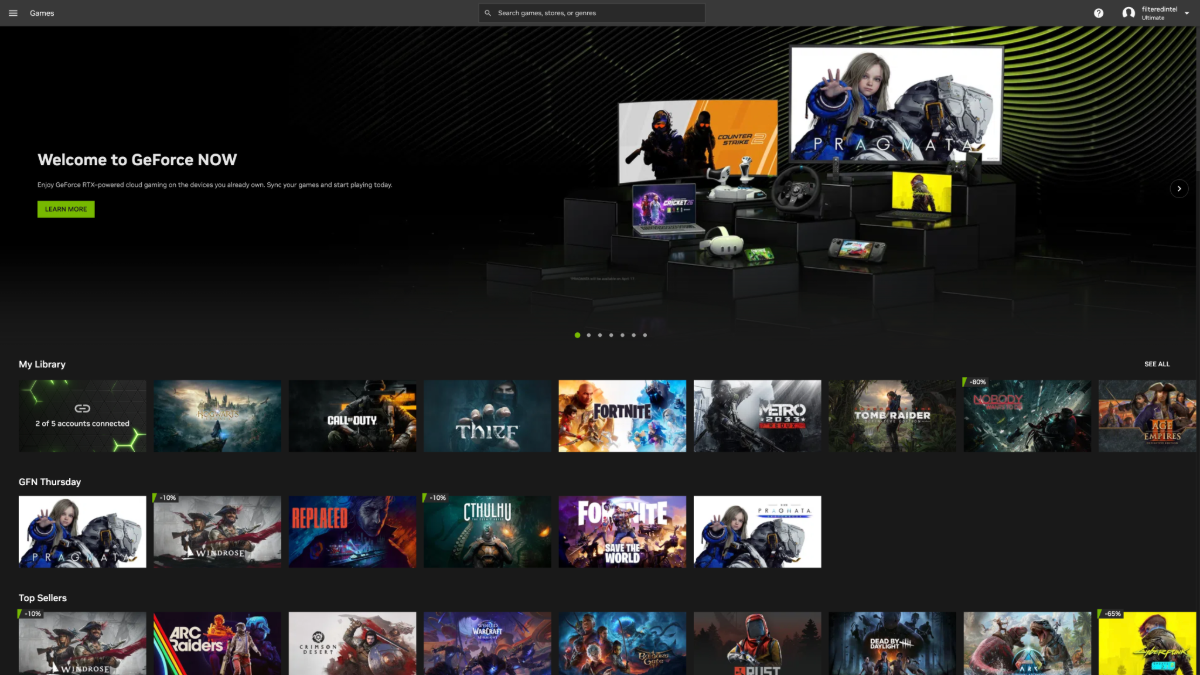
The GeForce Now home screen
GeForce Now Pricing, Features
Before talking about how GeForce Now performs, let's dive into what you get with the service. The cloud gaming service launched in India in early access on April 16. Interested users can head to the GeForce Now website and sign up to be put on a waitlist, with invitations rolling out in waves. Nvidia is offering 90-day early access passes to start off, with the option to buy another pass and extend GeForce Now access.
The Performance pass, which supports six-hour gaming sessions at up to 1440p and 60fps, is priced at Rs. 999. The Ultimate pass, which allows eight-hour streaming sessions up to 5K and 240fps, comes in at Rs. 1,999. On the Ultimate tier, select games are also powered by RTX 5080 servers; the rest run on RTX 4080. Nvidia also plans to roll out a free ad-supported tier in the coming weeks, where performance will be capped to 1080p and 60fps and gaming sessions will be limited to an hour.

Hogwarts Legacy running on GeForce Now
Games on GeForce Now are ready-to-play, meaning they are pre-installed on Nvidia's servers and are ready stream instantly with a single click. With the latest version of GFN, powered by Blackwell RTX, you also get an additional tranche of install-to-play games that can be directly downloaded to cloud storage, just as if you were installing them on a local PC. You can purchase 200GB of persistent cloud storage for Rs. 299 as an add-on for the 90-day access pass.
With the addition of install-to-play supported titles, GeForce Now currently supports over 4,500 PC games across storefronts like Steam, Epic Games Store, Xbox Store and Game Pass, Battle.net, Ubisoft Connect, GOG.com, and EA. You can connect to any of these storefronts in the GeForce Now app and sync your game library — and that's about it. You're ready to stream supported PC games you own directly off the cloud on your PC, Mac, mobile phone, smart TV, or handheld. Once signed in to your account, your Steam library automatically syncs, showing your games on the GeForce Now app. Automatic sync, however, is not available for Epic Games Store yet, and you have to manually search for the games you own on the store and add them to your GeForce Now library.
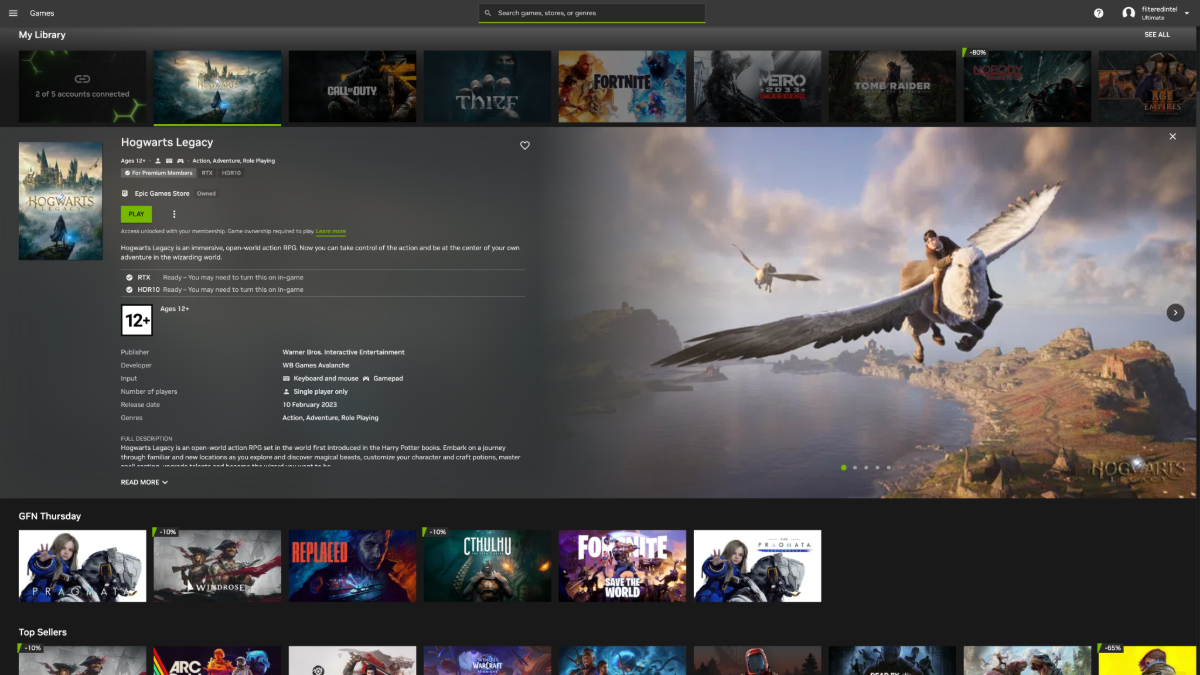
GeForce Now syncs with your games library on third-party storefronts
How Well Does GeForce Now Perform?
You can head to settings in the GeForce Now app and test your network connection to check if you clear bandwidth, packet loss, and latency requirements. With GeForce Now servers located in Mumbai, I recorded a latency of 26ms on 100Mbps Airtel Wi-Fi in Bengaluru. With a wired ethernet connection, the recorded latency dropped to 24ms. You can also choose your streaming quality between Balanced, Data Saver, Competitive, and Cinematic, or set custom max bit rate, resolution, frame rate, Vsync, VRR, HDR, and colour settings. I did most of my game testing on a Mac connected to a 2K, 180Hz monitor, and was left quite impressed with how GeForce Now performed.
The streaming service, with the power of GeForce RTX GPUs, can handle demanding games without really breaking a sweat. For instance, Hogwarts Legacy, with ultra graphics settings, ray-tracing on, and 2K resolution, rendered at high frame rates above 240Hz. While playing, the GeForce Now overlay recorded a ping of 24ms. Gameplay feels seamless, and any input lag is unnoticeable. I do, however, recommend using a wired internet connection; Playing over 5GHz Wi-Fi resulted in noticeable stuttering and frame losses — though it isn't completely obstructive to the experience.
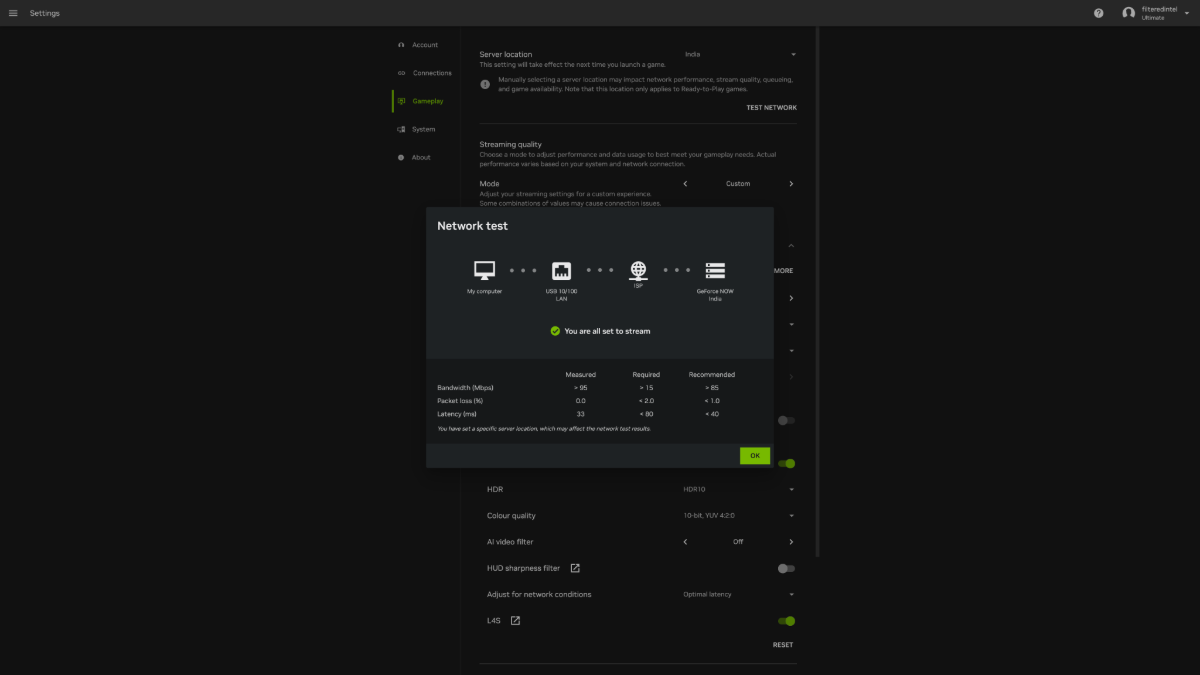
GeForce Now works better over a wired internet connection
I also tried out Call of Duty: Black Ops 7, and some slightly older titles like Shadow of the Tomb Raider, Thief, and Metro 2033 Redux, and had no problems running these games at high frame rates. You can tinker around with the GeForce Now streaming quality presets and lower the resolution for a smoother experience. If you have a compatible monitor, GeForce Now can stream games in up to 5K, 120fps.
Games will default to Nvidia-recommended settings when you load in with a preset in the GeForce Now app, but you can freely change graphics settings in-game. In some games, however, loading in with custom settings where I selected 2K resolution in GeForce Now app to access higher frame rates, locked out higher resolutions in game. In Call of Duty for instance, max resolution option was limited to 1200p when I selected 2K resolution in GeForce Now app — switching to 4K resolution in GeForce Now allowed me to access higher resolutions in the game and Black Ops 7 ran at 120fps at Ultra settings.
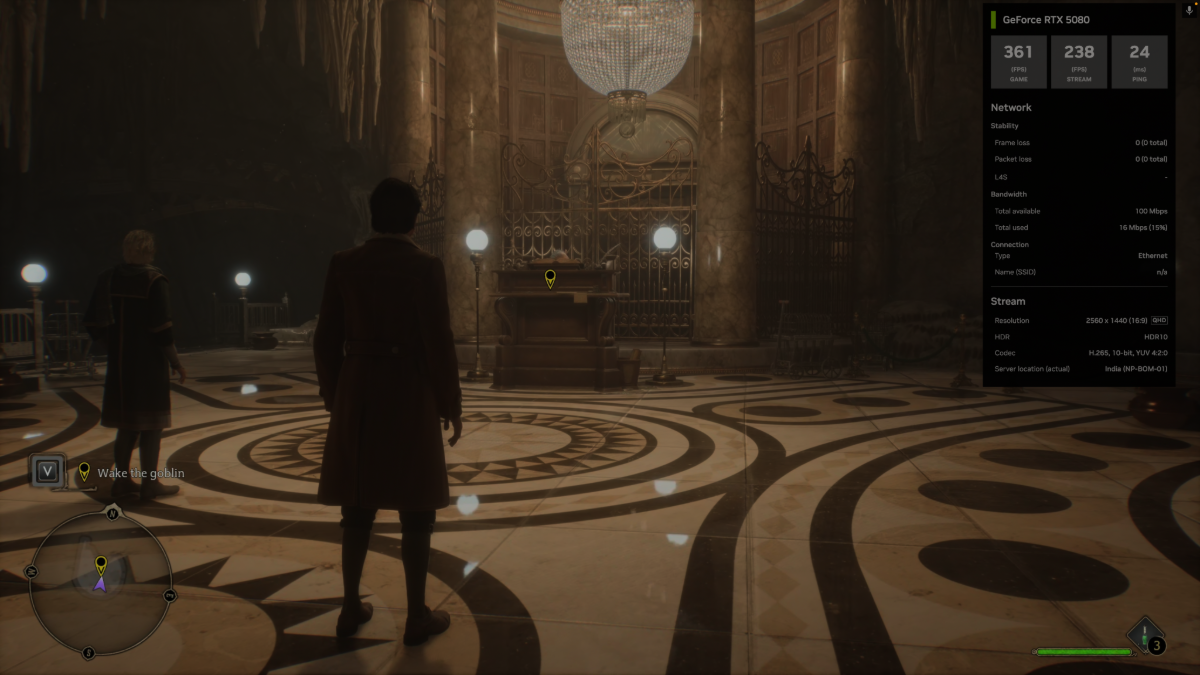
GeForce Now overlay shows streaming statistics like ping and framerate
When inside a game, you can bring up the GeForce Now overlay and check your streaming statistics for framerate and ping and access a host of features. On a PC or Mac, you can record gameplay and take screenshots, even play around with some game filters — though I don't recommend doing that. And all of it — syncing your library, tweaking settings in the GeForce Now app, and jumping into a game session — just works. You can pretty much max out settings in most games and run them without hiccups.
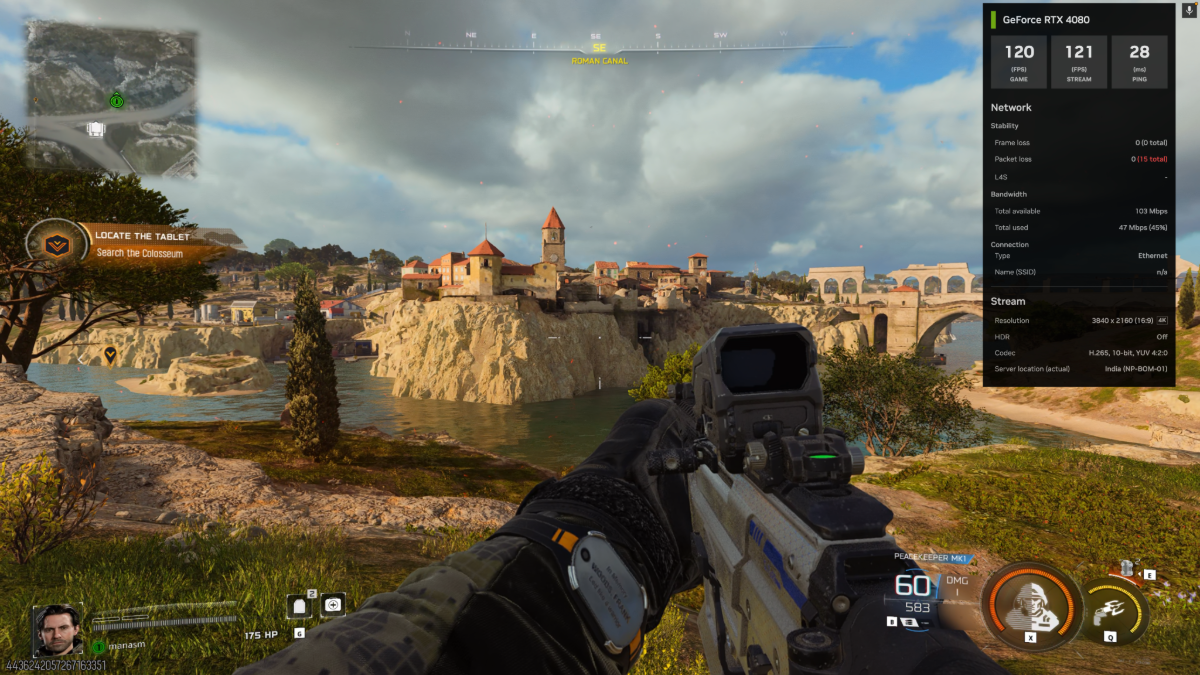
Call of Duty: Black Ops 7 on GeForce Now
GeForce Now Compared to Xbox Cloud Gaming, JioGames Cloud
GeForce Now is seamless and simple. And with Nvidia's Blackwell RTX architecture powering the service, it flies way higher than the competition. This is the definitive way to stream your PC games off the cloud. At Rs. 1,999 for three months of early access, the Ultimate tier, which lets you access higher resolutions and frame rates, is only slightly more expensive than competing services like Xbox Cloud Gaming and JioGames Cloud (Game Pass starts at Rs. 499 a month and JioGames Cloud pro pass costs the same for 28 days of access). But neither of those cloud gaming services come close to offering streaming quality comparable to GeForce Now. Xbox Cloud Gaming is capped at 1440p and 60fps, while Jio's cloud streaming service can only manage resolutions up to 1080p.
Considering the competition, GeForce Now's Performance pass, which offers cloud gaming at up to 1440p and 60fps, is an irresistible deal, too, at Rs. 999 for three months of early access. And if you want the power of an RTX 5080 GPU to run the latest games at high resolutions and frame rates, the Ultimate tier is the best choice. But, unlike Xbox and Jio cloud gaming services, you do not get a library of free games with GeForce Now. And as I mentioned earlier, this could be a hurdle for many.
Verdict
GeForce Now makes complete sense if you have a rich library of PC games on Steam, Epic, or any other storefront. And the service practically opens up the gated hallways of high-end PC gaming for the masses. There are many in India who want to play the latest games, but have hit the hurdle of hardware. If you don't have a high-end PC or console and are willing to spend on games, GeForce Now is a practical and affordable solution that will let you access top-shelf performance.
But, it's hard to get comfortable with the idea of streaming your games in the long run. I also feel reluctant to recommend GFN to players who do not have an existing library of titles on PC — although you can grab some great games during Steam sales or find deals on games and bundles on Green Man Gaming or Humble Bundle (newly released Pragmata is 18 percent off on GMG right now, compared to full price on Steam). Ultimately, running games you own on local hardware is the best choice. But if that choice is unaffordable to you right now, GeForce Now is perhaps the next best option.
Pros
- Seamless performance
- Low latency
- Stable stream quality
- Variety of supported devices
- Local Nvidia server
- Reasonable early access pricing
Cons
- No library of free PC games
- Occasional stuttering, glitches
- Nvidia subscription amidst rising hardware costs
Comments
Get your daily dose of tech news, reviews, and insights, in under 80 characters on Gadgets 360 Turbo. Connect with fellow tech lovers on our Forum. Follow us on X, Facebook, WhatsApp, Threads and Google News for instant updates. Catch all the action on our YouTube channel.
Further reading:
Nvidia GeForce Now, GeForce Now, Nvidia, Cloud Gaming, India, PC Gaming, PC Games, Steam, Epic Games Store, Nvidia RTX 5080, Nvidia RTX GPU, GeForce Now Review
Related Stories



Advertisement
Follow Us




-
![[Sponsored] LG NANO 4K UHD AI TV NU885: Gemini Search, Dolby Atmos & 5 Years of Updates](https://www.gadgets360.com/static/desktop/images/spacer.png)
04:17
[Sponsored] LG NANO 4K UHD AI TV NU885: Gemini Search, Dolby Atmos & 5 Years of Updates -
00:57
[Sponsored] Samsung Galaxy Z Fold8 My Fan Cam in Action: Find the Moment, Then Share It -
01:41
[Sponsored] What Do You Need To Know Before Your Next Run? | Samsung Galaxy Watch Ultra2 -
01:32
[Sponsored] Big Day Tomorrow? Prep Today | Samsung Galaxy Watch Ultra2 -
04:37
[Sponsored]: CP PLUS CarKam CP-F89B: 4K Dashcam With Rear Camera, GPS & Emergency Recording
-
iPhone 16 आज भी Amazon सेल में मिल रहा ₹15 हजार से ज्यादा सस्ता
-
OnePlus 15 को Amazon Great Indian Festival Sale में खरीदें सस्ता
-
₹2250 सस्ता मिल रहा Motorola का 7000mAh बैटरी वाला फोन! Flipkart पर ऑफर
-
Amazon Great Indian Festival Sale: सस्ता हो गया OnePlus का मिड रेंज स्मार्टफोन
-
Samsung Galaxy F70 5G vs Redmi 17C 5G vs OnePlus N6: ₹20 हजार के बजट में मुकाबला
Advertisement
Popular on Gadgets
- Samsung Galaxy S26 Ultra
- Motorola Razr Fold
- ChatGPT
- OPPO Find N6
- Mobiles Under Rs. 40,000
- Vivo X300 Ultra
- Asus Zenbook S14
- iQOO 15
- Vivo X300 Pro
- Lenovo Yoga Slim 7i Aura Edition
- iQOO 15R
- Vivo X Fold 5
- Sony PlayStation 5
- HP OmniPad 12
- OnePlus Nord CE 6 Lite
- OnePlus Pad 4
- OPPO F33 Pro 5G
- Cryptocurrency
- HP OmniBook Ultra 14 (2026)
- iPhone 17
- Eureka Forbes AP 355 Room Air Purifier
- Latest Mobile Phones
- Compare Phones
Latest Gadgets
- Samsung Galaxy F70 5G
- Tecno Spark 50S 5G
- Vivo Y600s Pro
- Vivo Y32 (2026)
- Infinix Smart 20 HD
- Vivo V80
- Vivo S2 FE
- Vivo Y600K Turbo
- HP ZBook Ultra G3a
- Dell Pro Rugged 14
- Amazon Alexa Tablet 8
- Amazon Alexa Tablet 11
- Amazfit T-Rex Dual Solar
- OPPO Watch S2
- Toshiba 65-Inch 4K Ultra HD Smart Mini LED QLED TV (65Z670SP)
- Haier M70 Mini LED 65-inch
- Acer Predator Atlas 8
- Asus ROG Ally
- Blue Star 1.5 Ton 5 Star Inverter Split AC (IE518ZNURS)
- Blue Star 2 Ton 3 Star Inverter Window AC (WIE324L)

- About Us
- Sitemaps
- Feedback
- Archives
- Contact Us
- RSS
- Advertise
- Career
- Privacy Policy
- Ethics
- Editorial Policy
- Terms & Conditions
- Complaint Redressal
Download Our Apps
Available in Hindi
© Copyright Red Pixels Ventures Limited 2026. All rights reserved.