-
 Intel, Qualcomm Raise CPU Prices Amid AI Demand, Panther Lake Processors See Steepest Hike: Report12 October 2026
 -
AMD Ryzen 7500 and Ryzen 5 5500F Desktop Processors Launched: Specifications, Features11 September 2026
-
Computex 2026: Top 10 Product Launches and Announcements on Day 12 June 2026
-
Computex 2026: AMD Unveils Ryzen 7 7700X3D, Radeon RX 9070 GRE; Extends AM5 Support to 20291 June 2026
-
How AMD is Anchoring India's AI Ambitions Amid Global Headwinds, Explains Vinay Sinha1 June 2026
- Home
- Laptops
- Laptops News
- AMD Unveils Its First APUs Based on Heterogeneous System Architecture
AMD Unveils Its First APUs Based on Heterogeneous System Architecture
By Jamshed Avari | Updated: 20 November 2014 18:04 IST
Click Here to Add Gadgets360 As A Trusted Source

Advertisement
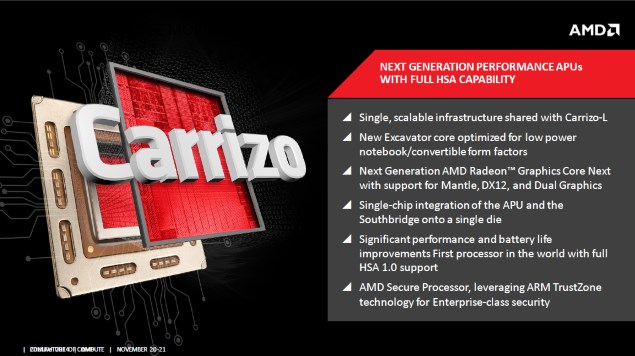
AMD has made the first public announcement of its next-generation APUs (Accelerated Processing Units), codenamed Carizzo and Carizzo-L. At the company's Future of Compute press event in Singapore, Joe Macri, Corporate Vice President and Product CTO announced the Carrizo family for the first half of 2015. Products based on it are expected to be available in markets by mid-2015. Carizzo is intended to be a high-performance platform and will feature AMD's new x86 'Excavator' core with an integrated next-generation Radeon GPU and south bridge logic on the same die. AMD promises much improved power efficiency as well as support for 4K UHD video, AMD's own Mantle API and DirectX 12 to allow developers to tap into the processor's full graphics capabilities. Carrizo-L will be aimed at more mainstream devices and will be based on the existing Puma+ CPU and Radeon R-series graphics. All Carrizo APUs will also feature security hardware compliant with ARM Trust Zone for sensitive business as well as personal data transactions.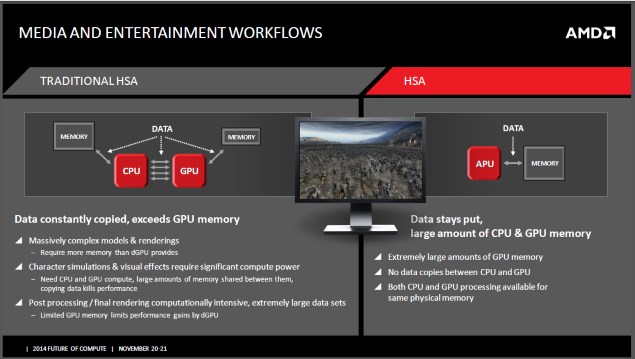
AMD's APU strategy will take a leap forward with Carrizo, which will be a true System-on-a-Chip (SoC) design. The Heterogeneous System Architecture (HSA) unifies a CPU, which is traditionally designed to change directions quickly and respond to short operations in sequence, with a GPU, which is usually designed for greater throughput when it comes to repetitive tasks that can be performed in parallel.
Carrizo will not just throw two separate logic blocks onto a package, but integrate them into the same processor die. The lynchpin of this approach is coherent unified memory, which allows both the CPU and GPU to access data as and when required in one combined memory pool, rather than wasting time sending it to where it is needed. Unified memory also has the scope to greatly simplify workflows and reduce equipment costs in data-intensive workstation scenarios such as oil and gas exploration, 3D manufacturing design, and content creation.
Carrizo is also expected to widen the range of form factors in which AMD processors can be found thanks to improved power efficiency and significant gains in battery life. AMD hopes that HSA-based devices will enable natural UIs such as gestures and voice recognition to become more widely used. Augmented reality and virtual reality applications would also get a boost. The company also anticipates smarter and more secure utilization of cloud services, as operations currently offloaded to remote servers for processing could be handled locally.
Disclosure: AMD sponsored the correspondent's flights and hotel for the event in Singapore.
Comments
Get your daily dose of tech news, reviews, and insights, in under 80 characters on Gadgets 360 Turbo. Connect with fellow tech lovers on our Forum. Follow us on X, Facebook, WhatsApp, Threads and Google News for instant updates. Catch all the action on our YouTube channel.
Further reading:
AMD, Future of Compute, HSA, HSA Foundation, Heterogeneous System Architecture, laptops
Related Stories





Advertisement
Follow Us




-
![[Sponsored] Galaxy Watch9 for Everyday Health Insights | Smarter Wellness Choices](https://www.gadgets360.com/static/desktop/images/spacer.png)
01:42
[Sponsored] Galaxy Watch9 for Everyday Health Insights | Smarter Wellness Choices -
01:15
[Sponsored] Galaxy Tab S10 Lite for Students: Notes, Solve Math and More -
04:17
[Sponsored] LG NANO 4K UHD AI TV NU885: Gemini Search, Dolby Atmos & 5 Years of Updates -
00:57
[Sponsored] Samsung Galaxy Z Fold8 My Fan Cam in Action: Find the Moment, Then Share It -
01:41
[Sponsored] What Do You Need To Know Before Your Next Run? | Samsung Galaxy Watch Ultra2
-
NVIDIA के सीईओ ने पेश किए माइक्रोडक रोबोट, AI से चलते हैं, क्या काम आएंगे
-
iPhone Duo को बीच से खोला, फोल्डेबल डिस्प्ले से हटाया कवर, फिर क्या दिखा?
-
1 जनवरी से फोन में बिना सिम नहीं चलेगा WhatsApp, सिम बाइडिंग हुआ अनिवार्य
-
HP Star Book Air 14 लैपटॉप लॉन्च, OLED टच स्क्रीन, 42.5 घंटे तक चलने वाली बैटरी!
-
Realme 17 Pro सीरीज में मिल सकती है 10,000mAh की बैटरी
Advertisement
Popular on Gadgets
- Samsung Galaxy S26 Ultra
- Motorola Razr Fold
- ChatGPT
- OPPO Find N6
- Mobiles Under Rs. 40,000
- Vivo X300 Ultra
- Asus Zenbook S14
- iQOO 15
- Vivo X300 Pro
- Lenovo Yoga Slim 7i Aura Edition
- iQOO 15R
- Vivo X Fold 5
- Sony PlayStation 5
- HP OmniPad 12
- OnePlus Nord CE 6 Lite
- OnePlus Pad 4
- OPPO F33 Pro 5G
- Cryptocurrency
- HP OmniBook Ultra 14 (2026)
- iPhone 17
- Eureka Forbes AP 355 Room Air Purifier
- Latest Mobile Phones
- Compare Phones
Latest Gadgets
- HMD 2660 Flip Senior Edition
- Lava Aura Curve
- Poco X8s
- Samsung Galaxy F70 5G
- Tecno Spark 50S 5G
- Vivo Y600s Pro
- Vivo Y32 (2026)
- Infinix Smart 20 HD
- Lenovo Yoga 9n 2-in-1
- Lenovo Yoga Pro 9n
- Amazon Alexa Tablet 8
- Amazon Alexa Tablet 11
- Pebble Qore 2
- Amazfit T-Rex Dual Solar
- Toshiba 65-Inch 4K Ultra HD Smart Mini LED QLED TV (65Z670SP)
- Haier M70 Mini LED 65-inch
- Acer Predator Atlas 8
- Asus ROG Ally
- Blue Star 1.5 Ton 5 Star Inverter Split AC (IE518ZNURS)
- Blue Star 2 Ton 3 Star Inverter Window AC (WIE324L)

- About Us
- Sitemaps
- Feedback
- Archives
- Contact Us
- RSS
- Advertise
- Career
- Privacy Policy
- Ethics
- Editorial Policy
- Terms & Conditions
- Complaint Redressal
Download Our Apps
Available in Hindi
© Copyright Red Pixels Ventures Limited 2026. All rights reserved.