-
 The Dinosaurs OTT Release Date Revealed: Know When to Watch This Netflix Original’s Upcoming Docuseries8 February 2026
 -
New Fossil Evidence Shows Dinosaurs Flourished Until Their Final Days26 October 2025
-
New Fossil Teeth Evidence Suggests Herbivorous Dinosaurs Preferred Nutrient-Rich, Textured Plants22 October 2025
-
Microscopic Tooth Scratches Unlock Secrets of Sauropod Dinosaurs9 September 2025
-
New Study Traces T-Rex’s Origins to Asia and Links Gigantic Size to Climate Shift12 May 2025
- Home
- Science
- Science News
- Fossils of Dinosaur With Armoured Plate and Bony Spikes Found, Could Withstand Impacts From Car Crash
Fossils of Dinosaur With Armoured Plate and Bony Spikes Found, Could Withstand Impacts From Car Crash
The armour of Borealopelta markmitchelli could absorb impacts comparable to high-speed crashes, a study finds.
Written by Gadgets 360 Staff | Updated: 8 November 2024 21:21 IST

Photo Credit: Unsplash/ engin akyurt
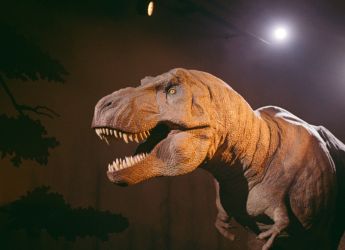
Borealopelta markmitchelli, an armoured dinosaur from the Early Cretaceous.
Click Here to Add Gadgets360 As A Trusted Source


Advertisement
A study has shown that the well-preserved fossil of a nodosaur, a plant-eating dinosaur, could withstand the force of a high-speed car crash. The fossil, discovered in Alberta, Canada, belongs to Borealopelta markmitchelli , a species that lived around 110 million years ago during the Early Cretaceous period. This fossil is one of the best-preserved dinosaur specimens ever found, offering unprecedented insights into the defensive capabilities of the nodosaur's armour.
Study Insights from Expert Researchers
The research, led by biomechanical paleontologist Dr. Michael Habib from UCLA, revealed that the keratin sheaths covering the nodosaur's bony spikes were significantly thicker than originally thought. The thickness of the keratin layer on the fossil was measured at nearly 16 centimetres in some areas, much thicker than the keratin found in modern-day animals like cattle horns. This keratin, combined with bony spikes, provided an exceptionally strong defence.
According to Dr. Habib, the strength of the nodosaur's armour was such that it could withstand over 125,000 joules of energy per square metre—equivalent to the force from a high-speed car collision. The research highlighted that this armour was a defence against predators but it also likely played a role in combat between males of the same species.
Adaptations for Flexibility and Protection
The study further suggested that the nodosaur's armour, consisting of a flexible keratin layer, allowed for greater mobility and protection. If the keratin was damaged, it could be shed, offering a quick recovery mechanism compared to brittle bone armour that could crack under impact. The presence of keratin would also have allowed the dinosaur to fight effectively with its rivals, which could have been crucial in mating battles.
The fossil's remarkable preservation has led to further insights into the armour of other dinosaur species, with researchers suggesting that similar adaptations might have been widespread among armoured dinosaurs.
Comments
Get your daily dose of tech news, reviews, and insights, in under 80 characters on Gadgets 360 Turbo. Connect with fellow tech lovers on our Forum. Follow us on X, Facebook, WhatsApp, Threads and Google News for instant updates. Catch all the action on our YouTube channel.
Related Stories
Fossils of Dinosaur With Armoured Plate and Bony Spikes Found, Could Withstand Impacts From Car Crash


Advertisement
Follow Us




-
00:21
[Sponsored] Samsung Galaxy Z Fold8, Fold8 Ultra -
03:41
[Sponsored] Samsung Galaxy Z Fold8: How It Fits Into an Actor’s Busy Day | Camera, Multitasking & More -
09:53
iPhone 18 Goes On Sale In India: Huge Crowds, Long Queues At Apple Stores -
06:32
Google Pixel 11 Pro XL Review: The Most Exciting Pixel Yet? | 120X Zoom + Tensor G6 -
05:20
Samsung Galaxy Watch Ultra 2 Review: Is This the Best Android Smartwatch?
-
Amazon Great Indian Festival: सेल से पहले 6 मोबाइल पर Early Bird Deals
-
Vivo Y600i हुआ लॉन्च; 8000mAh बैटरी और ड्रॉप प्रोटेक्शन के साथ आया फोन
-
लैपटॉप की बैटरी हेल्थ ऐसे करें चेक, नहीं होगा नुकसान
-
Motorola Signature Flipkart सेल में ₹3 हजार सस्ता खरीदें, 50MP तीन कैमरा वाला फोन
-
IND vs WI Live: भारत-वेस्ट इंडीज पहला वनडे मैच कुछ ही देर में LIVE, यहां देखें फ्री!
Advertisement
Popular on Gadgets
- Samsung Galaxy S26 Ultra
- Motorola Razr Fold
- ChatGPT
- OPPO Find N6
- Mobiles Under Rs. 40,000
- Vivo X300 Ultra
- Asus Zenbook S14
- iQOO 15
- Vivo X300 Pro
- Lenovo Yoga Slim 7i Aura Edition
- iQOO 15R
- Vivo X Fold 5
- Sony PlayStation 5
- HP OmniPad 12
- OnePlus Nord CE 6 Lite
- OnePlus Pad 4
- OPPO F33 Pro 5G
- Cryptocurrency
- HP OmniBook Ultra 14 (2026)
- iPhone 17
- Eureka Forbes AP 355 Room Air Purifier
- Latest Mobile Phones
- Compare Phones
Latest Gadgets
- Vivo Y600i
- Mivi One 5G
- Xiaomi 18 Pro Max
- Motorola Signature 27
- OPPO Find X10 E
- OnePlus N6 Lite 4G
- Ai+ Nova 2 Power 5G
- Lava Virat Curve 5G
- Microsoft Surface Laptop, 13-inch (2nd Edition)
- Lenovo LOQ 15AHP11
- Microsoft Surface Pro, 12-inch (2nd Edition)
- Xiaomi Pad 9 Pro
- Amazfit T-Rex Dual Solar
- OPPO Watch S2
- Haier M70 Mini LED 65-inch
- Xiaomi TV FX Mini LED 65
- Acer Predator Atlas 8
- Asus ROG Ally
- Blue Star 1.5 Ton 5 Star Inverter Split AC (IE518ZNURS)
- Blue Star 2 Ton 3 Star Inverter Window AC (WIE324L)

- About Us
- Sitemaps
- Feedback
- Archives
- Contact Us
- RSS
- Advertise
- Career
- Privacy Policy
- Ethics
- Editorial Policy
- Terms & Conditions
- Complaint Redressal
Download Our Apps
Available in Hindi
© Copyright Red Pixels Ventures Limited 2026. All rights reserved.