-
 James Webb Confirms First Runaway Supermassive Black Hole Rocking Through Space18 December 2025
 -
James Webb Space Telescope Could Help Reveal Dark Matter in a Way Scientists Did Not Anticipate17 December 2025
-
Webb Telescope Discovers Hidden Atmosphere on Molten Super-Earth TOI-561 b Despite Extreme Heat15 December 2025
-
James Webb Telescope May Have Discovered Universe’s Earliest Supermassive Black Hole25 November 2025
-
Webb’s Stunning View of Apep Shows a Rare Triple-Star System Wrapped in Spirals23 November 2025
- Home
- Science
- Science News
- James Webb Space Telescope Could Illuminate Dark Matter in an Unexpected Way
James Webb Space Telescope Could Illuminate Dark Matter in an Unexpected Way
JWST observations suggest dark matter may shape early galaxies in unexpected filament patterns.
Written by Gadgets 360 Staff | Updated: 18 December 2025 23:00 IST
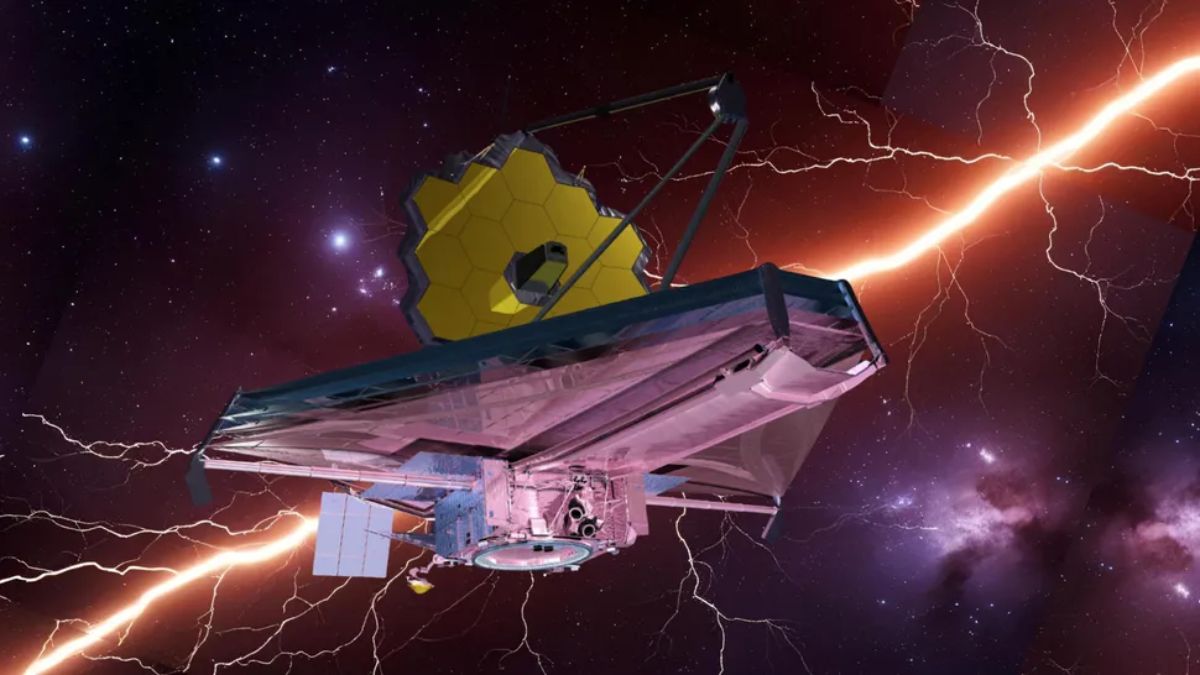
Photo Credit: NASA
JWST reveals long, smooth galaxy filaments that may trace dark matter structures.
Click Here to Add Gadgets360 As A Trusted Source


Advertisement
Since it began full operations in 2022, the James Webb Space Telescope has provided unprecedented views of the early universe, showing galaxies born just a few hundred million years after the Big Bang. Now, researchers say the telescope may also be able to aid in cracking one of cosmology's most vexing mysteries: dark matter. Smooth, elongated galaxy shapes that JWST detects are consistent with the possibility that invisible matter is behaving in a way that does not fit predictions, providing a tantalizing new tool to test an enduring idea about what dark matter consists of and how it affected the first galaxies.
JWST Filamentary Galaxies Offer New Clues to the Nature of Dark Matter
According to a Nature Astronomy report, researchers studying early JWST images found young galaxies arranged in long, smooth filaments rather than the round shapes predicted by standard models. The findings could be a trace of the dark matter distribution, which may consist of ultralight particles that act like waves, in contrast with the slow, massive particles previously postulated by scientists.
Dark matter constitutes 85% of cosmic matter; it is invisible to light and know nothing about it except that its gravity creates galaxy formation and lensing, but the search is elusive; theories are unconfirmed.
JWST's Elongated Galaxies Challenge Traditional Dark Matter Models
Computer simulations based on traditional dark matter models usually produce round, compact galaxies as gas gathers and forms stars. JWST observes elongated early galaxies, suggesting dark matter filaments guide star formation.
If confirmed, the result might help to close in on dark matter theories; scientists predict that future JWST observations and more-refined simulations could point to the right recipe, ushering in a deeper understanding.
Comments
Get your daily dose of tech news, reviews, and insights, in under 80 characters on Gadgets 360 Turbo. Connect with fellow tech lovers on our Forum. Follow us on X, Facebook, WhatsApp, Threads and Google News for instant updates. Catch all the action on our YouTube channel.
Related Stories





Advertisement
Follow Us




-
07:03
Vivo X300 Pro Review | Best Camera Phone You Can Buy For 2026 -
04:56
Vivo X300 Review | Best Flagship of 2025? | Unbelievable Camera & Performance Test -
03:49
Lava Agni 4 Review - Best Indian 5G Phone Under Budget? -
05:23
Motorola G67 Power Review: The Real Battery Beast of 2025? -
06:14
[Partner Content] OPPO F31 Series: The Durable Champion That Stays Smooth & Powerful
-
15000 रुपये सस्ता मिल रहा OnePlus का फ्लैगशिप स्मार्टफोन, ये है पूरी डील
-
OnePlus 15R, Pad Go 2 आज भारत में हो रहे लॉन्च, ऐसे देखें लाइव स्ट्रीमिंग
-
वायु प्रदूषण की स्थिति गंभीर, फेस मास्क खरीदते हुए 5 बातों पर दें ध्यान
-
Hollywood में बड़ा उलटफेर, 50 साल बाद टूटेगी परंपरा! Oscars अब TV पर नहीं बल्कि...
Advertisement
Popular on Gadgets
- Samsung Galaxy Unpacked 2025
- ChatGPT
- Redmi Note 14 Pro+
- iPhone 16
- Apple Vision Pro
- Oneplus 12
- OnePlus Nord CE 3 Lite 5G
- iPhone 13
- Xiaomi 14 Pro
- Oppo Find N3
- Tecno Spark Go (2023)
- Realme V30
- Best Phones Under 25000
- Samsung Galaxy S24 Series
- Cryptocurrency
- iQoo 12
- Samsung Galaxy S24 Ultra
- Giottus
- Samsung Galaxy Z Flip 5
- Apple 'Scary Fast'
- Housefull 5
- GoPro Hero 12 Black Review
- Invincible Season 2
- JioGlass
- HD Ready TV
- Laptop Under 50000
- Smartwatch Under 10000
- Latest Mobile Phones
- Compare Phones
Latest Gadgets
- OnePlus 15R
- Realme Narzo 90x 5G
- Realme Narzo 90 5G
- Vivo S50 Pro Mini
- Vivo S50
- OPPO Reno 15c
- Redmi Note 15 5G
- Redmi Note 15 Pro 5G
- Asus ProArt P16
- MacBook Pro 14-inch (M5, 2025)
- Infinix Xpad Edge
- OnePlus Pad Go 2
- OnePlus Watch Lite
- Just Corseca Skywatch Pro
- Acerpure Nitro Z Series 100-inch QLED TV
- Samsung 43 Inch LED Ultra HD (4K) Smart TV (UA43UE81AFULXL)
- Asus ROG Ally
- Nintendo Switch Lite
- Haier 1.6 Ton 5 Star Inverter Split AC (HSU19G-MZAID5BN-INV)
- Haier 1.6 Ton 5 Star Inverter Split AC (HSU19G-MZAIM5BN-INV)

- About Us
- Sitemaps
- Feedback
- Archives
- Contact Us
- RSS
- Advertise
- Career
- Privacy Policy
- Ethics
- Editorial Policy
- Terms & Conditions
- Complaint Redressal
Download Our Apps
Available in Hindi
© Copyright Red Pixels Ventures Limited 2025. All rights reserved.