-
 JWST Reveals Salt Clouds in the Atmosphere of the ‘Pink Planet’ GJ 504b21 June 2026
 -
JWST Watches HD 80606 bExoplanet Heat Up by 1,100 Degrees in Hours19 June 2026
-
Scientists May Have Solved the Missing Sulfur Mystery in Star-Forming Clouds16 June 2026
-
Astronomers Discover Why Massive Galaxies Died Early in the Universe13 June 2026
-
JWST Reveals the True Identity of Mysterious Little Red Dots11 June 2026
- Home
- Science
- Science News
- James Webb Watches a Young Star Bake Crystals for Future Planets
James Webb Watches a Young Star Bake Crystals for Future Planets
James Webb observations show the young protostar EC 53 forming crystalline silicate minerals during periodic outbursts. The intense heat creates crystals that are later carried outward, explaining how comets and planet-forming disks contain minerals forged near young stars.
Written by Gadgets 360 Staff | Updated: 22 January 2026 22:32 IST
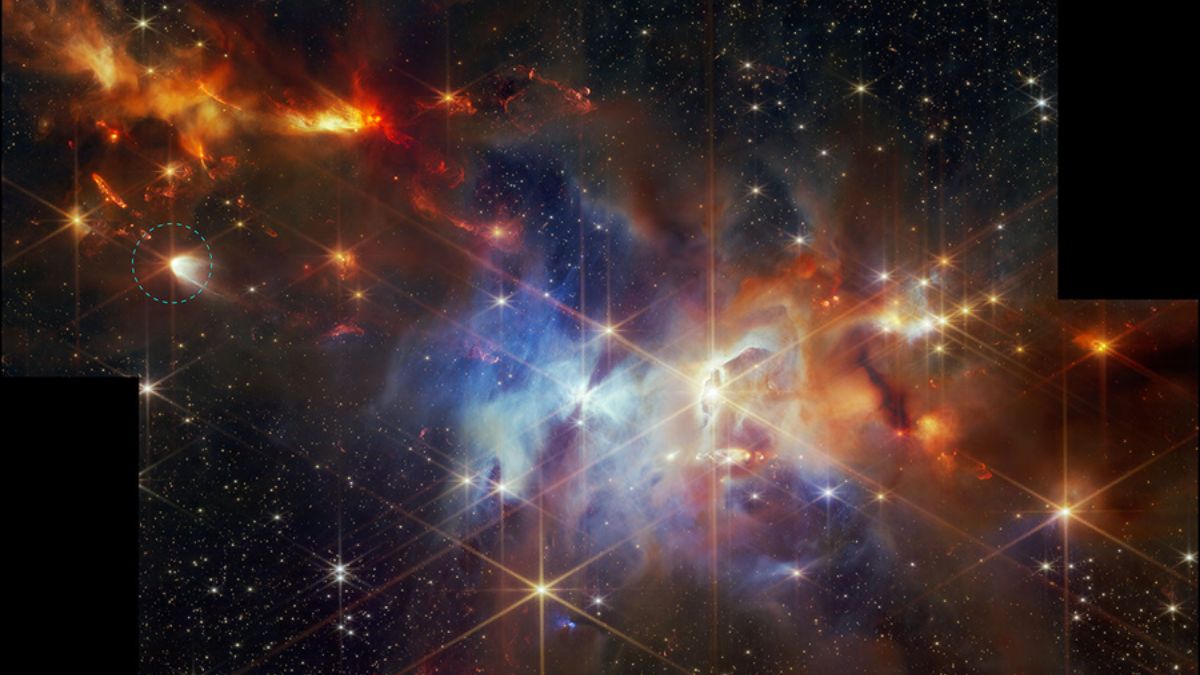
Photo Credit: NASA-JPL
James Webb reveals young Sun-like star forming silicate crystals shaping comets, planets
Click Here to Add Gadgets360 As A Trusted Source


Advertisement
Using NASA's James Webb Telescope, astronomers have witnessed a young, Sun-like protostar within the Serpens Nebula named EC 53 actively forging crystalline silicate minerals within its surrounding disk. There has been much speculation regarding how comets, literally frozen in space, could compose a crystal that requires intense heat to form. Now, thanks to data from Webb, scientists have evidence that periodic outbursts from EC 53 heat its inner disk enough to form the silicate crystals, then fling them outward with its stellar winds.
Young Star Forges Crystals
According to the new paper, the team of researchers focused on the EC 53 during the quiet state as well as during the eruptive state. The infrared spectra observed by Webb showed crystalline silicate features during star eruptions, confirming that the silicate crystals are formed in the hot inner disk region of the star, because it is the only time when the spectra appear. The results verified that forsterite and enstatite, the two major silicate compounds on Earth's crust, are present in the silicate crystals. Every outburst helps 'bake' the dust into crystals, which are subsequently transported by the star's jets of gas and winds toward the outer edge of the disk, which is cold.
Building Planets from Stardust
These silicate crystals are nothing but the same kinds of minerals that comprise 90 percent of Earth's crust. The formation of these crystals in situ, as well as their migration outwards, have been cited as reasons for icy comets and planet-forming disks containing similar crystals. By revealing this process, Webb provides insight into a key stage of planet formation: over millions of years, the tiny crystalline grains can stick and grow into larger bodies, ultimately building rocky planets and icy worlds.
Comments
Get your daily dose of tech news, reviews, and insights, in under 80 characters on Gadgets 360 Turbo. Connect with fellow tech lovers on our Forum. Follow us on X, Facebook, WhatsApp, Threads and Google News for instant updates. Catch all the action on our YouTube channel.
Further reading:
James Webb Space Telescope, protostars, planet formation, silicate crystals, Serpens Nebula, EC 53, astronomy, protoplanetary disks
Related Stories


Advertisement
Follow Us




-
01:15
[Sponsored] Galaxy Tab S10 Lite for Students: Notes, Solve Math and More -
04:17
[Sponsored] LG NANO 4K UHD AI TV NU885: Gemini Search, Dolby Atmos & 5 Years of Updates -
00:57
[Sponsored] Samsung Galaxy Z Fold8 My Fan Cam in Action: Find the Moment, Then Share It -
01:41
[Sponsored] What Do You Need To Know Before Your Next Run? | Samsung Galaxy Watch Ultra2 -
01:32
[Sponsored] Big Day Tomorrow? Prep Today | Samsung Galaxy Watch Ultra2
-
₹30 हजार के बजट में मिल रहे ये बेहतरीन फोन, Amazon Sale में डिस्काउंट भी
-
2000 सस्ता खरीदें Xiaomi का 9000mAh बैटरी वाला फोन! Flipkart पर तगड़ा ऑफर
-
10000mAh की विशाल बैटरी वाला HONOR WIN Tablet लॉन्च, बड़ी स्क्रीन, जानें
-
Redmi K100 में मिलेगा 50 मेगापिक्सल का प्राइमरी कैमरा
-
6500mAh बैटरी वाला फोन Amazon Sale में ₹15 हजार से भी सस्ता हुआ
Advertisement
Popular on Gadgets
- Samsung Galaxy S26 Ultra
- Motorola Razr Fold
- ChatGPT
- OPPO Find N6
- Mobiles Under Rs. 40,000
- Vivo X300 Ultra
- Asus Zenbook S14
- iQOO 15
- Vivo X300 Pro
- Lenovo Yoga Slim 7i Aura Edition
- iQOO 15R
- Vivo X Fold 5
- Sony PlayStation 5
- HP OmniPad 12
- OnePlus Nord CE 6 Lite
- OnePlus Pad 4
- OPPO F33 Pro 5G
- Cryptocurrency
- HP OmniBook Ultra 14 (2026)
- iPhone 17
- Eureka Forbes AP 355 Room Air Purifier
- Latest Mobile Phones
- Compare Phones
Latest Gadgets
- Lava Aura Curve
- Poco X8s
- Samsung Galaxy F70 5G
- Tecno Spark 50S 5G
- Vivo Y600s Pro
- Vivo Y32 (2026)
- Infinix Smart 20 HD
- Vivo V80
- HP ZBook Ultra G3a
- Dell Pro Rugged 14
- Amazon Alexa Tablet 8
- Amazon Alexa Tablet 11
- Pebble Qore 2
- Amazfit T-Rex Dual Solar
- Toshiba 65-Inch 4K Ultra HD Smart Mini LED QLED TV (65Z670SP)
- Haier M70 Mini LED 65-inch
- Acer Predator Atlas 8
- Asus ROG Ally
- Blue Star 1.5 Ton 5 Star Inverter Split AC (IE518ZNURS)
- Blue Star 2 Ton 3 Star Inverter Window AC (WIE324L)

- About Us
- Sitemaps
- Feedback
- Archives
- Contact Us
- RSS
- Advertise
- Career
- Privacy Policy
- Ethics
- Editorial Policy
- Terms & Conditions
- Complaint Redressal
Download Our Apps
Available in Hindi
© Copyright Red Pixels Ventures Limited 2026. All rights reserved.