-
 Astronomers Witness Longest-Lasting Gamma-Ray Burst in History, 8 Billion Light-Years Away16 December 2025
 -
NASA Explores Industry Collaboration to Boost Swift Observatory’s Orbit and Extend Its Mission15 August 2025
-
Brightest Gamma-Ray Burst Ever Observed Reveals Cosmic Secrets1 August 2025
-
New Study Finds Hercules-Corona Borealis Great Wall Bigger and Nearer Than Thought23 April 2025
-
Wolf-Rayet 104's Orbit Tilt Reduces Gamma-Ray Burst Threat, Study Finds20 March 2025
- Home
- Science
- Science News
- Astronomers Spot the Longest Gamma Ray Burst Ever Seen: What You Need to Know
Astronomers Spot the Longest Gamma-Ray Burst Ever Seen: What You Need to Know
NASA’s Fermi telescope detected a record-breaking gamma-ray burst lasting nearly seven hours. The unusual, multi-pulse explosion may have been caused by a rare intermediate-mass black hole tearing a star apart, challenging current models of cosmic explosions.
Written by Gadgets 360 Staff | Updated: 10 December 2025 23:33 IST
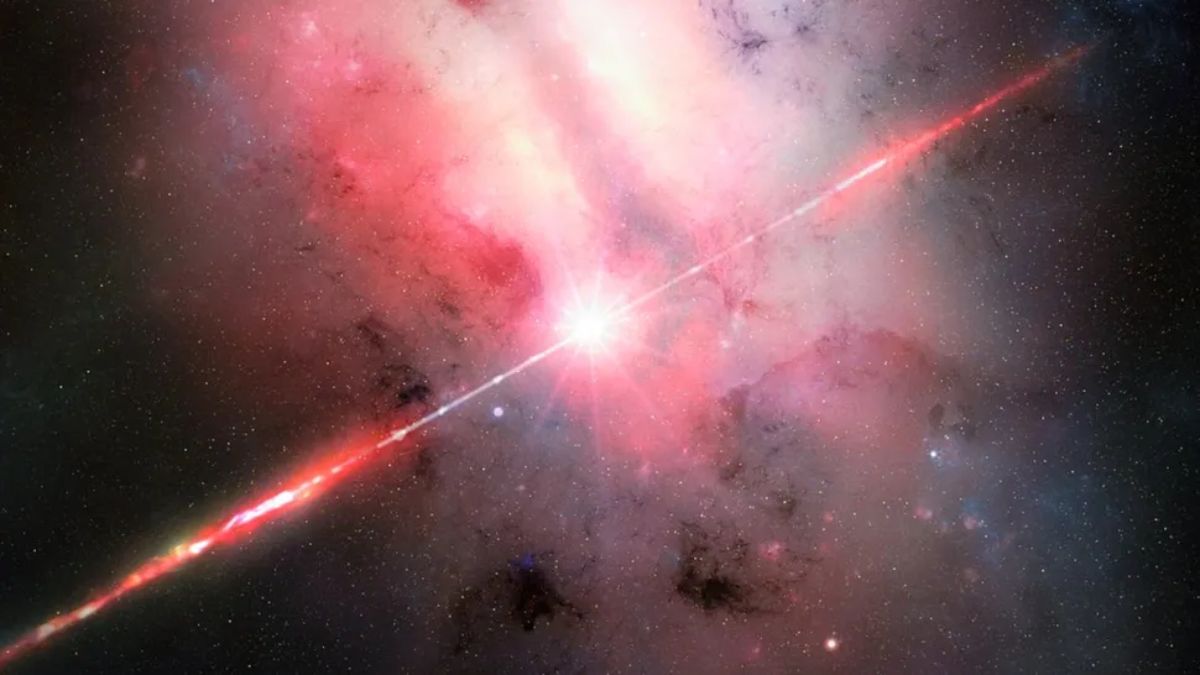
Photo Credit: NOIRLab/NSF/AURA/M. Garlick
Fermi detected seven-hour gamma burst from star by black hole
Click Here to Add Gadgets360 As A Trusted Source


Advertisement
In July 2025, NASA's Fermi Gamma-ray Space Telescope detected a gamma-ray burst that lasted about seven hours, making it the longest on record. This event, dubbed GRB 250702B, far exceeds typical GRBs (which last milliseconds to minutes) and produced repeating pulses. Its odd behaviour has prompted theories, including that a “middleweight” black hole (hundreds to thousands of solar masses) tore apart a star.
A record-breaking cosmic explosion
According to the paper, on July 2, 2025, GRB 250702B was first observed by NASA's Fermi telescope. Over the course of the following few hours, it repeatedly triggered, releasing gamma rays for at least seven hours—nearly twice as long as any prior burst. It produced several emission spikes over the course of the following day before fading. For days, astronomers tracked its afterglow in optical light and X-rays. This extended, multi-peaked blast was a novel type of explosion because typical GRBs fade in a matter of minutes.
Possible origins: a rare black hole?
One hypothesis is that the jets of the gamma-ray burst were powered by an intermediate-mass black hole (about 100–100,000 times the Sun's mass) that tore apart a star. Such “middleweight” black holes are an eventuality, but they are hardly ever detected; therefore, if this were the case, it would be the very first time that one was seen producing a gamma-ray jet. A different idea is that a small black hole (only a few times the Sun's mass) was orbiting a compact “helium” star, eating it from the inside and causing the burst. Both scenarios have some evidence to support them, but neither is definite, and the actual cause of the event is still unknown.
Comments
Get your daily dose of tech news, reviews, and insights, in under 80 characters on Gadgets 360 Turbo. Connect with fellow tech lovers on our Forum. Follow us on X, Facebook, WhatsApp, Threads and Google News for instant updates. Catch all the action on our YouTube channel.
Related Stories


Advertisement
Follow Us




-
01:42
[Sponsored] Galaxy Watch9 for Everyday Health Insights | Smarter Wellness Choices -
01:15
[Sponsored] Galaxy Tab S10 Lite for Students: Notes, Solve Math and More -
04:17
[Sponsored] LG NANO 4K UHD AI TV NU885: Gemini Search, Dolby Atmos & 5 Years of Updates -
00:57
[Sponsored] Samsung Galaxy Z Fold8 My Fan Cam in Action: Find the Moment, Then Share It -
01:41
[Sponsored] What Do You Need To Know Before Your Next Run? | Samsung Galaxy Watch Ultra2
-
NVIDIA के सीईओ ने पेश किए माइक्रोडक रोबोट, AI से चलते हैं, क्या काम आएंगे
-
iPhone Duo को बीच से खोला, फोल्डेबल डिस्प्ले से हटाया कवर, फिर क्या दिखा?
-
1 जनवरी से फोन में बिना सिम नहीं चलेगा WhatsApp, सिम बाइडिंग हुआ अनिवार्य
-
Realme 17 Pro सीरीज में मिल सकती है 10,000mAh की बैटरी
-
Amazon Sale में ₹6300 सस्ता खरीदें Vivo V80 5G, 50MP तीन कैमरा वाला फोन
Advertisement
Popular on Gadgets
- Samsung Galaxy S26 Ultra
- Motorola Razr Fold
- ChatGPT
- OPPO Find N6
- Mobiles Under Rs. 40,000
- Vivo X300 Ultra
- Asus Zenbook S14
- iQOO 15
- Vivo X300 Pro
- Lenovo Yoga Slim 7i Aura Edition
- iQOO 15R
- Vivo X Fold 5
- Sony PlayStation 5
- HP OmniPad 12
- OnePlus Nord CE 6 Lite
- OnePlus Pad 4
- OPPO F33 Pro 5G
- Cryptocurrency
- HP OmniBook Ultra 14 (2026)
- iPhone 17
- Eureka Forbes AP 355 Room Air Purifier
- Latest Mobile Phones
- Compare Phones
Latest Gadgets
- HMD 2660 Flip Senior Edition
- Lava Aura Curve
- Poco X8s
- Samsung Galaxy F70 5G
- Tecno Spark 50S 5G
- Vivo Y600s Pro
- Vivo Y32 (2026)
- Infinix Smart 20 HD
- Lenovo Yoga 9n 2-in-1
- Lenovo Yoga Pro 9n
- Amazon Alexa Tablet 8
- Amazon Alexa Tablet 11
- Pebble Qore 2
- Amazfit T-Rex Dual Solar
- Toshiba 65-Inch 4K Ultra HD Smart Mini LED QLED TV (65Z670SP)
- Haier M70 Mini LED 65-inch
- Acer Predator Atlas 8
- Asus ROG Ally
- Blue Star 1.5 Ton 5 Star Inverter Split AC (IE518ZNURS)
- Blue Star 2 Ton 3 Star Inverter Window AC (WIE324L)

- About Us
- Sitemaps
- Feedback
- Archives
- Contact Us
- RSS
- Advertise
- Career
- Privacy Policy
- Ethics
- Editorial Policy
- Terms & Conditions
- Complaint Redressal
Download Our Apps
Available in Hindi
© Copyright Red Pixels Ventures Limited 2026. All rights reserved.