-
 NASA’s MAVEN Detects Rare Solar Wind Effect in Mars Atmosphere28 May 2026
 -
Scientists Develop Swarm Robots to Explore Hidden Lava Tubes on Mars27 May 2026
-
Mysterious Stacked Rocks Spotted by NASA Perseverance Rover on Mars22 May 2026
-
Massive Solar Storm Reveals How Mars Is Losing Its Atmosphere19 May 2026
-
New Biosignature Method Could Transform Search for Alien Life16 May 2026
- Home
- Science
- Science News
- NASA’s Perseverance Records First Ever Mini Lightning on Mars
NASA’s Perseverance Records First-Ever Mini-Lightning on Mars
NASA’s Perseverance rover has captured the first electrical discharges—mini-lightning sparks—in Mars’ dusty atmosphere.
Written by Gadgets 360 Staff | Updated: 2 December 2025 23:36 IST
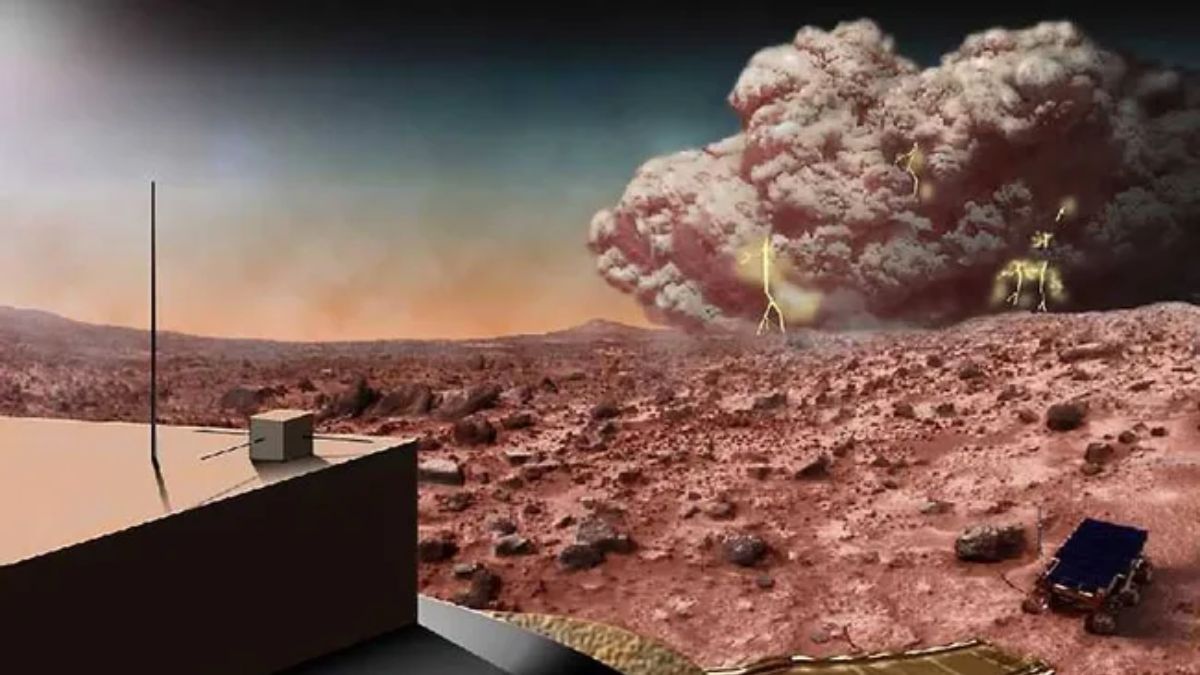
Photo Credit: NASA
An illustration of lightning being discharged from a dust storm on the Red Planet
Click Here to Add Gadgets360 As A Trusted Source


Advertisement
Scientists have reported the first observation of electrical discharges - small lightning flashes - in the dusty atmosphere of Mars. These events were recorded by NASA's Perseverance rover, which has a very sensitive microphone that captured the crackling sounds during the period of the strong winds and dust devils. The team found nearly 55 short discharges over the span of two Mars years, thus establishing that the dust raised by the winds on Mars can cause electric sparks. The article describing this research, appearing in Nature, marks the beginning of a new domain to understand Martian weather and its chemistry.
Martian mini-lightning detected
As per the study, researchers report the first evidence of electricity in Mars's atmosphere. A microphone on NASA's Perseverance rover captured crackling sounds and interference from dozens of short electrical discharges during dust storms. By analysing 28 hours of recordings over two Martian years, the team identified 55 such “mini-lightning” eventsap.org. Each spark was only a few centimeters long, producing a brief static spike and a faint shockwave, akin to a tiny spark in Mars's thin air.
Implications for Mars exploration
Importantly, these micro-lightning sparks help explain long-mysterious oxidants on Mars. The discharges produce reactive compounds (such as hydrogen peroxide) that can destroy organic molecules and potential biosignatures. As per Science News, scientists caution that while the tiny zaps are too weak to harm astronauts directly, they could degrade sensitive electronics over time.
The discovery suggests that future missions should account for such static effects, using extra shielding or sensors. Researchers call for new instruments to monitor Mars's electric fields, to better design rovers and spacesuits capable of handling these discharges.
Comments
Get your daily dose of tech news, reviews, and insights, in under 80 characters on Gadgets 360 Turbo. Connect with fellow tech lovers on our Forum. Follow us on X, Facebook, WhatsApp, Threads and Google News for instant updates. Catch all the action on our YouTube channel.
Related Stories



Advertisement
Follow Us




-
04:17
[Sponsored] LG NANO 4K UHD AI TV NU885: Gemini Search, Dolby Atmos & 5 Years of Updates -
00:57
[Sponsored] Samsung Galaxy Z Fold8 My Fan Cam in Action: Find the Moment, Then Share It -
01:41
[Sponsored] What Do You Need To Know Before Your Next Run? | Samsung Galaxy Watch Ultra2 -
01:32
[Sponsored] Big Day Tomorrow? Prep Today | Samsung Galaxy Watch Ultra2 -
04:37
[Sponsored]: CP PLUS CarKam CP-F89B: 4K Dashcam With Rear Camera, GPS & Emergency Recording
-
आ गई हवा में उड़ने वाली Tesla Roadster कार, आखिर सच हुआ फिल्मों वाला कमाल
-
रोबोट ने की लड़की से छेड़छाड़, पीछे से पकड़ा और किए गंदे इशारे, जानें
-
PS5 कहां मिलेगा सस्ता, Flipkart या Amazon, जानें सबकुछ
-
Lenovo ने सस्ता लैपटॉप ग्लोबल मार्केट में किया लॉन्च, Snapdragon X चिप से लैस
-
Flipkart Big Billion Sale 2026: ₹10 हजार से ₹15 हजार में मिल रहे Mivi, Lava, Boltt के AI कैमरा फोन
Advertisement
Popular on Gadgets
- Samsung Galaxy S26 Ultra
- Motorola Razr Fold
- ChatGPT
- OPPO Find N6
- Mobiles Under Rs. 40,000
- Vivo X300 Ultra
- Asus Zenbook S14
- iQOO 15
- Vivo X300 Pro
- Lenovo Yoga Slim 7i Aura Edition
- iQOO 15R
- Vivo X Fold 5
- Sony PlayStation 5
- HP OmniPad 12
- OnePlus Nord CE 6 Lite
- OnePlus Pad 4
- OPPO F33 Pro 5G
- Cryptocurrency
- HP OmniBook Ultra 14 (2026)
- iPhone 17
- Eureka Forbes AP 355 Room Air Purifier
- Latest Mobile Phones
- Compare Phones
Latest Gadgets
- Tecno Spark 50S 5G
- Vivo Y600s Pro
- Vivo Y32 (2026)
- Infinix Smart 20 HD
- Vivo V80
- Vivo S2 FE
- Vivo Y600K Turbo
- Realme P4s Lite
- HP ZBook Ultra G3a
- Dell Pro Rugged 14
- Amazon Alexa Tablet 8
- Amazon Alexa Tablet 11
- Amazfit T-Rex Dual Solar
- OPPO Watch S2
- Toshiba 65-Inch 4K Ultra HD Smart Mini LED QLED TV (65Z670SP)
- Haier M70 Mini LED 65-inch
- Acer Predator Atlas 8
- Asus ROG Ally
- Blue Star 1.5 Ton 5 Star Inverter Split AC (IE518ZNURS)
- Blue Star 2 Ton 3 Star Inverter Window AC (WIE324L)

- About Us
- Sitemaps
- Feedback
- Archives
- Contact Us
- RSS
- Advertise
- Career
- Privacy Policy
- Ethics
- Editorial Policy
- Terms & Conditions
- Complaint Redressal
Download Our Apps
Available in Hindi
© Copyright Red Pixels Ventures Limited 2026. All rights reserved.