-
 JWST Reveals Salt Clouds in the Atmosphere of the ‘Pink Planet’ GJ 504b21 June 2026
 -
IceCube Traces High-Energy Neutrino to Distant Starburst Galaxy20 June 2026
-
JWST Watches HD 80606 bExoplanet Heat Up by 1,100 Degrees in Hours19 June 2026
-
Chandra Captures Sharpest-Ever X-Ray View of M87 Black Hole Jet18 June 2026
-
Scientists Discover Giant Planet Formation Around Supermassive Black Holes17 June 2026
- Home
- Science
- Science News
- Newly Found ‘Super Earth’ GJ 251 c Could Be One of the Most Promising Worlds for Alien Life
Newly Found ‘Super-Earth’ GJ 251 c Could Be One of the Most Promising Worlds for Alien Life
Astronomers discovered GJ 251 c, a rocky planet four times Earth’s mass orbiting in its star’s habitable zone.
Written by Gadgets 360 Staff | Updated: 26 October 2025 19:10 IST
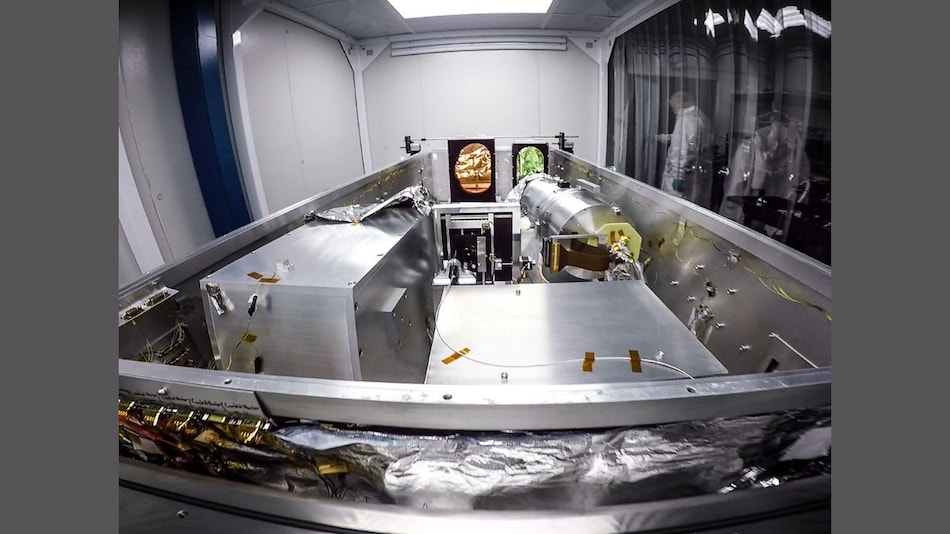
Photo Credit: Guðmundur Stefánssonn/Penn State
Astronomers find GJ 251 c, a rocky super-Earth in its star’s habitable zone
Click Here to Add Gadgets360 As A Trusted Source


Advertisement
An international team including Penn State astronomers has discovered a new ‘super-Earth' exoplanet orbiting the nearby star GJ 251. It has a mass approximately four times that of planet Earth, and it is probably rocky, named GJ 251 c. It rotates within the habitable (Goldilocks) zone of their star – the range over which liquid water might exist. This is one of the most promising possible discoveries so far in the quest to determine alien life.
Discovery and Detection
According to the study, GJ 251 c is roughly four times Earth's mass, putting it in the class known as a super-Earth – a planet larger than Earth but smaller than ice giants like Neptune. Astronomers detected it via the radial-velocity (or “wobble”) method. Tiny Doppler shifts in the star's light occur as a planet tugs on the star. By combining 20 years of observations, the team saw a consistent 54-day wobble in GJ 251's light. Crucial to this discovery was the Habitable Zone Planet Finder (HPF) – a high-precision infrared spectrograph on the Hobby-Eberly Telescope – which split the star's light to reveal the planet's gravitational pull.
Search for Life and Future Study
Because GJ 251 c lies in the habitable zone, it could have the right conditions for liquid water on its surface. Studying its atmosphere will require more powerful technology. Future 30-meter-class telescopes are expected to directly image nearby rocky planets and probe their atmospheres. Penn State researchers say GJ 251 c is “one of the best candidates” for detecting an atmospheric signature of life in the coming decade. This discovery shows how ever-better instruments and methods (from space transit surveys to precision wobble measurements) are bringing more Earth-like worlds within reach.
Comments
Get your daily dose of tech news, reviews, and insights, in under 80 characters on Gadgets 360 Turbo. Connect with fellow tech lovers on our Forum. Follow us on X, Facebook, WhatsApp, Threads and Google News for instant updates. Catch all the action on our YouTube channel.
Related Stories







Advertisement
Follow Us




-
01:42
[Sponsored] Galaxy Watch9 for Everyday Health Insights | Smarter Wellness Choices -
01:15
[Sponsored] Galaxy Tab S10 Lite for Students: Notes, Solve Math and More -
04:17
[Sponsored] LG NANO 4K UHD AI TV NU885: Gemini Search, Dolby Atmos & 5 Years of Updates -
00:57
[Sponsored] Samsung Galaxy Z Fold8 My Fan Cam in Action: Find the Moment, Then Share It -
01:41
[Sponsored] What Do You Need To Know Before Your Next Run? | Samsung Galaxy Watch Ultra2
-
NVIDIA के सीईओ ने पेश किए माइक्रोडक रोबोट, AI से चलते हैं, क्या काम आएंगे
-
iPhone Duo को बीच से खोला, फोल्डेबल डिस्प्ले से हटाया कवर, फिर क्या दिखा?
-
1 जनवरी से फोन में बिना सिम नहीं चलेगा WhatsApp, सिम बाइडिंग हुआ अनिवार्य
-
Amazon Sale में ₹6300 सस्ता खरीदें Vivo V80 5G, 50MP तीन कैमरा वाला फोन
-
Redmi K100 में होगी 16GB रैम, Snapdragon 8 Elite चिप! 27 अक्टूबर को है लॉन्च
Advertisement
Popular on Gadgets
- Samsung Galaxy S26 Ultra
- Motorola Razr Fold
- ChatGPT
- OPPO Find N6
- Mobiles Under Rs. 40,000
- Vivo X300 Ultra
- Asus Zenbook S14
- iQOO 15
- Vivo X300 Pro
- Lenovo Yoga Slim 7i Aura Edition
- iQOO 15R
- Vivo X Fold 5
- Sony PlayStation 5
- HP OmniPad 12
- OnePlus Nord CE 6 Lite
- OnePlus Pad 4
- OPPO F33 Pro 5G
- Cryptocurrency
- HP OmniBook Ultra 14 (2026)
- iPhone 17
- Eureka Forbes AP 355 Room Air Purifier
- Latest Mobile Phones
- Compare Phones
Latest Gadgets
- HMD 2660 Flip Senior Edition
- Lava Aura Curve
- Poco X8s
- Samsung Galaxy F70 5G
- Tecno Spark 50S 5G
- Vivo Y600s Pro
- Vivo Y32 (2026)
- Infinix Smart 20 HD
- Lenovo Yoga 9n 2-in-1
- Lenovo Yoga Pro 9n
- Amazon Alexa Tablet 8
- Amazon Alexa Tablet 11
- Pebble Qore 2
- Amazfit T-Rex Dual Solar
- Toshiba 65-Inch 4K Ultra HD Smart Mini LED QLED TV (65Z670SP)
- Haier M70 Mini LED 65-inch
- Acer Predator Atlas 8
- Asus ROG Ally
- Blue Star 1.5 Ton 5 Star Inverter Split AC (IE518ZNURS)
- Blue Star 2 Ton 3 Star Inverter Window AC (WIE324L)

- About Us
- Sitemaps
- Feedback
- Archives
- Contact Us
- RSS
- Advertise
- Career
- Privacy Policy
- Ethics
- Editorial Policy
- Terms & Conditions
- Complaint Redressal
Download Our Apps
Available in Hindi
© Copyright Red Pixels Ventures Limited 2026. All rights reserved.