-
 Google Cloud Adds GPT-6 Astra, GPT-6.1 Sol, GPT-6 Luna Models to Model Garden22 October 2026
 -
Google Adds Personal Intelligence to Gemini on Android Auto22 October 2026
-
Fitbit Air Review: Is This Google’s Best Fitness Tracker Yet?18 October 2026
-
ViewSonic India Bets Big on LED Displays as It Expands Beyond Monitors17 October 2026
-
Google Play Store ‘Shop Devices’ Feature Goes Live in India With Pixel Phones and Accessories15 October 2026
Google Unveils Gemini Embedding 2, Its First AI Model to Map Text, Images and Video Together
Gemini Embedding 2 understands text, images, and videos in the same language for easier retrieval.
Written by Akash Dutta, Edited by Ketan Pratap | Updated: 11 March 2026 11:14 IST
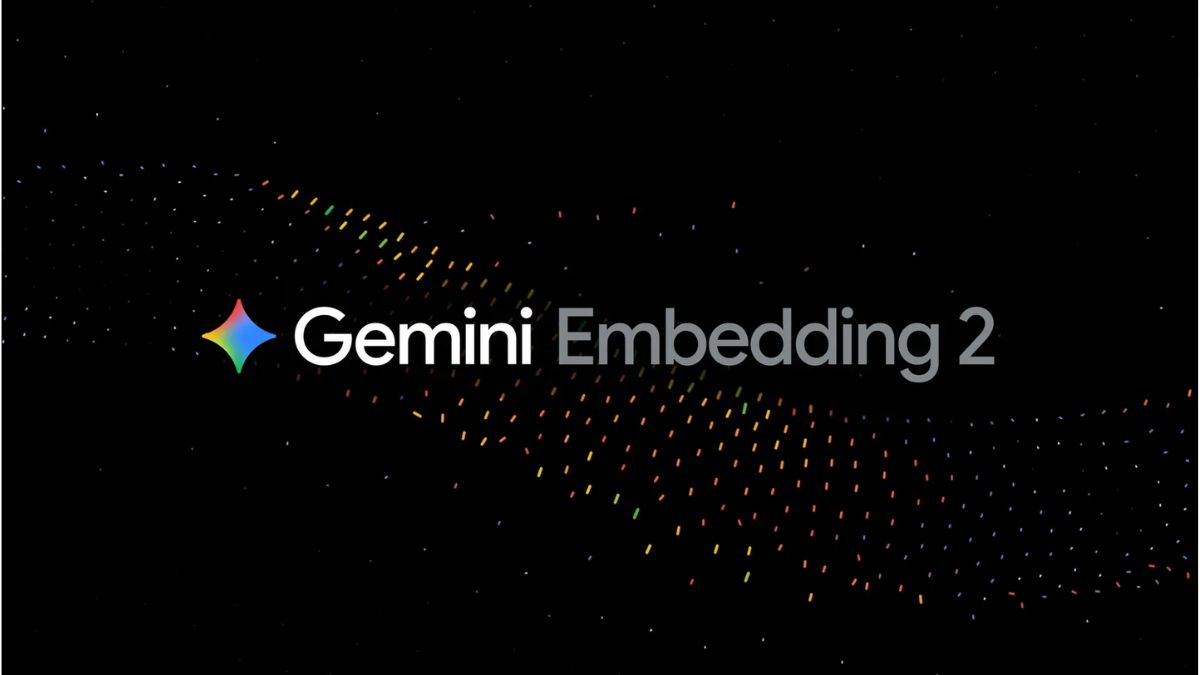
Photo Credit: Google
Gemini Embedding 2 can also understand interleaved input across multiple modalities
Click Here to Add Gadgets360 As A Trusted Source
Advertisement
Google released its first fully multimodal embedding model on Tuesday. Dubbed Gemini Embedding 2, the artificial intelligence (AI) model maps text, images, audio, and videos into a single, unified embedding space. This means it uses an architecture to understand concepts whether they are written as words, spoken aloud, or shown in an image or a video. The Mountain View-based tech giant says this new system will simplify the way a large language model (LLM) understands information and will allow it to perform more complex actions.
Google's First Multimodal Embedding Model Is Here
In a blog post, the tech giant detailed the new AI model. It is the successor to the text-only embedding model that was released last year, and it captures semantic intent across more than 100 languages. Gemini Embedding 2 is currently available in public preview via the Gemini application programming interface (API) and Vertex AI.
AI models typically have different digital file cabinets to store text, photos, videos, and audio files. Whenever a user requests information in a specific format, it begins looking into that specific cabinet. Usually, an LLM treats a "cat" in a text document and a "cat" in a video as two completely different things. And to make matters more complex, the method to obtain information differs with each format.
Gemini Embedding 2 solves this problem by creating a new architecture that can only use a single cabinet for all kinds of information. This allows it to process a document that has both text and images at the same time, as humans do. Google says this new system simplifies “complex pipelines and enhances a wide variety of multimodal downstream tasks.” Some of these include Retrieval-Augmented Generation (RAG) and semantic search, sentiment analysis, and data clustering.
Coming to the AI model's capabilities, it has a text context window of up to 8,192 input tokens. It can also process up to six images per request in PNG and JPEG formats, and supports up to 120 seconds of video input in MP4 and MOV formats. Additionally, it can natively process and map audio data without needing text transcriptions. Further, it can also embed up to six-page-long PDFs.
The Gemini Embedding 2 can also understand interleaved input, so users can send across multiple modalities (such as text and image) in the same request. Google says this capability allows the model to gain a more accurate understanding of complex, real-world data.
Comments
Get your daily dose of tech news, reviews, and insights, in under 80 characters on Gadgets 360 Turbo. Connect with fellow tech lovers on our Forum. Follow us on X, Facebook, WhatsApp, Threads and Google News for instant updates. Catch all the action on our YouTube channel.
Related Stories





Google Unveils Gemini Embedding 2, Its First AI Model to Map Text, Images and Video Together


Advertisement
Follow Us




-
01:15
[Sponsored] Galaxy Tab S10 Lite for Students: Notes, Solve Math and More -
04:17
[Sponsored] LG NANO 4K UHD AI TV NU885: Gemini Search, Dolby Atmos & 5 Years of Updates -
00:57
[Sponsored] Samsung Galaxy Z Fold8 My Fan Cam in Action: Find the Moment, Then Share It -
01:41
[Sponsored] What Do You Need To Know Before Your Next Run? | Samsung Galaxy Watch Ultra2 -
01:32
[Sponsored] Big Day Tomorrow? Prep Today | Samsung Galaxy Watch Ultra2
-
X पर वीडियो पोस्ट करके जीतें 2.83 लाख रुपये, किकस्टार्ट बोनस शुरू, जानें
-
6500mAh बैटरी वाला फोन Amazon Sale में ₹15 हजार से भी सस्ता हुआ
-
Oura Ring 5 लॉन्च, हेल्थ और मेडिकेशन दोनों की ट्रैकिंग, 7 दिन चलेगी बैटरी
-
Amazon Great Indian Sale 2026 में ₹35 हजार रेंज में मिल रहे iQOO, Samsung, OnePlus धांसू फोन, 8000mAh तक बैटरी
-
Vivo Y600 होगा 30 अक्टूबर को लॉन्च, 10,000mAh की मिलेगी बैटरी
Advertisement
Popular on Gadgets
- Samsung Galaxy S26 Ultra
- Motorola Razr Fold
- ChatGPT
- OPPO Find N6
- Mobiles Under Rs. 40,000
- Vivo X300 Ultra
- Asus Zenbook S14
- iQOO 15
- Vivo X300 Pro
- Lenovo Yoga Slim 7i Aura Edition
- iQOO 15R
- Vivo X Fold 5
- Sony PlayStation 5
- HP OmniPad 12
- OnePlus Nord CE 6 Lite
- OnePlus Pad 4
- OPPO F33 Pro 5G
- Cryptocurrency
- HP OmniBook Ultra 14 (2026)
- iPhone 17
- Eureka Forbes AP 355 Room Air Purifier
- Latest Mobile Phones
- Compare Phones
Latest Gadgets
- HMD 2660 Flip Senior Edition
- Lava Aura Curve
- Poco X8s
- Samsung Galaxy F70 5G
- Tecno Spark 50S 5G
- Vivo Y600s Pro
- Vivo Y32 (2026)
- Infinix Smart 20 HD
- Acer TravelLite TL44-53M-G2
- HP ZBook Ultra G3a
- Amazon Alexa Tablet 8
- Amazon Alexa Tablet 11
- Pebble Qore 2
- Amazfit T-Rex Dual Solar
- Toshiba 65-Inch 4K Ultra HD Smart Mini LED QLED TV (65Z670SP)
- Haier M70 Mini LED 65-inch
- Acer Predator Atlas 8
- Asus ROG Ally
- Blue Star 1.5 Ton 5 Star Inverter Split AC (IE518ZNURS)
- Blue Star 2 Ton 3 Star Inverter Window AC (WIE324L)

- About Us
- Sitemaps
- Feedback
- Archives
- Contact Us
- RSS
- Advertise
- Career
- Privacy Policy
- Ethics
- Editorial Policy
- Terms & Conditions
- Complaint Redressal
Download Our Apps
Available in Hindi
© Copyright Red Pixels Ventures Limited 2026. All rights reserved.