-
 Total Solar Eclipse Today: How to Watch Live Online, Timings, Safety Tips, and More12 August 2026
 -
JWST Watches HD 80606 bExoplanet Heat Up by 1,100 Degrees in Hours19 June 2026
-
Chandra Captures Sharpest-Ever X-Ray View of M87 Black Hole Jet18 June 2026
-
Astrophotographer Captures Giant Human-Shaped Solar Prominence8 June 2026
-
Blue Origin’s New Glenn Rocket Explodes During Pre-Launch Test in Florida29 May 2026
- Home
- Science
- Science News
- James Webb Telescope Finds Rare Cosmic Dust in One of the Universe’s Most Primitive Galaxies
James Webb Telescope Finds Rare Cosmic Dust in One of the Universe’s Most Primitive Galaxies
NASA’s James Webb Telescope has detected an Early-Universe Analog’s capability to produce dust. The Iron and Silicone carbide have been detected in the Sextans A.
Written by Gadgets 360 Staff | Updated: 11 January 2026 19:00 IST
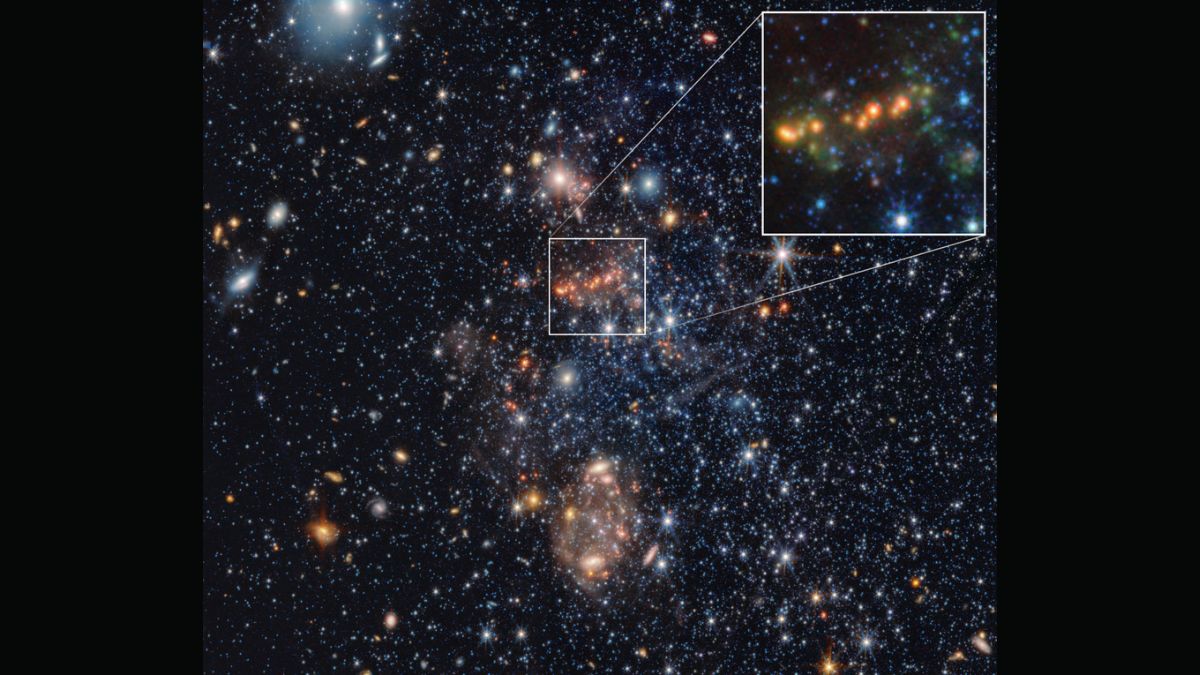
Photo Credit: NASA
NASA’s James Webb Telescope found rare dust in galaxy Sextans A, shedding light on early planet-building
Click Here to Add Gadgets360 As A Trusted Source


Advertisement
Astronomers have discovered two rare kinds of dust in one of the most chemically primitive galaxies, i.e., Sextans A, near the Milky Way using NASA's James Webb Space Telescope. The scientists detected iron and silicon carbide, accompanied by small clusters of carbon-based molecules, which exemplifies the star's capability of creating dust grains. This research by NASA's Webb Telescope, is reshaping the ideologies that surface around the evolution of galaxies in the Universe and how the building blocks for planets were developed.
Understanding Sextans A and How The Star Forge Dust Without Usual Ingredients
According to the study published in the Astrophysical Journey, Sextans A is located about 4-million light years away and barely contains 3-7 percent of the Sun's metallicity. With such low gravity, the chances of producing elements by the stars are next to zero. However, what the James Webb Telescope observed was beyond imagination. The aging asymptotic giant branch (AGB) star showed different results, where one star produced dust made with iron, while another one showed dust evolved out of silicone carbide. Such results identified that the stars could use alternative recipes available within the universe to create dust.
Discovering the Tiny Clumps of Organic Molecules
Additionally, the companion study suggested that the telescope imaged Sextans A's interstellar medium and detected the presence of polycyclic aromatic hydrocarbons (PAHs). These smallest dust grains, carbon-based molecules made the Sextans A, the lowest-metalicity galaxy to ever exist containing PAHs. Furthermore, the research also proved that the existence of the PAHs and their formation can only be commenced within the metal-starved galaxies, but only, if protected under the dense gas.
This discovery by James Webb Space Telescope challenged the established methods and proved that the Early universe was way beyond the imagination.
Comments
Get your daily dose of tech news, reviews, and insights, in under 80 characters on Gadgets 360 Turbo. Connect with fellow tech lovers on our Forum. Follow us on X, Facebook, WhatsApp, Threads and Google News for instant updates. Catch all the action on our YouTube channel.
Related Stories


James Webb Telescope Finds Rare Cosmic Dust in One of the Universe’s Most Primitive Galaxies


Advertisement
Follow Us




-
04:17
[Sponsored] LG NANO 4K UHD AI TV NU885: Gemini Search, Dolby Atmos & 5 Years of Updates -
00:57
[Sponsored] Samsung Galaxy Z Fold8 My Fan Cam in Action: Find the Moment, Then Share It -
01:41
[Sponsored] What Do You Need To Know Before Your Next Run? | Samsung Galaxy Watch Ultra2 -
01:32
[Sponsored] Big Day Tomorrow? Prep Today | Samsung Galaxy Watch Ultra2 -
04:37
[Sponsored]: CP PLUS CarKam CP-F89B: 4K Dashcam With Rear Camera, GPS & Emergency Recording
-
Amazon Sale: 7200mAh बैटरी वाले iQOO Z11xa 5G पर ₹4 हजार का डिस्काउंट
-
EVs Under 10L: दिवाली पर ₹4.69 लाख से शुरू होने वाली ये 4 EV देखें
-
Samsung TV खरीदने पर ₹1.59 लाख का TV फ्री, कुछ मॉडल्स पर मुफ्त Soundbar
-
Flipkart Big Billion Days Sale: 50 इंच स्मार्ट टीवी मिल रहे सस्ते, कीमत 21 हजार से शुरू
-
Poco X8s के जल्द लॉन्च की तैयारी, 50 मेगापिक्सल हो सकता है प्राइमरी कैमरा
Advertisement
Popular on Gadgets
- Samsung Galaxy S26 Ultra
- Motorola Razr Fold
- ChatGPT
- OPPO Find N6
- Mobiles Under Rs. 40,000
- Vivo X300 Ultra
- Asus Zenbook S14
- iQOO 15
- Vivo X300 Pro
- Lenovo Yoga Slim 7i Aura Edition
- iQOO 15R
- Vivo X Fold 5
- Sony PlayStation 5
- HP OmniPad 12
- OnePlus Nord CE 6 Lite
- OnePlus Pad 4
- OPPO F33 Pro 5G
- Cryptocurrency
- HP OmniBook Ultra 14 (2026)
- iPhone 17
- Eureka Forbes AP 355 Room Air Purifier
- Latest Mobile Phones
- Compare Phones
Latest Gadgets
- Vivo Y600s Pro
- Vivo Y32 (2026)
- Infinix Smart 20 HD
- Vivo V80
- Vivo S2 FE
- Vivo Y600K Turbo
- Realme P4s Lite
- Vivo S60t
- HP ZBook Ultra G3a
- Dell Pro Rugged 14
- Amazon Alexa Tablet 8
- Amazon Alexa Tablet 11
- Amazfit T-Rex Dual Solar
- OPPO Watch S2
- Toshiba 65-Inch 4K Ultra HD Smart Mini LED QLED TV (65Z670SP)
- Haier M70 Mini LED 65-inch
- Acer Predator Atlas 8
- Asus ROG Ally
- Blue Star 1.5 Ton 5 Star Inverter Split AC (IE518ZNURS)
- Blue Star 2 Ton 3 Star Inverter Window AC (WIE324L)

- About Us
- Sitemaps
- Feedback
- Archives
- Contact Us
- RSS
- Advertise
- Career
- Privacy Policy
- Ethics
- Editorial Policy
- Terms & Conditions
- Complaint Redressal
Download Our Apps
Available in Hindi
© Copyright Red Pixels Ventures Limited 2026. All rights reserved.