-
 Uranus’ Outer Rings May Reveal Hidden Moons, Scientists Say24 April 2026
 -
Hubble Telescope Captures Comet Reversing Its Rotation for the First Time27 March 2026
-
Hubble and Euclid Reveal Stunning New View of Cat’s Eye Nebula13 March 2026
-
NASA's Hubble Images Show Binary Stars Can Shape the Evolution of Star Clusters8 March 2026
-
Astronomers Find ‘Impossible’ Galaxy ACDG-2 With Virtually No Stars and a Massive Dark Matter Core20 February 2026
- Home
- Science
- Science News
- Hubble Telescope Spots Starless Dark Matter Cloud Cloud 9, Opening Window Into Dark Universe
Hubble Telescope Spots Starless Dark Matter Cloud Cloud 9, Opening Window Into Dark Universe
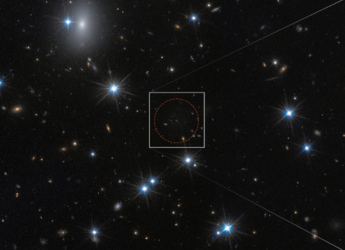
Hubble finds Cloud 9, a starless dark-matter cloud, offering insights into galaxy formation and dark matter.
Written by Gadgets 360 Staff | Updated: 10 January 2026 19:00 IST
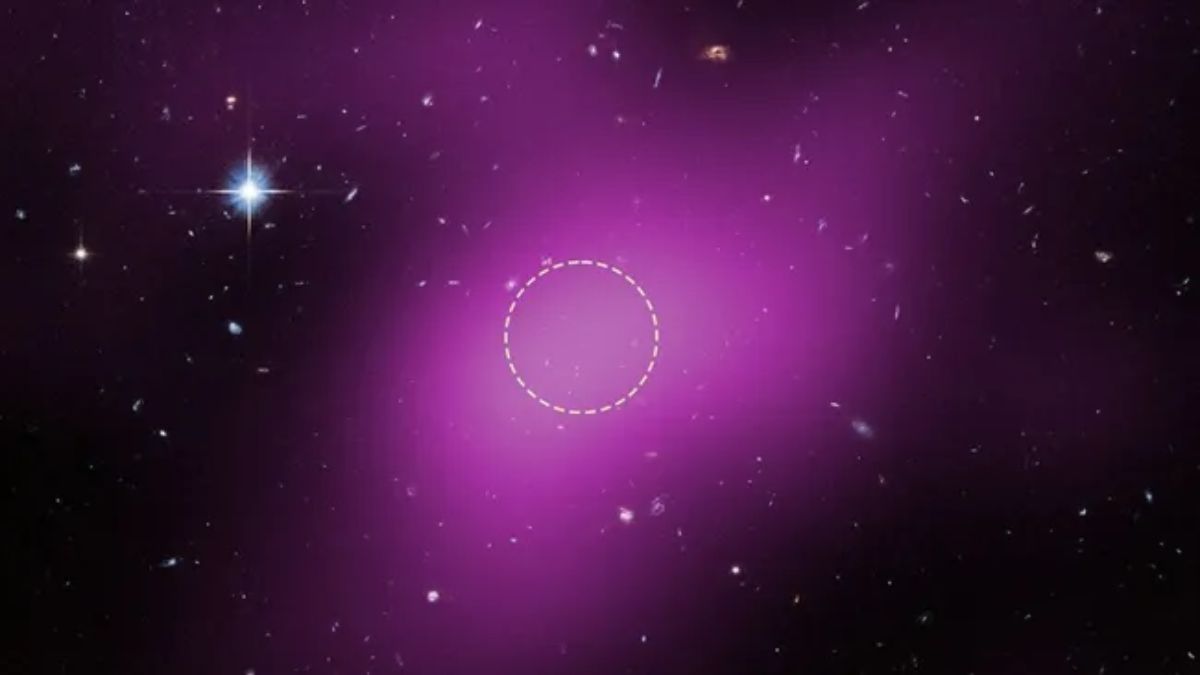
Photo Credit: NASA, ESA, VLA, Gagandeep Anand (STScI), Alejandro Benitez-Llambay (University of Milano-Bicocca); Image
Hubble Telescope reveals Cloud 9, a dark-matter-dominated cloud with no stars near M94.
Click Here to Add Gadgets360 As A Trusted Source


Advertisement
Astronomers have discovered a remarkable new cosmic object using the Hubble Space Telescope: a cloud of dark matter and gas containing no stars, located about 14 million light-years away near the spiral galaxy Messier 94. Nicknamed “Cloud 9”, it is one of the few dark-matter-dominated clouds in the local universe. Unlike typical galaxies, this cloud exhibits no signs of star formation and offers a rare opportunity to help identify the early processes of galaxy formation as well as help scientists understand the role dark matter plays in its infancy; it represents most of the mass in the universe.
ESA and Hubble Identify ‘Failed Galaxy' Cloud 9, Offering Insights into Dark Matter and Galaxy Formation
According to an ESA report, the discovery of Cloud 9 confirms the existence of Reionization-Limited Hydrogen I Clouds, or RELHICs. Team members said Hubble's Advanced Camera for Surveys made it possible to detect that no stars are present, ruling out a faint dwarf galaxy. Alejandro Benitez-Llambay, team leader, described the object as a “failed galaxy” that offers critical insight into how galaxies begin and why some never form stars.
Cloud 9 is compact, spherical, and 4,900 light-years across, with dark matter five billion times the Sun's mass. Hydrogen exists but cannot form stars, serving as a dark matter laboratory.
Cloud 9 Discovery Suggests Numerous Starless RELHICs Lurk Among Nearby Galaxies
The researchers propose that other similar RELHICs might be present near galaxies, known as ‘abandoned houses', of which Cloud 9 could aid future searches and understanding of the evolution of galaxies.
The discovery, presented at AAS (The American Astronomical Society) 247 in Phoenix and published in Astrophysical Journal Letters, highlights Hubble's role in revealing hidden cosmic objects.
Comments
Get your daily dose of tech news, reviews, and insights, in under 80 characters on Gadgets 360 Turbo. Connect with fellow tech lovers on our Forum. Follow us on X, Facebook, WhatsApp, Threads and Google News for instant updates. Catch all the action on our YouTube channel.
Related Stories
Hubble Telescope Spots Starless Dark Matter Cloud Cloud 9, Opening Window Into Dark Universe


Advertisement
Follow Us




-
04:37
[Sponsored]: CP PLUS CarKam CP-F89B: 4K Dashcam With Rear Camera, GPS & Emergency Recording -
04:23
[Partner Content] Your Phone Can Do WAY More Than You Think | OPPO ColorOS 16 -
01:59
Samsung Galaxy Z Fold8 Ultra: Unfold the Ultra Night -
03:24
Apple Pay Launches In India: Supported Devices, Cards And Payments Explained -
00:21
[Sponsored] Samsung Galaxy Z Fold8, Fold8 Ultra
-
Amazon Sale 2026: Samsung के 20K से लेकर 1 लाख वाले फोन पर बंपर डील
-
₹30 हजार में Samsung का प्रीमियम फोन चाहिए? Amazon Sale में चेक करें डील
-
Vivo V80 की सेल शुरू, बड़ा डिस्काउंट, एक्सचेंज बोनस और कई तरह के फायदे
-
Vivo X Fold 6 की सेल शुरू, ₹26 हजार से ज्यादा सस्ता खरीदें फोल्डेबल फोन
-
iQOO Neo 12 लॉन्च होगा 9,000mAh बैटरी, 185Hz 2K डिस्प्ले, Q3 गेमिंग चिप के साथ!
Advertisement
Popular on Gadgets
- Samsung Galaxy S26 Ultra
- Motorola Razr Fold
- ChatGPT
- OPPO Find N6
- Mobiles Under Rs. 40,000
- Vivo X300 Ultra
- Asus Zenbook S14
- iQOO 15
- Vivo X300 Pro
- Lenovo Yoga Slim 7i Aura Edition
- iQOO 15R
- Vivo X Fold 5
- Sony PlayStation 5
- HP OmniPad 12
- OnePlus Nord CE 6 Lite
- OnePlus Pad 4
- OPPO F33 Pro 5G
- Cryptocurrency
- HP OmniBook Ultra 14 (2026)
- iPhone 17
- Eureka Forbes AP 355 Room Air Purifier
- Latest Mobile Phones
- Compare Phones
Latest Gadgets
- Vivo Y600s Pro
- Vivo Y32 (2026)
- Infinix Smart 20 HD
- Vivo V80
- Vivo S2 FE
- Vivo Y600K Turbo
- Realme P4s Lite
- Vivo S60t
- Dell Pro Rugged 14
- Dell Pro Rugged 13 Extreme
- Amazon Alexa Tablet 8
- Amazon Alexa Tablet 11
- Amazfit T-Rex Dual Solar
- OPPO Watch S2
- Toshiba 65-Inch 4K Ultra HD Smart Mini LED QLED TV (65Z670SP)
- Haier M70 Mini LED 65-inch
- Acer Predator Atlas 8
- Asus ROG Ally
- Blue Star 1.5 Ton 5 Star Inverter Split AC (IE518ZNURS)
- Blue Star 2 Ton 3 Star Inverter Window AC (WIE324L)

- About Us
- Sitemaps
- Feedback
- Archives
- Contact Us
- RSS
- Advertise
- Career
- Privacy Policy
- Ethics
- Editorial Policy
- Terms & Conditions
- Complaint Redressal
Download Our Apps
Available in Hindi
© Copyright Red Pixels Ventures Limited 2026. All rights reserved.