-
 Scientists Reveal Why Jupiter and Saturn’s Polar Weather Looks So Different23 January 2026
 -
MIT Develops 3D-Printable Aluminum Alloy That’s Up to Five Times Stronger Than Conventional Metals31 December 2025
-
MIT Detects Traces of a Lost ‘Proto Earth’ Deep Beneath Our Planet’s Surface20 October 2025
-
Study Suggests Primordial Black Hole Burst as Source of Detected High-Energy Neutrino21 September 2025
-
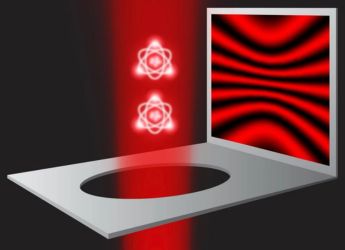
MIT Just Proved Einstein Wrong in the Famous Double-Slit Quantum Experiment31 July 2025
- Home
- Science
- Science News
- MIT Physicists Discover a Way to See Inside Atoms Using Tabletop Molecular Technique
MIT Physicists Discover a Way to See Inside Atoms Using Tabletop Molecular Technique
MIT scientists develop tabletop molecular method to probe atomic nuclei using radium monofluoride.
Written by Gadgets 360 Staff | Updated: 27 October 2025 22:30 IST

Photo Credit: MIT
MIT’s tabletop experiment uses radium monofluoride to reveal atomic nucleus details
Click Here to Add Gadgets360 As A Trusted Source


Advertisement
Physicists at MIT have come up with a new way to look inside atoms and observe, in real-time, what happens there — an advance that offers more opportunity to study materials and atoms than using light. Researchers used a radium monofluoride molecule to create a molecular arrangement in which electrons can probe the interior of atomic nuclei, discovering tiny energy shifts that hint at interactions between electrons and nuclear matter. This tabletop method provides a convenient, cost-effective means for probing the physics behind how matter behaves as it's crushed to densities many times greater than an atomic nucleus and may help researchers discover why the universe contains more matter than antimatter.
MIT Scientists Turn Molecules into Mini Colliders to Explore the Heart of Atoms
According to a report published in Science and presented by the Massachusetts Institute of Technology, the research team led by physicist Ronald Fernando Garcia Ruiz used a mixture of radium and fluoride atoms cooled to extreme temperatures. Within this molecule, electrons were confined close to the nucleus, increasing the chances of them briefly passing through it. When these electrons emerged, they carried detectable energy shifts—essentially “messages” from inside the nucleus—revealing unseen nuclear interactions.
Researchers used a tabletop setup to study a molecule as a particle accelerator, observing electron energy variations, which could help map nuclear properties and explain matter's dominance over antimatter.
Radium's pear-shaped nucleus can detect symmetry violations, explaining natural imbalances. Future experiments aim to control molecules for precise nuclear maps.
A discovery years in the making, the new approach to learning about the mysteries of our cosmos allows scientists to explore some of a laboratory's strongest high-energy insights by recreating the same conditions that existed just moments after the Big Bang.
Comments
Get your daily dose of tech news, reviews, and insights, in under 80 characters on Gadgets 360 Turbo. Connect with fellow tech lovers on our Forum. Follow us on X, Facebook, WhatsApp, Threads and Google News for instant updates. Catch all the action on our YouTube channel.
Further reading:
MIT, atomic physics, electrons, radium monofluoride, antimatter, nuclear research, Science journal
Related Stories






Advertisement
Follow Us




-
01:42
[Sponsored] Galaxy Watch9 for Everyday Health Insights | Smarter Wellness Choices -
01:15
[Sponsored] Galaxy Tab S10 Lite for Students: Notes, Solve Math and More -
04:17
[Sponsored] LG NANO 4K UHD AI TV NU885: Gemini Search, Dolby Atmos & 5 Years of Updates -
00:57
[Sponsored] Samsung Galaxy Z Fold8 My Fan Cam in Action: Find the Moment, Then Share It -
01:41
[Sponsored] What Do You Need To Know Before Your Next Run? | Samsung Galaxy Watch Ultra2
Advertisement
Popular on Gadgets
- Samsung Galaxy S26 Ultra
- Motorola Razr Fold
- ChatGPT
- OPPO Find N6
- Mobiles Under Rs. 40,000
- Vivo X300 Ultra
- Asus Zenbook S14
- iQOO 15
- Vivo X300 Pro
- Lenovo Yoga Slim 7i Aura Edition
- iQOO 15R
- Vivo X Fold 5
- Sony PlayStation 5
- HP OmniPad 12
- OnePlus Nord CE 6 Lite
- OnePlus Pad 4
- OPPO F33 Pro 5G
- Cryptocurrency
- HP OmniBook Ultra 14 (2026)
- iPhone 17
- Eureka Forbes AP 355 Room Air Purifier
- Latest Mobile Phones
- Compare Phones
Latest Gadgets
- Vivo Y600
- HMD 2660 Flip Senior Edition
- Lava Aura Curve
- Poco X8s
- Samsung Galaxy F70 5G
- Tecno Spark 50S 5G
- Vivo Y600s Pro
- Vivo Y32 (2026)
- Lenovo Yoga 9n 2-in-1
- Lenovo Yoga Pro 9n
- Amazon Alexa Tablet 8
- Amazon Alexa Tablet 11
- Pebble Qore 2
- Amazfit T-Rex Dual Solar
- Toshiba 65-Inch 4K Ultra HD Smart Mini LED QLED TV (65Z670SP)
- Haier M70 Mini LED 65-inch
- Acer Predator Atlas 8
- Asus ROG Ally
- Blue Star 1.5 Ton 5 Star Inverter Split AC (IE518ZNURS)
- Blue Star 2 Ton 3 Star Inverter Window AC (WIE324L)

- About Us
- Sitemaps
- Feedback
- Archives
- Contact Us
- RSS
- Advertise
- Career
- Privacy Policy
- Ethics
- Editorial Policy
- Terms & Conditions
- Complaint Redressal
Download Our Apps
Available in Hindi
© Copyright Red Pixels Ventures Limited 2026. All rights reserved.