
-
 New Biosignature Method Could Transform Search for Alien Life16 May 2026
 -
NASA’s Europa Clipper May Cross a Comet’s Tail, Offering Rare Glimpse of Interstellar Material26 October 2025
-
NASA’s Europa Clipper Captures Stunning Infrared Image of Mars17 May 2025
-
Space Exploration Highlights 2024: Lunar Missions, Mars Discoveries, and More10 December 2024
-
NASA Europa Clipper Advances Toward Jupiter’s Moon, Instruments Successfully Deployed26 November 2024
- Home
- Science
- Science News
- NASA’s Europa Clipper Probe Begins Deploying Science Instruments on Way to Jupiter
NASA’s Europa Clipper Probe Begins Deploying Science Instruments on Way to Jupiter
Europa Clipper starts deploying science instruments as it heads to Jupiter to study Europa's ocean.
Written by Gadgets 360 Staff | Updated: 28 November 2024 22:15 IST

Photo Credit: NASA/JPL-Caltech
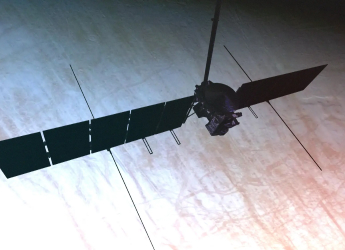
Europa Clipper spacecraft with deployed solar arrays, magnetometer boom, and radar antennas
Click Here to Add Gadgets360 As A Trusted Source


Advertisement
NASA's Europa Clipper spacecraft has begun deploying its scientific instruments during its journey to Jupiter. The probe, launched on October 14, 2023 aboard a SpaceX Falcon Heavy rocket from Kennedy Space Centre, is set to study Europa, one of Jupiter's moons. Europa is believed to possess a subsurface ocean, potentially harbouring conditions suitable for life. According to NASA, the spacecraft has travelled over 13 million miles (20 million kilometres) since its launch, moving at 35 kilometres per second relative to the Sun.
Instrument Deployment and Purpose
The spacecraft has successfully extended two major instruments, the magnetometer's boom and several radar antennas, according to NASA reports. The magnetometer, deployed on an 8.5-metre boom, will measure Europa's magnetic field, aiding in confirming the existence of an underground ocean while providing details about its depth and salinity.
The radar antennas, part of the Radar for Europa Assessment and Sounding: Ocean to Near-surface (REASON) instrument, include four high-frequency antennas measuring 17.6 metres each and eight smaller antennas. These components are
designed to analyse Europa's icy crust.
Jordan Evans, project manager for the Europa Clipper mission at NASA's Jet Propulsion Laboratory, explained in a statement that the deployment process is being carefully monitored to ensure the spacecraft's instruments function as expected. Data sent back to Earth is assisting engineers in assessing the behaviour and performance of the deployed equipment, as per reports.
Upcoming Mission Milestones
NASA officials have outlined a series of gravity-assist manoeuvres planned for the spacecraft. The first of these will involve Mars in March 2025, allowing tests of some instruments and thermal imaging of the planet. Another gravity assist around Earth in December 2026 will fine-tune its trajectory toward Jupiter, calibrating instruments like the magnetometer along the way.
The spacecraft, described by NASA as the largest ever built for a planetary mission, is expected to reach Jupiter in 2030 and conduct 49 flybys of Europa starting in 2031. These flybys will gather data to help determine if the moon's environment could support life.
Comments
Get your daily dose of tech news, reviews, and insights, in under 80 characters on Gadgets 360 Turbo. Connect with fellow tech lovers on our Forum. Follow us on X, Facebook, WhatsApp, Threads and Google News for instant updates. Catch all the action on our YouTube channel.
Related Stories






Advertisement
Follow Us




-
05:20
Samsung Galaxy Watch Ultra 2 Review: Is This the Best Android Smartwatch? -
07:01
Samsung Galaxy Z Fold 8 Review: Is This the Best Foldable Phone? -
06:39
Samsung Galaxy Z Fold8 Ultra Review: Cameras, Battery, Performance Tested -
04:33
[Sponsored] JBL Live 780NC: Great Sound, Perfect Comfort, Smart ANC & 80-Hour Battery -
12:04
[Partner Content] OPPO Reno16 Series Deep Dive: Built for Creators?
-
Ganesh Chaturthi Stickers: ऐसे डाउनलोड करें और भेजे गणपति बप्पा के स्टिकर
-
iQOO 16 में होगा दुनिया का पहला 2K 165Hz डिस्प्ले
-
Xiaomi का ये छोटा सा सॉकेट पुराने पंखे-लैंप को बना देगा सुपर स्मार्ट
-
Samsung Galaxy S26 FE vs Oppo Reno 16 vs Xiaomi 17T: जानें कौन सा फोन है बेस्ट?
-
Vivo ला रही नया मिडरेंज फोन, 44W फास्ट चार्जिंग के साथ!
Advertisement
Popular on Gadgets
- Samsung Galaxy S26 Ultra
- Motorola Razr Fold
- ChatGPT
- OPPO Find N6
- Mobiles Under Rs. 40,000
- Vivo X300 Ultra
- Asus Zenbook S14
- iQOO 15
- Vivo X300 Pro
- Lenovo Yoga Slim 7i Aura Edition
- iQOO 15R
- Vivo X Fold 5
- Sony PlayStation 5
- HP OmniPad 12
- OnePlus Nord CE 6 Lite
- OnePlus Pad 4
- OPPO F33 Pro 5G
- Cryptocurrency
- HP OmniBook Ultra 14 (2026)
- iPhone 17
- Eureka Forbes AP 355 Room Air Purifier
- Latest Mobile Phones
- Compare Phones
Latest Gadgets
- iPhone Duo
- OPPO A7 Pro
- Huawei Mate XT 2 Ultimate Design
- Realme 16 Pro Harry Potter Edition
- Samsung Galaxy A07s
- Huawei Pura X View
- Tecno Camon Slim 5G
- iQOO Z11xa
- Acer Aspire G 3D 16
- Acer Swift Air 16 (2026)
- Xiaomi Pad 9 Pro
- Xiaomi Pad 9
- Apple Watch Ultra 4
- Apple Watch Series 12
- Haier M70 Mini LED 65-inch
- Xiaomi TV FX Mini LED 65
- Acer Predator Atlas 8
- Asus ROG Ally
- Blue Star 1.5 Ton 5 Star Inverter Split AC (IE518ZNURS)
- Blue Star 2 Ton 3 Star Inverter Window AC (WIE324L)

- About Us
- Sitemaps
- Feedback
- Archives
- Contact Us
- RSS
- Advertise
- Career
- Privacy Policy
- Ethics
- Editorial Policy
- Terms & Conditions
- Complaint Redressal
Download Our Apps
Available in Hindi
© Copyright Red Pixels Ventures Limited 2026. All rights reserved.