-
 CES 2026: Samsung Reportedly Plans to Unveil Brain Health Service to Detect Early Signs of Dementia30 December 2025
 -
NASA’s Expedition 73: Astronauts Study Brain, Balance, and Immunity on ISS24 August 2025
-
Brain’s Built-In Signal Threshold Helps Differentiate Imagination from Reality18 June 2025
-
Neuralink Device Helps Monkey See Something That’s Not There14 June 2025
-
Apple Reportedly Partnering With Synchron to Develop Brain-Computer Interfaces14 May 2025
- Home
- Science
- Science News
- New Technique to Map Human Brain in Finer Detail
New Technique to Map Human Brain in Finer Detail
By Indo-Asian News Service | Updated: 12 August 2015 11:42 IST
Click Here to Add Gadgets360 As A Trusted Source

Advertisement
A new technology developed by researchers at a Swiss institute can map the human brain in unprecedented detail without distorting the architecture of the brain.
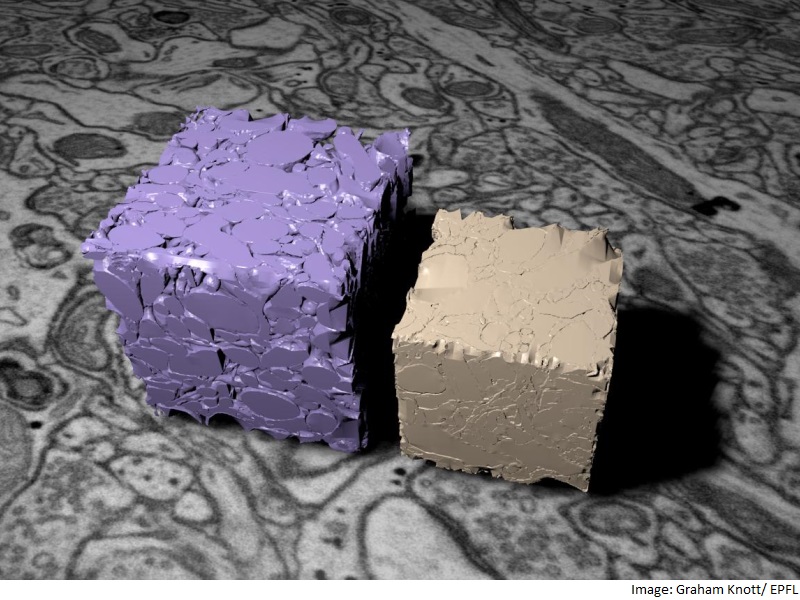
The results also showed that our brain may not be as compact as generally thought.
To study the fine structure of the brain - including its connections between neurons and the synapses - scientists generally use electron microscopes.
However, the brain tissue must first be fixed to prepare it for this high magnification imaging method.
This process causes the brain to shrink and as a result, microscope images can be distorted - showing neurons to be much closer than they actually are.
The team from Swiss Federal Institute of Technology in Lausanne have now solved the problem by using a technique that rapidly freezes the brain, preserving its true structure.
The researchers Graham Knott, Natalya Korogod, and Carl Petersen successfully used the innovative method called "cryofixation" to prevent brain shrinkage during the preparation for electron microscopy.
The method uses jets of liquid nitrogen to "snap-freeze" brain tissue down to -90 degrees celsius within milliseconds.
The brain tissue here was mouse cerebral cortex.
"The high-pressure 'cryofixation' is a very attractive method for brain imaging," Knott said, adding that the results showed our brains may not be as cramped as previously thought.
The team is now aiming to use the technique on other parts of the brain and even other types of tissue.
The work was published in the journal eLife.
Comments
Get your daily dose of tech news, reviews, and insights, in under 80 characters on Gadgets 360 Turbo. Connect with fellow tech lovers on our Forum. Follow us on X, Facebook, WhatsApp, Threads and Google News for instant updates. Catch all the action on our YouTube channel.
Related Stories





Advertisement
Follow Us




-
![[Sponsored] LG NANO 4K UHD AI TV NU885: Gemini Search, Dolby Atmos & 5 Years of Updates](https://www.gadgets360.com/static/desktop/images/spacer.png)
04:17
[Sponsored] LG NANO 4K UHD AI TV NU885: Gemini Search, Dolby Atmos & 5 Years of Updates -
00:57
[Sponsored] Samsung Galaxy Z Fold8 My Fan Cam in Action: Find the Moment, Then Share It -
01:41
[Sponsored] What Do You Need To Know Before Your Next Run? | Samsung Galaxy Watch Ultra2 -
01:32
[Sponsored] Big Day Tomorrow? Prep Today | Samsung Galaxy Watch Ultra2 -
04:37
[Sponsored]: CP PLUS CarKam CP-F89B: 4K Dashcam With Rear Camera, GPS & Emergency Recording
-
आ गई हवा में उड़ने वाली Tesla Roadster कार, आखिर सच हुआ फिल्मों वाला कमाल
-
रोबोट ने की लड़की से छेड़छाड़, पीछे से पकड़ा और किए गंदे इशारे, जानें
-
PS5 कहां मिलेगा सस्ता, Flipkart या Amazon, जानें सबकुछ
-
Samsung Galaxy A38 5G में मिल सकती है ट्रिपल रियर कैमरा यूनिट
-
Oppo Find X10 Pro Max होगा ट्रिपल 200 मेगापिक्सल कैमरा सिस्टम वाला पहला स्मार्टफोन
Advertisement
Popular on Gadgets
- Samsung Galaxy S26 Ultra
- Motorola Razr Fold
- ChatGPT
- OPPO Find N6
- Mobiles Under Rs. 40,000
- Vivo X300 Ultra
- Asus Zenbook S14
- iQOO 15
- Vivo X300 Pro
- Lenovo Yoga Slim 7i Aura Edition
- iQOO 15R
- Vivo X Fold 5
- Sony PlayStation 5
- HP OmniPad 12
- OnePlus Nord CE 6 Lite
- OnePlus Pad 4
- OPPO F33 Pro 5G
- Cryptocurrency
- HP OmniBook Ultra 14 (2026)
- iPhone 17
- Eureka Forbes AP 355 Room Air Purifier
- Latest Mobile Phones
- Compare Phones
Latest Gadgets
- Tecno Spark 50S 5G
- Vivo Y600s Pro
- Vivo Y32 (2026)
- Infinix Smart 20 HD
- Vivo V80
- Vivo S2 FE
- Vivo Y600K Turbo
- Realme P4s Lite
- HP ZBook Ultra G3a
- Dell Pro Rugged 14
- Amazon Alexa Tablet 8
- Amazon Alexa Tablet 11
- Amazfit T-Rex Dual Solar
- OPPO Watch S2
- Toshiba 65-Inch 4K Ultra HD Smart Mini LED QLED TV (65Z670SP)
- Haier M70 Mini LED 65-inch
- Acer Predator Atlas 8
- Asus ROG Ally
- Blue Star 1.5 Ton 5 Star Inverter Split AC (IE518ZNURS)
- Blue Star 2 Ton 3 Star Inverter Window AC (WIE324L)

- About Us
- Sitemaps
- Feedback
- Archives
- Contact Us
- RSS
- Advertise
- Career
- Privacy Policy
- Ethics
- Editorial Policy
- Terms & Conditions
- Complaint Redressal
Download Our Apps
Available in Hindi
© Copyright Red Pixels Ventures Limited 2026. All rights reserved.