-
 Hubble Constant Puzzle Deepens as Supernova and CMB Measurements Clash4 March 2026
 -
Pulsar Observations Could Reveal Gravitational Wave Interference From Black Holes15 October 2025
-
PSR J0922+0638 Pulsar Keeps Glitching Every 550 Days, Scientists Are Intrigued31 July 2025
-
New Study Confirms TeV Halos Are Common in Middle-Aged Pulsars22 May 2025
-
NASA Telescopes Reveal Hidden Properties of X-Ray Pulsar RX J0032.9-734812 May 2025
- Home
- Science
- Science News
- New Study Claims There Might Be Way More Pulsars in Space Than We Previously Thought
New Study Claims There Might Be Way More Pulsars in Space Than We Previously Thought
Astronomers have discovered that millisecond pulsars emit radio waves far beyond their expected regions, extending to the edges of their magnetic fields.
Written by Gadgets 360 Staff | Updated: 6 April 2026 17:35 IST
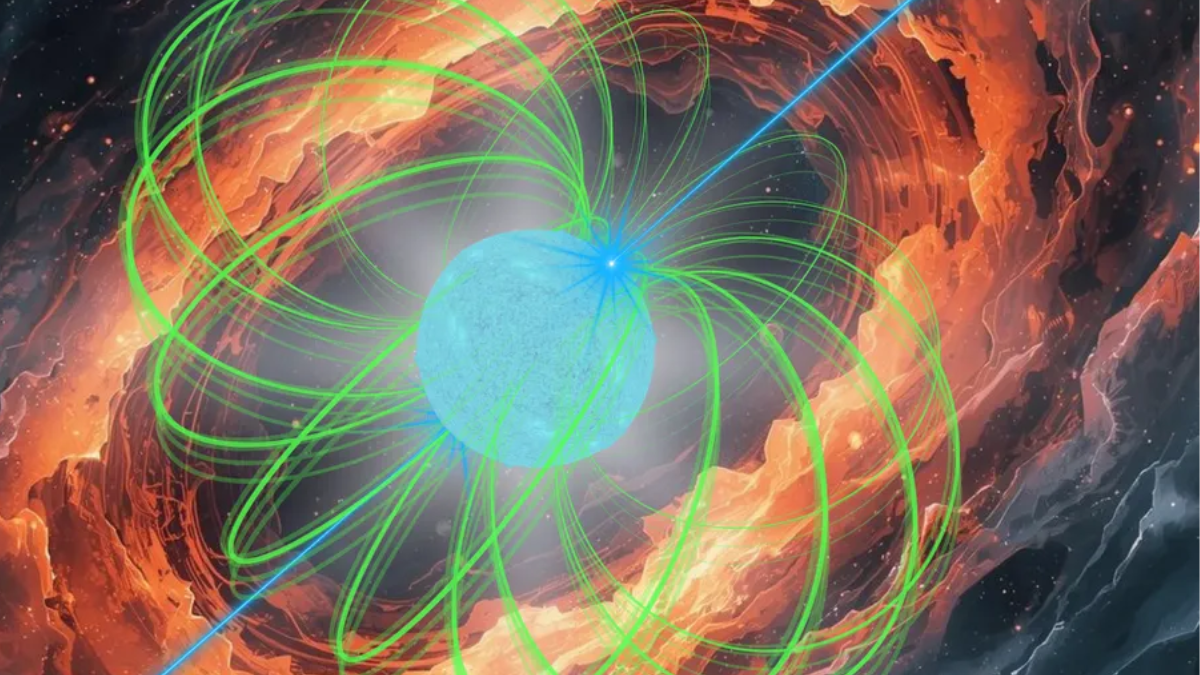
Photo Credit: Robert Lea
An illustration shows a neutron star at the heart of a pulsar and its strong magnetic field.
Click Here to Add Gadgets360 As A Trusted Source


Advertisement
The spinning remains of the dead massive stars, known as pulsars, have long been believed to be able to emit radio signals only near their surfaces and near their magnetic poles. That assumption is disproved by a new study in Monthly Notices of the Royal Astronomical Society, which finds that some of the fastest-spinning pulsars in the universe send radio waves to the very edges of their magnetic influence - a finding that changes our perception of these cosmic lighthouses.
A Surprising Pattern in the Data
According to the scientific study by Michael Kramer of Germany's Max Planck Institute for Radio Astronomy and Simon Johnston of Australia's CSIRO, 200 millisecond pulsars, whose rotation is very fast, were studied in relation to gamma rays collected by the Fermi Space Telescope operated by NASA. The study revealed that one-third of the millisecond pulsars generated radio waves from separate regions, something that happens in only 3 percent of the slow pulsars.
Importantly, the radio emission emanating from the outer region coincided perfectly with the gamma rays originating from the "current sheet" of electrically charged particles outside the light cylinder.
Why This Matters
This discovery implies that there could be many more pulsars to be discovered in the future since the emission of radio waves does not occur in a small cone around the magnetic poles alone, but occurs in a broader range of directions. It is even more critical for the study of gravitational waves, as their detection depends on the use of an array of pulsars as an instrument. The problem that scientists must address next is the mechanism behind this phenomenon.
Comments
Get your daily dose of tech news, reviews, and insights, in under 80 characters on Gadgets 360 Turbo. Connect with fellow tech lovers on our Forum. Follow us on X, Facebook, WhatsApp, Threads and Google News for instant updates. Catch all the action on our YouTube channel.
Related Stories





Advertisement
Follow Us




-
04:37
[Sponsored]: CP PLUS CarKam CP-F89B: 4K Dashcam With Rear Camera, GPS & Emergency Recording -
04:23
[Partner Content] Your Phone Can Do WAY More Than You Think | OPPO ColorOS 16 -
01:59
Samsung Galaxy Z Fold8 Ultra: Unfold the Ultra Night -
03:24
Apple Pay Launches In India: Supported Devices, Cards And Payments Explained -
00:21
[Sponsored] Samsung Galaxy Z Fold8, Fold8 Ultra
-
Flipkart Big Billion Days: Xiaomi के 5 Redmi स्मार्टफोन्स पर Deals रिवील
-
Delhi Pollution 2026: 50% Work From Home, बिना PUCC नहीं मिलेगा Fuel
-
Oppo K15x हुआ लॉन्च; 6500mAh बैटरी, 120Hz डिस्प्ले के साथ आया बजट 5G फोन
-
इलेक्ट्रिक मोटरसाइकिल्स के सेगमेंट में Oben Electric का पहला रैंक, 1,417 यूनिट्स की बिक्री
-
₹4,200 सस्ता मिल रहा Vivo का 5000mAh बैटरी वाला फोन! यहां आई जबरदस्त डील
Advertisement
Popular on Gadgets
- Samsung Galaxy S26 Ultra
- Motorola Razr Fold
- ChatGPT
- OPPO Find N6
- Mobiles Under Rs. 40,000
- Vivo X300 Ultra
- Asus Zenbook S14
- iQOO 15
- Vivo X300 Pro
- Lenovo Yoga Slim 7i Aura Edition
- iQOO 15R
- Vivo X Fold 5
- Sony PlayStation 5
- HP OmniPad 12
- OnePlus Nord CE 6 Lite
- OnePlus Pad 4
- OPPO F33 Pro 5G
- Cryptocurrency
- HP OmniBook Ultra 14 (2026)
- iPhone 17
- Eureka Forbes AP 355 Room Air Purifier
- Latest Mobile Phones
- Compare Phones
Latest Gadgets
- Samsung Galaxy F08
- Samsung Galaxy M08
- OPPO K15x
- OPPO K15s
- HMD Vibe 2 Pro 5G
- OPPO K14 Plus 5G
- Lava Shark 2 Pro 5G
- Ai+ Pulse 2 FE
- Dell 14 Plus 2-in-1 (AMD Ryzen AI 7 350, 2025)
- Microsoft Surface Laptop, 13-inch (2nd Edition)
- Samsung Galaxy Tab S12+
- Samsung Galaxy Tab S12 Ultra
- Amazfit T-Rex Dual Solar
- OPPO Watch S2
- Toshiba 65-Inch 4K Ultra HD Smart Mini LED QLED TV (65Z670SP)
- Haier M70 Mini LED 65-inch
- Acer Predator Atlas 8
- Asus ROG Ally
- Blue Star 1.5 Ton 5 Star Inverter Split AC (IE518ZNURS)
- Blue Star 2 Ton 3 Star Inverter Window AC (WIE324L)

- About Us
- Sitemaps
- Feedback
- Archives
- Contact Us
- RSS
- Advertise
- Career
- Privacy Policy
- Ethics
- Editorial Policy
- Terms & Conditions
- Complaint Redressal
Download Our Apps
Available in Hindi
© Copyright Red Pixels Ventures Limited 2026. All rights reserved.