-
 iPhones in Deep Space: NASA Breaks Rules for Artemis 2 Crew; 5 Key Facts2 April 2026
 -
Artemis II Launched: NASA’s First Crewed Mission in 50 Years Aims for the Moon2 April 2026
-
Artemis 2: NASA's Astronaut Moon Mission Explained in Five Points1 April 2026
-
Hubble Telescope Captures Comet Reversing Its Rotation for the First Time27 March 2026
-
Russia Plans Venera-D Mission to Venus in 2036 With Lander, Orbiter, and Balloon Probe18 March 2026
- Home
- Science
- Science News
- Scientists Identify Rare Black Hole Merger in the Early Universe Using Gravitational Mapping
Scientists Identify Rare Black Hole Merger in the Early Universe Using Gravitational Mapping
As two supermassive black holes orbit toward each other, they send out gravitational waves that go from lower to higher frequencies.
Written by Gadgets 360 Staff | Updated: 16 February 2026 09:46 IST
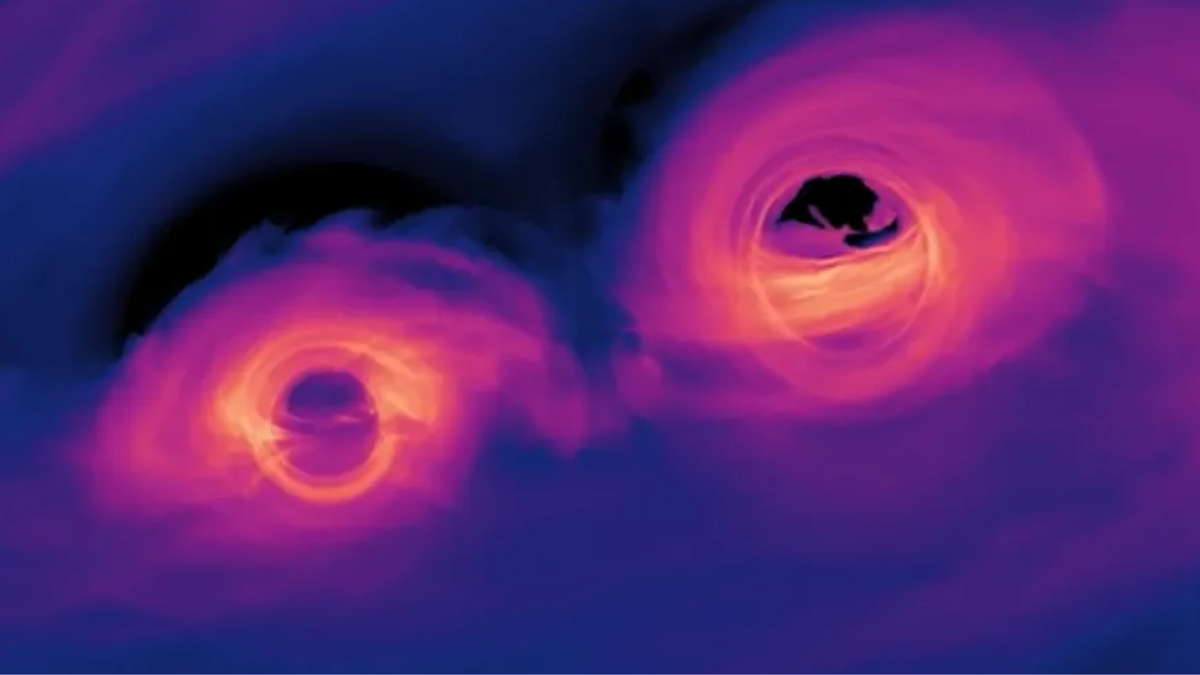
Photo Credit: NASA Goddard Space Flight Centre
Artist view of merging black holes named Gondor and Rohan detected through cosmic signals.
Click Here to Add Gadgets360 As A Trusted Source


Advertisement
In a superb blend of science and pop culture, astronomers have identified two supermassive black hole systems on a collision course and named them Gondor and Rohan, after the kingdom beacons in The Lord of the Rings: The Return of the King. These cosmic giants were spotted in an unconventional way: by analyzing the faint background hum of gravitational waves alongside bright quasars. Scientists say these quasars act like cosmic beacons, illuminating regions of the universe where gargantuan black holes are gradually pulling toward each other in preparation for a future merger.
NANOGrav Uses Active Galactic Nuclei and Gravitational Wave Signals to Trace Merging Supermassive Black Holes
As per a Space.com report, the discovery was made by the NANOGrav team as part of its observations of 114 active galactic nuclei, which are the extremely bright centres of galaxies that are powered by feeding central black holes.
As two supermassive black holes orbit toward each other, they send out gravitational waves that go from lower to higher frequencies. This results in an ever-present background signal that can be mapped through space.
Targeted Search Highlights Quasar-Linked Black Hole Binaries as Key Benchmarks for Gravitational Wave Detection
The systems officially known as SDSS J0729+4008 and SDSS J1536+0411 were found during a targeted search. The paper found that such binaries are more likely to be present inside quasars, which serve as useful signposts for scientists.
This approach is said to offer explicit benchmarks for the detection of continuous gravitational wave sources, experts noted. The findings were reported in The Astrophysical Journal Letters and are set to aid the mapping of future black hole mergers, as well as the knowledge base for galaxy evolution and gravitational wave physics.
Comments
Get your daily dose of tech news, reviews, and insights, in under 80 characters on Gadgets 360 Turbo. Connect with fellow tech lovers on our Forum. Follow us on X, Facebook, WhatsApp, Threads and Google News for instant updates. Catch all the action on our YouTube channel.
Related Stories





Scientists Identify Rare Black Hole Merger in the Early Universe Using Gravitational Mapping


Advertisement
Follow Us




-
05:05
Goboult Mustang Racer Smartwatch Review: Should You Get This Mustang Smartwatch? -
04:58
OnePlus Nord Buds 4 Pro Review: Specs, Sound Quality, ANC, and Battery Backup Tested -
02:29
[Sponsored] Samsung Galaxy S26 Ultra First Look: AI Smartphone for Creators, Gaming & Productivity -
04:25
Vivo X200T Review - Full Camera, Gaming & Battery Test | Worth Buying? -
28:31
The Future of Productivity: Logitech's Anatoliy Polyanker On AI, Hybrid Work, And India's Tech Boom
Advertisement
Popular on Gadgets
- Samsung Galaxy Unpacked 2026
- iPhone 17 Pro Max
- ChatGPT
- iOS 26
- Laptop Under 50000
- Smartwatch Under 10000
- Apple Vision Pro
- Oneplus 12
- OnePlus Nord CE 3 Lite 5G
- iPhone 13
- Xiaomi 14 Pro
- Oppo Find N3
- Tecno Spark Go (2023)
- Realme V30
- Best Phones Under 25000
- Samsung Galaxy S24 Series
- Cryptocurrency
- iQoo 12
- Samsung Galaxy S24 Ultra
- Giottus
- Samsung Galaxy Z Flip 5
- Apple 'Scary Fast'
- Housefull 5
- GoPro Hero 12 Black Review
- Invincible Season 2
- JioGlass
- HD Ready TV
- Latest Mobile Phones
- Compare Phones
Latest Gadgets
- Honor X80i
- Honor Play 80 Pro
- Redmi Note 15 SE 5G
- Redmi A7 Pro
- OPPO K15 Pro
- OPPO K15 Pro+
- Lava Bold N2 Lite
- Lava Bold N2 Pro
- Xiaomi Book Pro 14
- MacBook Neo
- Vivo Pad 6 Pro
- Lenovo Legion Y700 Gen 5
- boAt Valour Watch 1R
- Xiaomi Watch S5
- Xiaomi QLED TV X Pro 75
- Haier H5E Series
- Asus ROG Ally
- Nintendo Switch Lite
- Haier 1.6 Ton 5 Star Inverter Split AC (HSU19G-MZAID5BN-INV)
- Haier 1.6 Ton 5 Star Inverter Split AC (HSU19G-MZAIM5BN-INV)

- About Us
- Sitemaps
- Feedback
- Archives
- Contact Us
- RSS
- Advertise
- Career
- Privacy Policy
- Ethics
- Editorial Policy
- Terms & Conditions
- Complaint Redressal
Download Our Apps
Available in Hindi
© Copyright Red Pixels Ventures Limited 2026. All rights reserved.