-
 Sun Unleashes Triple Solar Flare Blast, Triggering G3 Geomagnetic Storm Alert4 June 2026
 -
Massive Solar Storm Reveals How Mars Is Losing Its Atmosphere19 May 2026
-
Sun Erupts with Powerful Solar Flare, Sending Plasma Toward Earth13 May 2026
-
Carrington-Level Solar Storm Could Disrupt Satellites, GPS, and Power Grids, Scientists Warn14 April 2026
-
Scientists Trace Solar Storm Origins to Hidden Layer Deep Inside the Sun28 March 2026
- Home
- Science
- Science News
- Severe Solar Storm Warning: NOAA Predicts Auroras Across US, Possible Power Grid Impact
Severe Solar Storm Warning: NOAA Predicts Auroras Across US, Possible Power Grid Impact
A severe solar storm is expected on Oct 10-11, with possible disruptions to power grids and enhanced auroras visible in lower US latitudes.
Written by Gadgets 360 Staff | Updated: 11 October 2024 13:16 IST

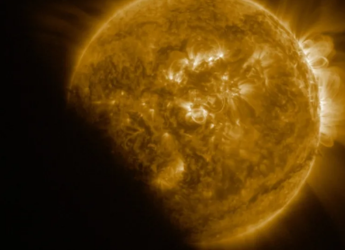
Photo Credit: NASA/SDO
The sun emitted a strong solar flare, peaking at 9:56 p.m. ET on Tuesday, Oct. 8, 2024.
Click Here to Add Gadgets360 As A Trusted Source


Advertisement
A powerful solar storm is predicted to reach Earth on Thursday, 10th October, according to forecasters from the U.S. National Oceanic and Atmospheric Administration (NOAA). The storm could generate stunning auroras and affect radio communications, power grids, and satellites. NOAA's Space Weather Prediction Centre (SWPC) has issued a G4-class geomagnetic storm warning, the second-highest level on their scale. A similar storm was last seen in May of this year, causing dramatic auroral displays.
The solar flare and its consequences
This event stems from a massive solar flare, classified as X1.8, which erupted from the sun on the night of 8th October. The flare was accompanied by a coronal mass ejection (CME), which is now speeding towards Earth. Shawn Dahl, service coordinator at SWPC, explained that the impact could vary depending on how the CME's magnetic field aligns with Earth's. A direct connection would heighten the storm's intensity, while a mismatch might lessen its impact.
Impact on auroras and communications
The SWPC estimates that the solar storm could impact communications, power grids, and satellites. Auroral displays, also known as the northern and southern lights, are expected to be more vivid and visible at lower latitudes, offering a rare sight for observers across the US. Dahl mentioned that the CME is moving at extraordinary speeds, up to 2.9 million miles per hour, and could begin affecting Earth's magnetic field as early as Thursday morning.
What to expect
Geomagnetic storms can also disrupt communication systems and power grids. NOAA encourages aurora watchers to keep an eye on real-time solar wind data and be prepared for potential disruptions in services. The intensity of the auroras will depend on how the storm evolves as it reaches Earth, with the strongest effects possibly appearing in the evening of 10th October.
Comments
Get your daily dose of tech news, reviews, and insights, in under 80 characters on Gadgets 360 Turbo. Connect with fellow tech lovers on our Forum. Follow us on X, Facebook, WhatsApp, Threads and Google News for instant updates. Catch all the action on our YouTube channel.
Further reading:
solar storm, NOAA, Auroras, Geomagnetic Storm, Power Grids, Shawn Dahl, Space Weather, NASA, solar flare, coronal mass ejection
Related Stories


Advertisement
Follow Us




-
04:23
[Partner Content] Your Phone Can Do WAY More Than You Think | OPPO ColorOS 16 -
01:59
Samsung Galaxy Z Fold8 Ultra: Unfold the Ultra Night -
03:24
Apple Pay Launches In India: Supported Devices, Cards And Payments Explained -
00:21
[Sponsored] Samsung Galaxy Z Fold8, Fold8 Ultra -
03:41
[Sponsored] Samsung Galaxy Z Fold8: How It Fits Into an Actor’s Busy Day | Camera, Multitasking & More
-
iQOO Pad Ultra 165Hz AMOLED डिस्प्ले के साथ हुआ लॉन्च
-
Apple Pay की भारत में एंट्री, सीधा iPhone और स्मार्टवॉच से होगी पेमेंट
-
भारत में बच्चों के सोशल मीडिया पर लगेगा बैन? सरकार उठा सकती है बड़ा कदम
-
Oppo F35 सीरीज में मिलेगा 50 मेगापिक्सल का प्राइमरी कैमरा, अगले सप्ताह भारत में लॉन्च
-
Cellecor ने दो वायरलेस माइक के साथ लॉन्च किया Beat Rider पार्टी स्पीकर
Advertisement
Popular on Gadgets
- Samsung Galaxy S26 Ultra
- Motorola Razr Fold
- ChatGPT
- OPPO Find N6
- Mobiles Under Rs. 40,000
- Vivo X300 Ultra
- Asus Zenbook S14
- iQOO 15
- Vivo X300 Pro
- Lenovo Yoga Slim 7i Aura Edition
- iQOO 15R
- Vivo X Fold 5
- Sony PlayStation 5
- HP OmniPad 12
- OnePlus Nord CE 6 Lite
- OnePlus Pad 4
- OPPO F33 Pro 5G
- Cryptocurrency
- HP OmniBook Ultra 14 (2026)
- iPhone 17
- Eureka Forbes AP 355 Room Air Purifier
- Latest Mobile Phones
- Compare Phones
Latest Gadgets
- OPPO K15x
- OPPO K15s
- HMD Vibe 2 Pro 5G
- OPPO K14 Plus 5G
- Lava Shark 2 Pro 5G
- Ai+ Pulse 2 FE
- OPPO Reno 16t
- Itel Zeno 300
- Dell 14 Plus 2-in-1 (AMD Ryzen AI 7 350, 2025)
- Microsoft Surface Laptop, 13-inch (2nd Edition)
- Samsung Galaxy Tab S12+
- Samsung Galaxy Tab S12 Ultra
- Amazfit T-Rex Dual Solar
- OPPO Watch S2
- Toshiba 65-Inch 4K Ultra HD Smart Mini LED QLED TV (65Z670SP)
- Haier M70 Mini LED 65-inch
- Acer Predator Atlas 8
- Asus ROG Ally
- Blue Star 1.5 Ton 5 Star Inverter Split AC (IE518ZNURS)
- Blue Star 2 Ton 3 Star Inverter Window AC (WIE324L)

- About Us
- Sitemaps
- Feedback
- Archives
- Contact Us
- RSS
- Advertise
- Career
- Privacy Policy
- Ethics
- Editorial Policy
- Terms & Conditions
- Complaint Redressal
Download Our Apps
Available in Hindi
© Copyright Red Pixels Ventures Limited 2026. All rights reserved.