-
 Xiaomi Fan Festival 2026 Brings Offers on Flagship Phones, Tablets, Smart TVs, Including Xiaomi 17 Ultra7 April 2026
 -
Redmi Pad 2 Pro 5G Launched in India With 12,000mAh Battery, 12.1-Inch Display: Price, Specifications6 January 2026
-
Redmi Pad 2 Pro 5G Price Range, Chipset Revealed Ahead of India Launch on January 630 December 2025
-
Redmi Pad 2 Pro 5G India Launch Date Announced; Teaser Confirms 12,000mAh Battery22 December 2025
-
Redmi Pad 2 Pro 5G India Launch Teased Soon After Global Debut: Expected Specifications, Features18 December 2025
- Home
- Tablets
- Tablets Features
- Redmi Pad 2 Pro 5G vs OnePlus Pad Go 2 vs Realme Pad 3: Price in India, Specifications Compared
Redmi Pad 2 Pro 5G vs OnePlus Pad Go 2 vs Realme Pad 3: Price in India, Specifications Compared
Price of Redmi Pad 2 Pro 5G starts at Rs. 22,999 in India.
Written by Nithya P Nair, Edited by David Delima | Updated: 28 April 2026 19:09 IST
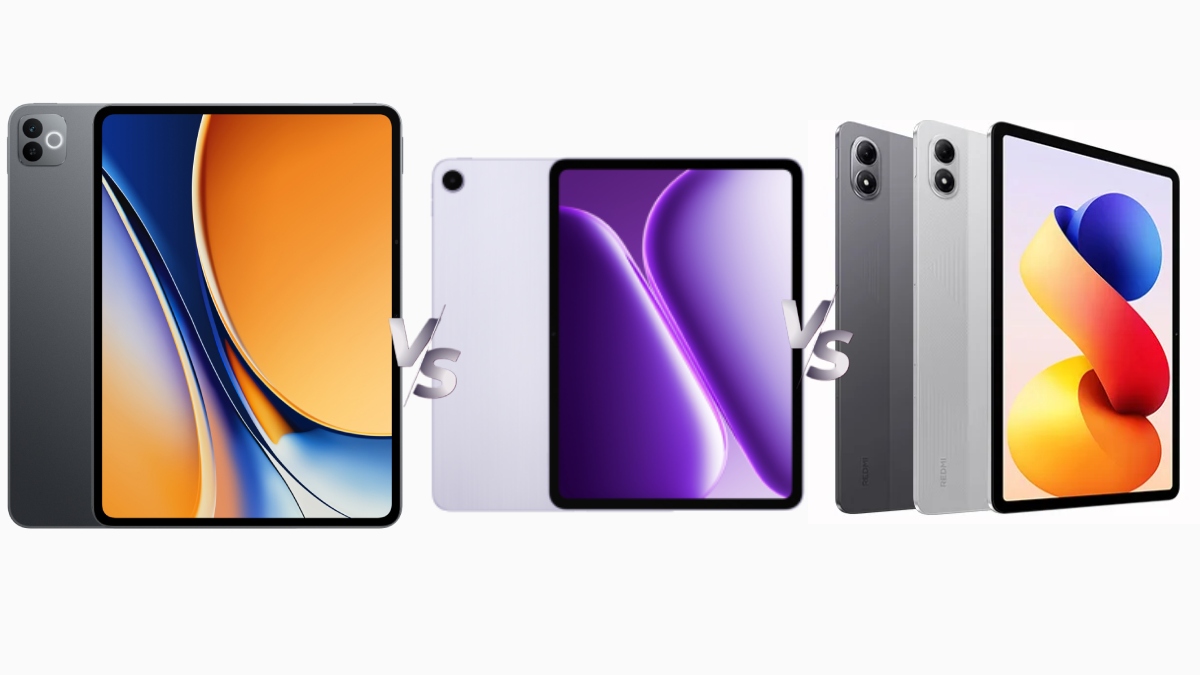
Photo Credit: Realme
Redmi Pad 2 Pro 5G has a single 13-megapixel rear camera
Click Here to Add Gadgets360 As A Trusted Source

Advertisement
Redmi Pad 2 Pro 5G with a 12,000mAh battery and a 12.1-inch display was launched earlier this year in India. The new Redmi tablet has a Snapdragon 7s Gen 4 chipset under the hood and features a 13-megapixel rear camera. With similar pricing and specifications, the new Redmi Pad 2 Pro 5G is poised to compete with the OnePlus Pad Go 2 and Realme Pad 3 in the Indian market. All three models have larger displays with a 120Hz refresh rate and feature quad speakers. They are compatible with different accessories and fall in the mid-range price segment in India.
Let's take a look at the differences and similarities between Redmi Pad 2 Pro 5G, OnePlus Pad Go 2 and Realme Pad 3.
Redmi Pad 2 Pro 5G vs OnePlus Pad Go 2 vs Realme Pad 3: Price in India
Redmi Pad 2 Pro 5G: Price of Redmi Pad 2 Pro 5G starts at Rs. 22,999 for the Wi-Fi-only variant with 8GB RAM + 128GB storage. The same model with Wi-Fi + 5G connectivity is priced at Rs. 25,999. The Wi-Fi + 5G model with 8GB RAM and 256GB of storage costs Rs. 27,999. It is released in Silver and Grey colourways.
OnePlus Pad Go 2: Price of the OnePlus Pad Go 2 is set at Rs. 26,999 for the base model with 8GB of RAM and 128GB storage (Wi-Fi only). The 256GB storage variant with the same amount of RAM and Wi-Fi connectivity costs Rs. 29,999. The 8GB + 256GB model with Wi-Fi and 5G connectivity has a price tag of Rs. 32,999. You can get it in Lavender Drift and Shadow Black (limited to 5G variant) colour options.
Realme Pad 3: Price of the Realme Pad 3 is Rs. 26,999 (Wi-Fi version) for the 8GB RAM + 128GB storage model. The 5G variant with 8GB+128GB and 8GB+256GB RAM and storage are priced at Rs. 29,999 and Rs. 31,999, respectively. It is available in Champagne Gold and Space Grey colours.
Redmi Pad 2 Pro 5G vs OnePlus Pad Go 2 vs Realme Pad 3: Display, OS
Redmi Pad 2 Pro 5G: The new Redmi Pad 2 Pro 5G runs on HyperOS 2 based on Android 15. It is assured to receive five years of OS upgrades and seven years of security updates. It features a 12.1-inch 2.5K (2,560x1,600 pixels) display with Dolby Vision support, up to 120Hz of refresh rate, and 249 ppi pixel density. The display is designed to deliver up to 600 nits of peak brightness.
OnePlus Pad Go 2: The OnePlus Pad Go 2 runs on OxygenOS 16 based on Android 16. The brand has promised five years of software updates for this model. It features a 12.1-inch 2.8K (1,980x2,800 pixels) LCD panel with Dolby Vision support, up to 120Hz adaptive refresh rate, and 284ppi pixel density. The display is rated to offer 600 nits of peak brightness.
Realme Pad 3: Finally, the Realme Pad 3 runs on Android 16-based Realme UI 7.0. It has an 11.61-inch 2.8K(2,000x2,800 pixels) display with a 120Hz refresh rate and 240Hz touch sampling rate. The display is touted to deliver 500 nits typical brightness.
Redmi Pad 2 Pro 5G vs OnePlus Pad Go 2 vs Realme Pad 3: Chipset, Battery
Redmi Pad 2 Pro 5G: The new Redmi Pad 2 Pro 5G has an octa-core 4nm Snapdragon 7s Gen 4 chipset under the hood. It includes Adreno 810 GPU, 8GB of LPDDR4x RAM, and up to 256GB of UFS 2.2 internal storage. You will get a 12,000mAh battery in this model with support for 33W wired fast charging and 27W wired reverse charging.
OnePlus Pad Go 2: A 4nm MediaTek Dimensity 7300-Ultra chipset powers the OnePlus Pad Go 2, paired with 8GB LPDDR5x RAM and up to 256GB of UFS 3.1 storage. It is backed by a 10,050mAh battery with 33W SuperVOOC fast charging (wired) support and 6.5W reverse wired charging support.
Realme Pad 3: Realme has used an octa-core MediaTek Dimensity 7300-Max chipset in the Realme Pad 3, built on a 4nm processor, alongside an Arm Mali-G615 GPU. It features 8GB of RAM, and it is available in 128GB and 256GB storage options, which can be expanded (up to 2TB) via a MicroSD card slot. This model has a 12,200mAh battery with 45W fast charging and 6.5W reverse charging support.
Redmi Pad 2 Pro 5G vs OnePlus Pad Go 2 vs Realme Pad 3: Camera, Dimensions
Redmi Pad 2 Pro 5G: For imaging, the Redmi Pad 2 Pro 5G has a single 13-megapixel camera. It features an 8-megapixel front-facing camera for selfies. It measures 279.80x181.65x7.5mm and weighs 610G.
OnePlus Pad Go 2: For optics, OnePlus Pad Go 2 sports a single 8-megapixel rear camera. On the front, it features an 8-megapixel front-facing camera. It measures around 266.01x192.77x6.83mm. The 5G variant weighs around 599g, while the Wi-Fi variant weighs about 597g.
Realme Pad 3: Like the OnePlus Pad Go 2, the Realme Pad 3 also boasts an 8-megapixel rear camera and an 8-megapixel front-facing camera. It measures 255.60 x 187.03 x 6.60mm and weighs 578g.
The new OnePlus Pad Go 2 supports inputs through the OnePlus Pad Go 2 Stylo (sold separately). The Redmi Pad 2 Pro 5G is also compatible with keyboard and smart pen accessories. Further, all three models have quad speaker units. The Redmi Pad 2 Pro has a quad-speaker setup with Dolby Atmos support, while the Realme Pad 3 has quad speakers with Dolby Audio support.
Redmi Pad 2 Pro 5G vs OnePlus Pad Go 2 vs Realme Pad 3: Which One Should You Buy?
Redmi Pad 2 Pro 5G, OnePlus Pad Go 2 and Realme Pad 3 share several features, such as large displays, quad-speaker setups, and single rear cameras. However, there are many key differences. The Redmi Pad 2 Pro 5G has the most powerful processor and 5G connectivity compared to the other two models. The OnePlus Pad Go 2 stands out with a cleaner user interface and a higher-resolution display. Meanwhile, the Realme Pad 3 is the better option for users who prioritise battery and charging speed, with a 12,200mAh battery and 45W charging support.
FAQs
1 Which tablet offers the largest battery?
Realme Pad 3. It has a 12,200mAh battery with 45W fast charging and 6.5W reverse charging support.
2. Which chipset is used in Redmi Pad 2 Pro 5G?
An octa-core 4nm Snapdragon 7s Gen 4 chipset powers the Redmi Pad 2 Pro 5G.
3. What is the battery capacity of the OnePlus Pad Go 2?
OnePlus Pad Go 2 is backed by a 10,050mAh battery, which supports 33W SuperVOOC fast charging.
Realme Pad 3 vs OnePlus Pad Go 2 vs Redmi Pad 2 Pro 5G comparison

|

|

|
|
| Key Specs | |||
| Display | 11.61-inch | 12.10-inch | 12.10-inch |
| Processor | MediaTek Dimensity 7300-Max | MediaTek Dimensity 7300-Ultra | Snapdragon 7s Gen 4 |
| Resolution | 2000x2800 pixels | 1980x2800 pixels | 2560x1600 pixels |
| RAM | 8GB | 8GB | 6GB |
| OS | Android 16 | Android 16 | Android |
| Storage | 128GB | 256GB | 128GB |
| Battery Capacity | 12200mAh | 10050mAh | 12,000mAh |
| Front Camera | - | 8-megapixel | 8-megapixel |
| Rear Camera | - | 8-megapixel | 8-megapixel |
| GENERAL | |||
| Brand | Realme | OnePlus | Redmi |
| Model | Pad 3 | Pad Go 2 | Pad 2 Pro 5G |
| Release date | January 6, 2026 | December 17, 2025 | September 24, 2025 |
| Launched in India | Yes | Yes | No |
| Dimensions (mm) | 255.60 x 187.03 x 6.60 | - | 279.80 x 181.65 x 7.50 |
| Weight (g) | 578.00 | - | 610.00 |
| Battery capacity (mAh) | 12200 | 10050 | 12,000 |
| Colours | Champagne Gold, Space Grey | Shadow Black, Lavender Drift | Lavender Purple, Silver, and Graphite Gray |
| Removable battery | - | No | No |
| DISPLAY | |||
| Screen size (inches) | 11.61 | 12.10 | 12.10 |
| Resolution | 2000x2800 pixels | 1980x2800 pixels | 2560x1600 pixels |
| Pixels per inch (PPI) | - | 284 | 249 |
| HARDWARE | |||
| Processor | octa-core | octa-core | 1.8GHz MHz octa-core |
| Processor make | MediaTek Dimensity 7300-Max | MediaTek Dimensity 7300-Ultra | Snapdragon 7s Gen 4 |
| RAM | 8GB | 8GB | 6GB |
| Internal storage | 128GB | 256GB | 128GB |
| Expandable storage | Yes | - | Yes |
| Expandable storage type | microSD | - | microSD |
| Expandable storage up to (GB) | - | - | 1024 |
| SOFTWARE | |||
| Operating system | Android 16 | Android 16 | Android |
| Skin | realme UI 7.0 | - | Xiaomi HyperOS 2 |
| CONNECTIVITY | |||
| Bluetooth | Yes | Yes | Yes |
| USB Type-C | - | Yes | Yes |
| Bluetooth version | - | - | 5.40 |
| CAMERA | |||
| Rear camera | - | 8-megapixel | 8-megapixel |
| Front camera | - | 8-megapixel | 8-megapixel |
| Rear flash | - | - | Yes |
| Ratings | |||
| Overall NDTV Rating | - | - | |
| Design Rating | - | - | |
| Display Rating | - | - | |
| Software Rating | - | - | |
| Performance Rating | - | - | |
| Battery Life Rating | - | - | |
| Camera Rating | - | - | |
| Value for Money Rating | - | - | |
| SENSORS | |||
| Accelerometer | - | - | Yes |
| Ambient light sensor | - | - | Yes |
| Compass/ Magnetometer | - | - | Yes |
| Gyroscope | - | - | Yes |
| Temperature sensor | - | - | Yes |
Comments
Get your daily dose of tech news, reviews, and insights, in under 80 characters on Gadgets 360 Turbo. Connect with fellow tech lovers on our Forum. Follow us on X, Facebook, WhatsApp, Threads and Google News for instant updates. Catch all the action on our YouTube channel.
Further reading:
Redmi Pad 2 Pro 5G, OnePlus Pad Go 2, Redmi Pad 2 Pro 5G Price in India, Redmi Pad 2 Pro 5G Specifications, OnePlus Pad Go 2 Price in India, OnePlus Pad Go 2 Specifications, Realme Pad 3, Realme Pad 3 Price in India, Realme Pad 3 Specifications, Redmi Pad 2 Pro 5G vs OnePlus Pad Go 2 vs Realme Pad 3
Related Stories



Redmi Pad 2 Pro 5G vs OnePlus Pad Go 2 vs Realme Pad 3: Price in India, Specifications Compared


Advertisement
Follow Us




-
01:42
[Sponsored] Galaxy Watch9 for Everyday Health Insights | Smarter Wellness Choices -
01:15
[Sponsored] Galaxy Tab S10 Lite for Students: Notes, Solve Math and More -
04:17
[Sponsored] LG NANO 4K UHD AI TV NU885: Gemini Search, Dolby Atmos & 5 Years of Updates -
00:57
[Sponsored] Samsung Galaxy Z Fold8 My Fan Cam in Action: Find the Moment, Then Share It -
01:41
[Sponsored] What Do You Need To Know Before Your Next Run? | Samsung Galaxy Watch Ultra2
-
Flipkart Big Bang Diwali Sale होगी 28 अक्टूबर से शुरू, iPhone 17 पर छूट
-
Tata Punch EV आई सबसे ज्यादा पसंद, 284% की ग्रोथ के साथ बनी नंबर 1 कार
-
Samsung Galaxy S25 FE 5G दिवाली सेल में ₹17 हजार से ज्यादा सस्ता
-
Redmi K100 में मिलेगा 'Snow Rock White' का नया कलर ऑप्शन
-
Flipkart पर फिर से आई iPhone 17 पर डील, ₹19 हजार की सीधी बचत
Advertisement
Popular on Gadgets
- Samsung Galaxy S26 Ultra
- Motorola Razr Fold
- ChatGPT
- OPPO Find N6
- Mobiles Under Rs. 40,000
- Vivo X300 Ultra
- Asus Zenbook S14
- iQOO 15
- Vivo X300 Pro
- Lenovo Yoga Slim 7i Aura Edition
- iQOO 15R
- Vivo X Fold 5
- Sony PlayStation 5
- HP OmniPad 12
- OnePlus Nord CE 6 Lite
- OnePlus Pad 4
- OPPO F33 Pro 5G
- Cryptocurrency
- HP OmniBook Ultra 14 (2026)
- iPhone 17
- Eureka Forbes AP 355 Room Air Purifier
- Latest Mobile Phones
- Compare Phones
Latest Gadgets
- Vivo Y600
- HMD 2660 Flip Senior Edition
- Lava Aura Curve
- Poco X8s
- Samsung Galaxy F70 5G
- Tecno Spark 50S 5G
- Vivo Y600s Pro
- Vivo Y32 (2026)
- Lenovo Yoga 9n 2-in-1
- Lenovo Yoga Pro 9n
- iPad mini (2026)
- Amazon Alexa Tablet 8
- Pebble Qore 2
- Amazfit T-Rex Dual Solar
- Toshiba 65-Inch 4K Ultra HD Smart Mini LED QLED TV (65Z670SP)
- Haier M70 Mini LED 65-inch
- Acer Predator Atlas 8
- Asus ROG Ally
- Blue Star 1.5 Ton 5 Star Inverter Split AC (IE518ZNURS)
- Blue Star 2 Ton 3 Star Inverter Window AC (WIE324L)

- About Us
- Sitemaps
- Feedback
- Archives
- Contact Us
- RSS
- Advertise
- Career
- Privacy Policy
- Ethics
- Editorial Policy
- Terms & Conditions
- Complaint Redressal
Download Our Apps
Available in Hindi
© Copyright Red Pixels Ventures Limited 2026. All rights reserved.