


-
 Everything Apple Launched in March: iPhone 17e, MacBook Neo, AirPods Max 2 and More23 March 2026
 -
iPhone 17e, MacBook Neo, iPad Air, Refreshed MacBook Pro and MacBook Air Models Go on Sale in India: Price, Availability11 March 2026
-
iPhone 17e to MacBook Neo: Here's Everything Apple Launched This Week5 March 2026
-
Samsung Reportedly Rules Out New iPhone Air Rival, Tri-Fold Successor Amid Weak Demand27 February 2026
-
Apple’s March 4 Event Could Bring iPhone 17e, Low-Cost MacBook and iPad Updates: Report23 February 2026
- Home
- Mobiles
- Mobiles News
- iPhone Air’s C1X Chip Performs on Par With Qualcomm's Flagship X80 Modem, Ookla Says
iPhone Air’s C1X Chip Performs on Par With Qualcomm's Flagship X80 Modem, Ookla Says
Apple’s C1X network chip is currently found on the iPhone Air and iPhone 17e.
Written by Dhruv Raghav, Edited by David Delima | Updated: 24 March 2026 11:00 IST
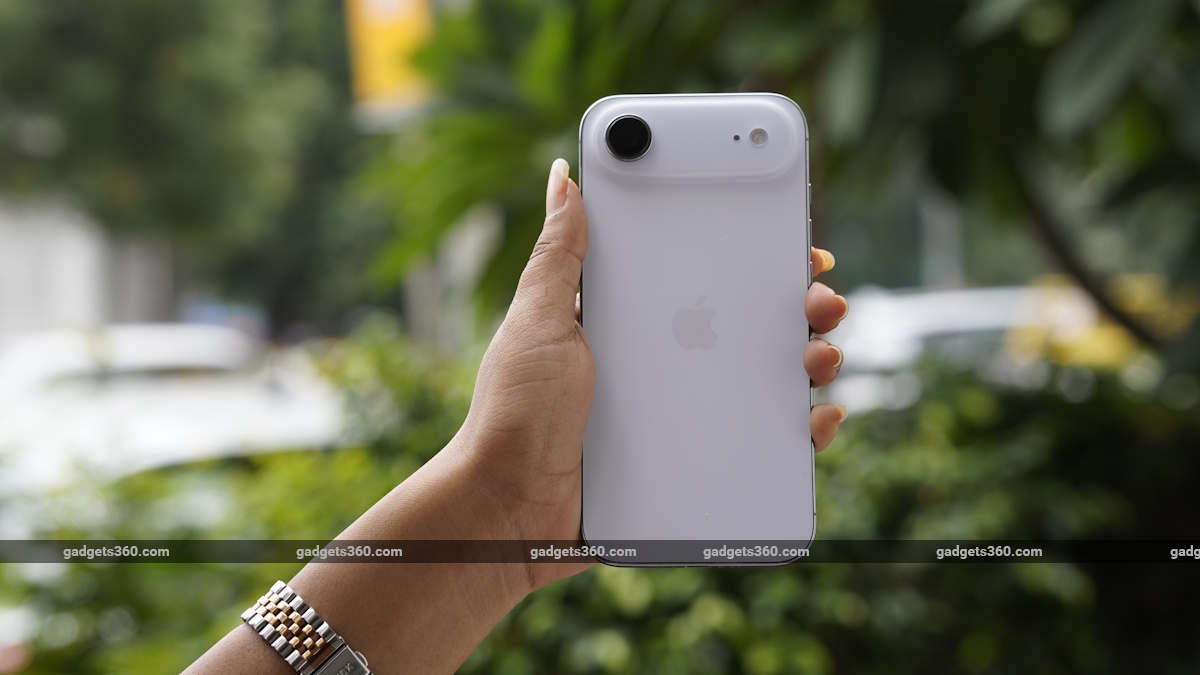
iPhone Air (pictured) features Apple's A19 Pro chipset
Click Here to Add Gadgets360 As A Trusted Source

Advertisement
Apple introduced its new C1X network chip in September last year with the thin and light iPhone Air. Launched earlier this month, the iPhone 17e is also equipped with the same modem. Recently, a report highlighted that the C1X chip failed on a user's iPhone Air when the handset suddenly stopped receiving network signals one morning, which raised doubts about its reliability. However, a report collating network test results from various devices suggests that the Apple Silicon C1X network chip managed to achieve “real-world” performance parity with its competition, which is also found on flagship iPhone models. The new thin and light iPhone model is reportedly also seeing a higher adoption rate than the Plus models.
iPhone Air's C1X Chip Outpaced Qualcomm's Modem on Some Tests
According to a report by Ookla, the Seattle-based network intelligence and diagnosis firm, Apple's proprietary C1X network chip found on the iPhone Air and iPhone 17e has managed to achieve “real-world” parity in latency and download performance with the Qualcomm X80 modem, found on flagship Android phones and iPhone models, including the iPhone 17 Pro Max.
Apple's in-house modem was able to provide similar performance on various networks “in both ideal and challenging conditions”. The report added that Apple's C1X network chip is no longer a compromise over the competition from the chipmaker Qualcomm. Instead, the C1X chip has come out as a “performance equaliser”. However, the report also acknowledged that the upcoming flagship Android phones, scheduled to be launched in the first half of this year, will be equipped with the Qualcomm X85 modem, which is expected to ship with enhanced performance over its predecessor.
Interestingly, Ookla also highlighted that the iPhone Air outpaced the iPhone 17 Pro Max, which uses the Qualcomm X80 chip, in terms of latency. The C1X-equipped iPhone Air managed to outperform the flagship iPhone model on various latency metrics in 19 of 22 markets, based on the speed test data analysed. The report speculates that this could have been possible because of Apple's better modem-to-processor integration, emerging as a “key differentiating point” for the Apple Silicon-powered devices.
However, Apple's proprietary chip reportedly still struggles in some aspects. For example, the Qualcomm X80-equipped iPhone 17 Pro Max retained up to a 32 percent lead in upload speeds. This reportedly suggests that the C1X modem could be limited by its narrower carrier aggregation capability. The report also highlighted that Qualcomm X80's superior upload speed performance is due to the Uplink Carrier Aggregation (UL-CA), which “remains the industry benchmark”.
Ookla's speed test results also indicate that the new iPhone Air, which was launched in September 2025 along with the iPhone 17 series, is seeing a higher adoption rate than the Plus models, with South Korea being the largest market for the thin and light handset, followed by Japan, Sweden, Singapore, Italy, Spain, and UAE.
- REVIEW
- KEY SPECS
- NEWS
- Good
- Incredibly lightweight and super thin
- Stunning display
- Solid performance
- Good primary and selfie cameras
- Bad
- A single-camera sensor at the back
- Slow charging
- Battery life could have been better
- Mono speaker leaves much to be desired
- Expensive
Read detailed Apple iPhone Air review
Display 6.50-inch
Processor Apple A19 Pro
Front Camera 18-megapixel
Rear Camera 48-megapixel
RAM 12GB
Storage 256GB, 512GB, 1TB
OS iOS 26
Resolution 1260x2736 pixels
- KEY SPECS
- NEWS
Display 6.10-inch
Processor Apple A19
Front Camera 12-megapixel
Rear Camera 48-megapixel
RAM 8GB
Storage 256GB, 512GB
OS iOS 26
Resolution 1170x2532 pixels
- REVIEW
- KEY SPECS
- NEWS
- Good
- The boldest redesign since the iPhone X
- Bright and stunning display
- A19 Pro under the hood guarantees excellent performance
- Massive camera upgrade
- Video quality gets a much-needed bump
- Centre Stage camera at the front changes selfie game on iPhones forever
- Improved charging speed
- Bad
- Aluminium body picks up scratches
- Expensive
- Heavier than the 16 Pro Max
Read detailed Apple iPhone 17 Pro Max review
Display 6.90-inch
Processor Apple A19 Pro
Front Camera 18-megapixel
Rear Camera 48-megapixel + 48-megapixel + 48-megapixel
RAM 12GB
Storage 256GB, 512GB, 1TB, 2TB
OS iOS 26
Resolution 1320x2868 pixels
Comments
Get your daily dose of tech news, reviews, and insights, in under 80 characters on Gadgets 360 Turbo. Connect with fellow tech lovers on our Forum. Follow us on X, Facebook, WhatsApp, Threads and Google News for instant updates. Catch all the action on our YouTube channel.
Further reading:
iPhone Air, Apple C1X Modem, Qualcomm X80 Modem, iPhone 17e, iPhone 17 Pro Max, Apple
Related Stories






Advertisement
Follow Us




-
![[Sponsored] Samsung Galaxy S26 Ultra First Look: AI Smartphone for Creators, Gaming & Productivity](https://www.gadgets360.com/static/desktop/images/spacer.png)
02:29
[Sponsored] Samsung Galaxy S26 Ultra First Look: AI Smartphone for Creators, Gaming & Productivity -
04:25
Vivo X200T Review - Full Camera, Gaming & Battery Test | Worth Buying? -
28:31
The Future of Productivity: Logitech's Anatoliy Polyanker On AI, Hybrid Work, And India's Tech Boom -
04:46
Infinix Note Edge 5G Review | Budget 5G Phone With Premium Features? -
04:54
Redmi Note 15 Review: Features, Specifications, Pros, Cons, And Everything Else
-
48MP कैमरा वाला Google Pixel 10a मिल रहा यहां पर सस्ता, जानें पूरा ऑफर
-
GST पोर्टल में कैसे करें लॉगिन, टैक्स से लेकर हर शिकायत का मिलेगा समाधान
-
Xiaomi ने लॉन्च किया Mijia Smart Air Fryer Pro, घर पर बिना गैस बनेगा खाना
-
Poco X8 Pro Max vs Oppo Reno 15C 5G vs Redmi Note 15 Pro+ 5G: कौन सा रहेगा बेहतर?
-
क्रिप्टो एक्सचेंज CoinDCX के को-फाउंडर हुए गिरफ्तार, फ्रॉड का है आरोप
Advertisement
Popular on Gadgets
- Samsung Galaxy Unpacked 2026
- iPhone 17 Pro Max
- ChatGPT
- iOS 26
- Laptop Under 50000
- Smartwatch Under 10000
- Apple Vision Pro
- Oneplus 12
- OnePlus Nord CE 3 Lite 5G
- iPhone 13
- Xiaomi 14 Pro
- Oppo Find N3
- Tecno Spark Go (2023)
- Realme V30
- Best Phones Under 25000
- Samsung Galaxy S24 Series
- Cryptocurrency
- iQoo 12
- Samsung Galaxy S24 Ultra
- Giottus
- Samsung Galaxy Z Flip 5
- Apple 'Scary Fast'
- Housefull 5
- GoPro Hero 12 Black Review
- Invincible Season 2
- JioGlass
- HD Ready TV
- Latest Mobile Phones
- Compare Phones
Latest Gadgets
- Huawei Mate 80 Pro Max Wind Edition
- Huawei Enjoy 90 Plus
- Huawei Enjoy 90 Pro Max
- OPPO A6s 5G
- Poco X8 Pro 5G
- Poco X8 Pro Max 5G
- OPPO K14 5G
- OPPO Find N6
- Xiaomi Book Pro 14
- MacBook Neo
- Lenovo Legion Y700 Gen 5
- Tecno Megapad 2
- boAt Valour Watch 1R
- Xiaomi Watch S5
- Xiaomi QLED TV X Pro 75
- Haier H5E Series
- Asus ROG Ally
- Nintendo Switch Lite
- Haier 1.6 Ton 5 Star Inverter Split AC (HSU19G-MZAID5BN-INV)
- Haier 1.6 Ton 5 Star Inverter Split AC (HSU19G-MZAIM5BN-INV)

- About Us
- Sitemaps
- Feedback
- Archives
- Contact Us
- RSS
- Advertise
- Career
- Privacy Policy
- Ethics
- Editorial Policy
- Terms & Conditions
- Complaint Redressal
Download Our Apps
Available in Hindi
© Copyright Red Pixels Ventures Limited 2026. All rights reserved.