
-
 Scientists Say the Milky Way Might Sit Inside a Massive Dark Matter Sheet8 March 2026
 -
Astronomers Find ‘Impossible’ Galaxy ACDG-2 With Virtually No Stars and a Massive Dark Matter Core20 February 2026
-
James Webb Telescope Finds Galaxies Nearly as Old as the Early Universe11 February 2026
-
Dark Matter May Not Exist, Study Suggests Gravity Works Differently at Cosmic Scales9 February 2026
-
Impossible Neutrino Detected on Earth May Come From an Exploding Primordial Black Hole6 February 2026
- Home
- Science
- Science News
- Fusion Reactors Could Generate Axions, Offering a New Path to Detect Dark Matter
Fusion Reactors Could Generate Axions, Offering a New Path to Detect Dark Matter
A new study suggests fusion reactors could generate axions—hypothetical dark matter particles—when fast neutrons collide with reactor walls.
Written by Gadgets 360 Staff | Updated: 29 December 2025 22:40 IST
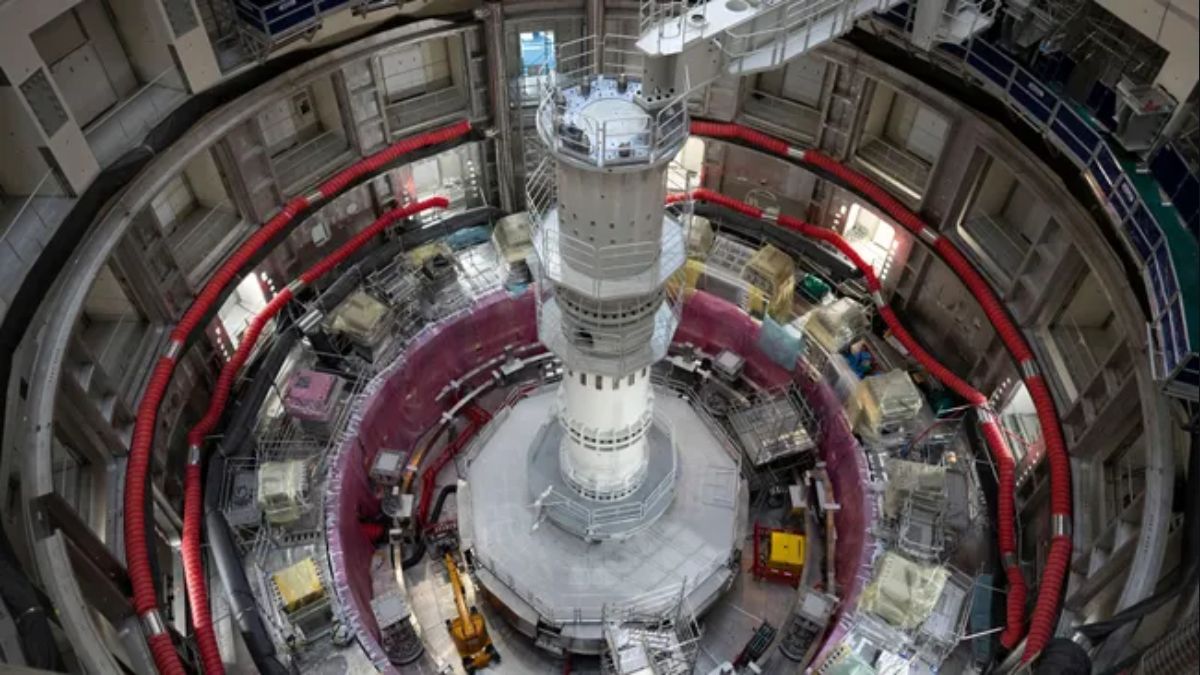
Photo Credit: Alamy
Physicists propose fusion reactors could generate axions, offering clues to dark matter.
Click Here to Add Gadgets360 As A Trusted Source


Advertisement
Fusion reactors are designed for clean power, but a new study by U.S. physicists suggests they could also be mysterious dark matter factories. Axions, theorized dark matter particles, may be born when fusion-generated neutrons smash into reactor walls. Dark matter makes up most of the universe's matter yet has never been directly seen. The key insight is that axions would not come from the hot fusion plasma but from the reactor's solid walls.
Fusion reactors as dark matter factories
According to the new study, fast neutrons from deuterium–tritium fusion slam into reactor walls, triggering nuclear reactions that could emit axions. The team models a lithium-lined reactor vessel (as planned in ITER) and finds its huge neutron flux could yield dark-sector particles. Neutron capture can leave nuclei excited, which then emit axions as they de-excite; these 'ghost' particles would slip out through the reactor's shielding. Although the Sun generates many more axions, researchers say fusion reactors offer a new production channel.
Implications and detection
The results suggest that future fusion plants may serve as dark matter research facilities. A heavy-water tank close to the reactor, for instance, could serve as a detector since an axion striking deuterium splits it into a neutron and a proton, leaving a distinct signal. It would be possible to separate genuine signals from backgrounds such as solar neutrinos by comparing data with the reactor on and off. The experiment would still limit theoretical models even in the absence of axions. To test the concept, more work will include intricate reactor simulations and unique detector designs.
Comments
Get your daily dose of tech news, reviews, and insights, in under 80 characters on Gadgets 360 Turbo. Connect with fellow tech lovers on our Forum. Follow us on X, Facebook, WhatsApp, Threads and Google News for instant updates. Catch all the action on our YouTube channel.
Related Stories






Advertisement
Follow Us




-
05:05
Goboult Mustang Racer Smartwatch Review: Should You Get This Mustang Smartwatch? -
04:58
OnePlus Nord Buds 4 Pro Review: Specs, Sound Quality, ANC, and Battery Backup Tested -
02:29
[Sponsored] Samsung Galaxy S26 Ultra First Look: AI Smartphone for Creators, Gaming & Productivity -
04:25
Vivo X200T Review - Full Camera, Gaming & Battery Test | Worth Buying? -
28:31
The Future of Productivity: Logitech's Anatoliy Polyanker On AI, Hybrid Work, And India's Tech Boom
-
200 मेगापिक्सल कैमरा, 7000mAh बैटरी के साथ Vivo V70 FE लॉन्च, जानें सबकुछ
-
Redmi Note 15 SE भारत में लेटेस्ट AI फीचर्स, 5800mAh बैटरी के साथ लॉन्च
-
5100mAh बैटरी, 50MP कैमरा वाला Pixel फोन हुआ 4700 रुपये सस्ता
-
Ola की इलेक्ट्रिक मोटरसाइकिल Roadster X+ पर भारी डिस्काउंट, प्राइस में हुई 60,000 रुपये की कमी
Advertisement
Popular on Gadgets
- Samsung Galaxy Unpacked 2026
- iPhone 17 Pro Max
- ChatGPT
- iOS 26
- Laptop Under 50000
- Smartwatch Under 10000
- Apple Vision Pro
- Oneplus 12
- OnePlus Nord CE 3 Lite 5G
- iPhone 13
- Xiaomi 14 Pro
- Oppo Find N3
- Tecno Spark Go (2023)
- Realme V30
- Best Phones Under 25000
- Samsung Galaxy S24 Series
- Cryptocurrency
- iQoo 12
- Samsung Galaxy S24 Ultra
- Giottus
- Samsung Galaxy Z Flip 5
- Apple 'Scary Fast'
- Housefull 5
- GoPro Hero 12 Black Review
- Invincible Season 2
- JioGlass
- HD Ready TV
- Latest Mobile Phones
- Compare Phones
Latest Gadgets
- Nord 6
- Honor X80i
- Honor Play 80 Pro
- Redmi Note 15 SE 5G
- Redmi A7 Pro
- OPPO K15 Pro
- OPPO K15 Pro+
- Lava Bold N2 Lite
- Xiaomi Book Pro 14
- MacBook Neo
- Vivo Pad 6 Pro
- Lenovo Legion Y700 Gen 5
- boAt Valour Watch 1R
- Xiaomi Watch S5
- Xiaomi QLED TV X Pro 75
- Haier H5E Series
- Asus ROG Ally
- Nintendo Switch Lite
- Haier 1.6 Ton 5 Star Inverter Split AC (HSU19G-MZAID5BN-INV)
- Haier 1.6 Ton 5 Star Inverter Split AC (HSU19G-MZAIM5BN-INV)

- About Us
- Sitemaps
- Feedback
- Archives
- Contact Us
- RSS
- Advertise
- Career
- Privacy Policy
- Ethics
- Editorial Policy
- Terms & Conditions
- Complaint Redressal
Download Our Apps
Available in Hindi
© Copyright Red Pixels Ventures Limited 2026. All rights reserved.