-
 Fusion Reactors Could Generate Axions, Offering a New Path to Detect Dark Matter29 December 2025
 -
Astrophysicists Map Invisible Universe Using Warped Galaxies to Reveal Dark Matter25 December 2025
-
New Telescope Data Deepens the Mystery of How Fast the Universe Is Expanding5 December 2025
-
Dark Matter and Dark Energy Might Not Exist After All, New Study Suggests8 November 2025
-
Is the Universe Slowing Down? Astronomers Detect Signs of Fading Dark Energy6 November 2025
- Home
- Science
- Science News
- Is Space Sticky? New Study Challenges Standard Dark Energy Theory
Is Space Sticky? New Study Challenges Standard Dark Energy Theory
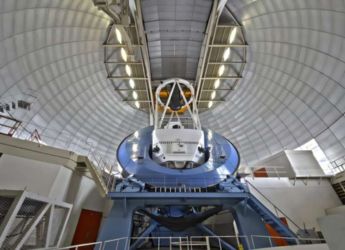
New DESI observations hint that galaxies are receding faster than expected, challenging the standard Lambda-CDM model.
Written by Gadgets 360 Staff | Updated: 18 January 2026 19:10 IST
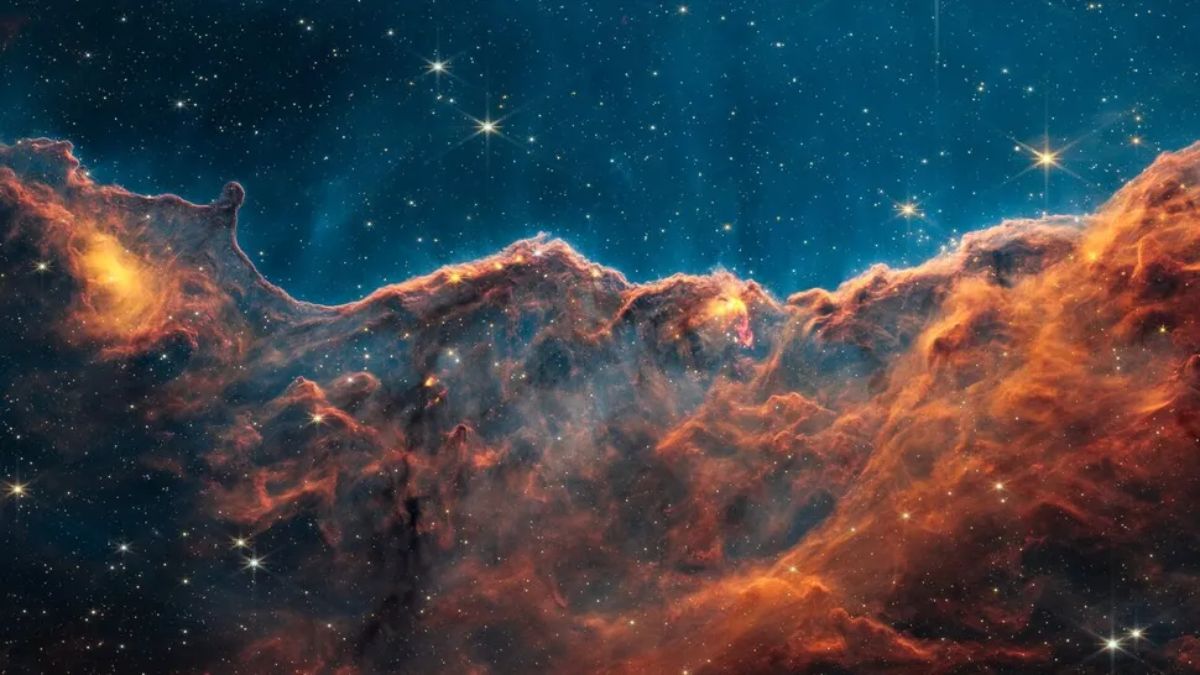
Photo Credit: NASA
New theory says space may act like a viscous fluid, explaining energy puzzles
Click Here to Add Gadgets360 As A Trusted Source


Advertisement
In the standard Lambda-CDM model, dark energy – the mysterious force behind the universe's accelerating expansion – is treated as a constant background. But new data from the Dark Energy Spectroscopic Instrument (DESI) hint at a mismatch with this model: galaxies appear to be receding slightly faster than predicted. A recent preprint suggests that treating space as a viscous ‘sticky fluid' might reconcile the difference. This idea implies the cosmos may be ‘stickier' than thought, with a ghostly viscosity slowing its growth.
Space as a viscous fluid
According to Khan's paper, the vacuum might have a “bulk viscosity”, meaning a subtle drag on cosmic expansion. For example, viscosity is like the difference between pouring water and honey; space would be slightly sticky as it expands. He imagines space as an elastic medium: tiny longitudinal “phonon” vibrations (sound waves in the vacuum) generate this viscosity.
This ghostly resistance would slow expansion, and the model reportedly matches DESI data: the observed cosmic slowdown aligns with these predictions. It may resolve a noted tension: DESI found galaxies receding slightly faster than Lambda-CDM predicts.
Implications and outlook
As Khan's preprint is unreferenced and unpublished, it is advised to be treated with care. Sutter himself advises, “We should approach cautiously—this is only a hypothesis.” This hypothesis, if correct, would be ‘a paradigm shift in our understanding of the nature of the vacuum of space.' Future work by DESI and Euclid telescopes is needed to verify if such ‘spectres' are in fact the correct description of the expansion of our cosmos. For the time being, the ‘Lambda CDM model' is in its usual place.
Comments
Get your daily dose of tech news, reviews, and insights, in under 80 characters on Gadgets 360 Turbo. Connect with fellow tech lovers on our Forum. Follow us on X, Facebook, WhatsApp, Threads and Google News for instant updates. Catch all the action on our YouTube channel.
Related Stories




Advertisement
Follow Us




-
04:25
Vivo X200T Review - Full Camera, Gaming & Battery Test | Worth Buying? -
28:31
The Future of Productivity: Logitech's Anatoliy Polyanker On AI, Hybrid Work, And India's Tech Boom -
04:46
Infinix Note Edge 5G Review | Budget 5G Phone With Premium Features? -
04:54
Redmi Note 15 Review: Features, Specifications, Pros, Cons, And Everything Else -
04:38
Realme 16 Pro Review | Camera, Performance & Battery Test | Best Mid-Range Phone?
-
50MP कैमरा, 7200mAh बैटरी के साथ Vivo T5x 5G भारत में लॉन्च, जानें
-
दुनिया का पहला रोबोट गिरफ्तार? महिला को डराया, फिर पुलिस ने क्या किया
-
Samsung Galaxy M17e 5G भारत में लॉन्च: 6000mAh बैटरी के साथ गजब फीचर्स
-
11 हजार सस्ता खरीदें Oppo का 7000mAh बैटरी वाला फोन! Flipkart ने कर दिया धमाका
-
अनलिमिटेड इंटरनेट, 22 से ज्यादा OTT और कॉलिंग वाले ब्रॉडबैंड प्लान, सिर्फ 1 रिचार्ज में मिलेगा सबकुछ
Advertisement
Popular on Gadgets
- Samsung Galaxy Unpacked 2026
- iPhone 17 Pro Max
- ChatGPT
- iOS 26
- Laptop Under 50000
- Smartwatch Under 10000
- Apple Vision Pro
- Oneplus 12
- OnePlus Nord CE 3 Lite 5G
- iPhone 13
- Xiaomi 14 Pro
- Oppo Find N3
- Tecno Spark Go (2023)
- Realme V30
- Best Phones Under 25000
- Samsung Galaxy S24 Series
- Cryptocurrency
- iQoo 12
- Samsung Galaxy S24 Ultra
- Giottus
- Samsung Galaxy Z Flip 5
- Apple 'Scary Fast'
- Housefull 5
- GoPro Hero 12 Black Review
- Invincible Season 2
- JioGlass
- HD Ready TV
- Latest Mobile Phones
- Compare Phones
Latest Gadgets
- Poco X8 Pro 5G
- Poco X8 Pro Max 5G
- OPPO K14 5G
- OPPO Find N6
- Vivo T5x 5G
- Samsung Galaxy M17e 5G
- Lava Bold 2 5G
- Motorola Edge 70 Fusion+
- MacBook Neo
- MacBook Pro 16-Inch (M5 Max, 2026)
- Tecno Megapad 2
- Apple iPad Air 13-Inch (2026) Wi-Fi + Cellular
- OPPO Watch X3
- Tecno Watch GT 1S
- Xiaomi QLED TV X Pro 75
- Haier H5E Series
- Asus ROG Ally
- Nintendo Switch Lite
- Haier 1.6 Ton 5 Star Inverter Split AC (HSU19G-MZAID5BN-INV)
- Haier 1.6 Ton 5 Star Inverter Split AC (HSU19G-MZAIM5BN-INV)

- About Us
- Sitemaps
- Feedback
- Archives
- Contact Us
- RSS
- Advertise
- Career
- Privacy Policy
- Ethics
- Editorial Policy
- Terms & Conditions
- Complaint Redressal
Download Our Apps
Available in Hindi
© Copyright Red Pixels Ventures Limited 2026. All rights reserved.