-
 Total Solar Eclipse Today: How to Watch Live Online, Timings, Safety Tips, and More12 August 2026
 -
JWST Watches HD 80606 bExoplanet Heat Up by 1,100 Degrees in Hours19 June 2026
-
Chandra Captures Sharpest-Ever X-Ray View of M87 Black Hole Jet18 June 2026
-
Astrophotographer Captures Giant Human-Shaped Solar Prominence8 June 2026
-
Blue Origin’s New Glenn Rocket Explodes During Pre-Launch Test in Florida29 May 2026
- Home
- Science
- Science News
- NASA Begins Building Dragonfly Drone; Nuclear Powered ‘Octocopter’ Enters Testing Ahead of 2028 Launch
NASA Begins Building Dragonfly Drone; Nuclear-Powered ‘Octocopter’ Enters Testing Ahead of 2028 Launch
The Dragonfly spacecraft is scheduled to launch in 2028 using SpaceX's Falcon Heavy rocket, which will take six years to travel to Titan.
Written by Gadgets 360 Staff | Updated: 15 March 2026 20:03 IST
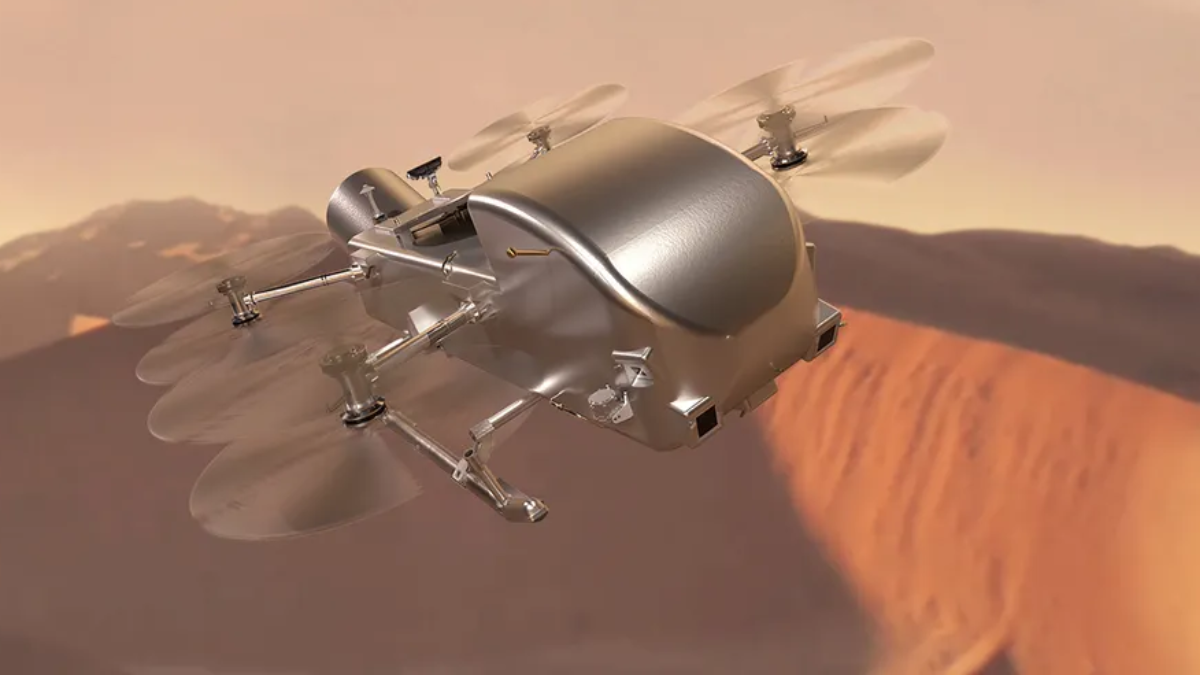
Photo Credit: NASA
NASA builds Dragonfly to explore Titan; launch 2028, arrival 2034
Click Here to Add Gadgets360 As A Trusted Source


Advertisement
NASA has begun construction of the Dragonfly mission, which will utilise a nuclear-powered rotorcraft lander to investigate Saturn's largest moon, Titan. The car-sized drone is scheduled to launch in 2028 and will conduct a comprehensive surface survey using its Multi-Mission Radioisotope Thermoelectric Generator (MMRTG). The spacecraft will complete a six-year cruise, arriving at Titan in 2034 to perform detailed exploration activities across the moon's surface.
Design and Technology
According to NASA, Dragonfly is a car-sized, eight-rotor lander designed for the dense atmosphere of Titan. While the Mars helicopter, or Ingenuity, is roughly the size of a tissue box, Dragonfly is a fully autonomous and nuclear-powered machine. Engineers at the Johns Hopkins APL laboratory, a NASA facility, are currently working to integrate the “brain” and power of the Dragonfly mission.
Titan's dense atmosphere and low gravity combine to create a powerful lift for the Dragonfly, but the moon's extreme cold and 1-hour signal delay present a challenge.
Science Goals and Timeline
The Dragonfly spacecraft is scheduled to launch in 2028 using SpaceX's Falcon Heavy rocket, which will take six years to travel to Titan. The landing site will be near the equator of Titan in a region known as Selk Crater. The area contains organic materials, which scientists believe developed through the existence of past liquid water.
The eight-rotor drone will begin operations by departing from this area to explore different territories. The drone will carry cameras, spectrometers and various sensors, which will be used to study complex organic materials present on Titan's surface.
The drone will also be able to test samples to be used in further research in the future.
Comments
Get your daily dose of tech news, reviews, and insights, in under 80 characters on Gadgets 360 Turbo. Connect with fellow tech lovers on our Forum. Follow us on X, Facebook, WhatsApp, Threads and Google News for instant updates. Catch all the action on our YouTube channel.
Related Stories





NASA Begins Building Dragonfly Drone; Nuclear-Powered ‘Octocopter’ Enters Testing Ahead of 2028 Launch


Advertisement
Follow Us




-
05:20
Samsung Galaxy Watch Ultra 2 Review: Is This the Best Android Smartwatch? -
07:01
Samsung Galaxy Z Fold 8 Review: Is This the Best Foldable Phone? -
06:39
Samsung Galaxy Z Fold8 Ultra Review: Cameras, Battery, Performance Tested -
04:33
[Sponsored] JBL Live 780NC: Great Sound, Perfect Comfort, Smart ANC & 80-Hour Battery -
12:04
[Partner Content] OPPO Reno16 Series Deep Dive: Built for Creators?
Advertisement
Popular on Gadgets
- Samsung Galaxy S26 Ultra
- Motorola Razr Fold
- ChatGPT
- OPPO Find N6
- Mobiles Under Rs. 40,000
- Vivo X300 Ultra
- Asus Zenbook S14
- iQOO 15
- Vivo X300 Pro
- Lenovo Yoga Slim 7i Aura Edition
- iQOO 15R
- Vivo X Fold 5
- Sony PlayStation 5
- HP OmniPad 12
- OnePlus Nord CE 6 Lite
- OnePlus Pad 4
- OPPO F33 Pro 5G
- Cryptocurrency
- HP OmniBook Ultra 14 (2026)
- iPhone 17
- Eureka Forbes AP 355 Room Air Purifier
- Latest Mobile Phones
- Compare Phones
Latest Gadgets
- iPhone Duo
- OPPO A7 Pro
- Huawei Mate XT 2 Ultimate Design
- Realme 16 Pro Harry Potter Edition
- Samsung Galaxy A07s
- Huawei Pura X View
- Tecno Camon Slim 5G
- iQOO Z11xa
- Acer Aspire G 3D 16
- Acer Swift Air 16 (2026)
- Xiaomi Pad 9 Pro
- Xiaomi Pad 9
- Apple Watch Ultra 4
- Apple Watch Series 12
- Haier M70 Mini LED 65-inch
- Xiaomi TV FX Mini LED 65
- Acer Predator Atlas 8
- Asus ROG Ally
- Blue Star 1.5 Ton 5 Star Inverter Split AC (IE518ZNURS)
- Blue Star 2 Ton 3 Star Inverter Window AC (WIE324L)

- About Us
- Sitemaps
- Feedback
- Archives
- Contact Us
- RSS
- Advertise
- Career
- Privacy Policy
- Ethics
- Editorial Policy
- Terms & Conditions
- Complaint Redressal
Download Our Apps
Available in Hindi
© Copyright Red Pixels Ventures Limited 2026. All rights reserved.