-
 Blue Origin Delays NASA Mars Launch Amid Weather and FAA Restrictions17 November 2025
 -
Blue Origin Joins SpaceX in Orbital Booster Reuse Era With New Glenn’s Successful Launch and Landing14 November 2025
-
NASA’s ESCAPADE Mission Will Send Twin Probes to Uncover Mars’s Atmospheric Secrets10 November 2025
-
Bad Weather Delays Blue Origin’s New Glenn Launch of NASA’s Mars Mission10 November 2025
-
Blue Origin Prepares New Glenn Rocket for NASA’s ESCAPADE Mars Mission12 October 2025
- Home
- Science
- Science News
- NASA’s ESCAPADE Mission to Study Space Weather Between Earth and Mars
NASA’s ESCAPADE Mission to Study Space Weather Between Earth and Mars
NASA’s ESCAPADE mission will launch twin satellites to orbit Mars and study how solar wind interacts with the planet’s magnetic field and atmosphere.
Written by Gadgets 360 Staff | Updated: 27 February 2026 21:14 IST
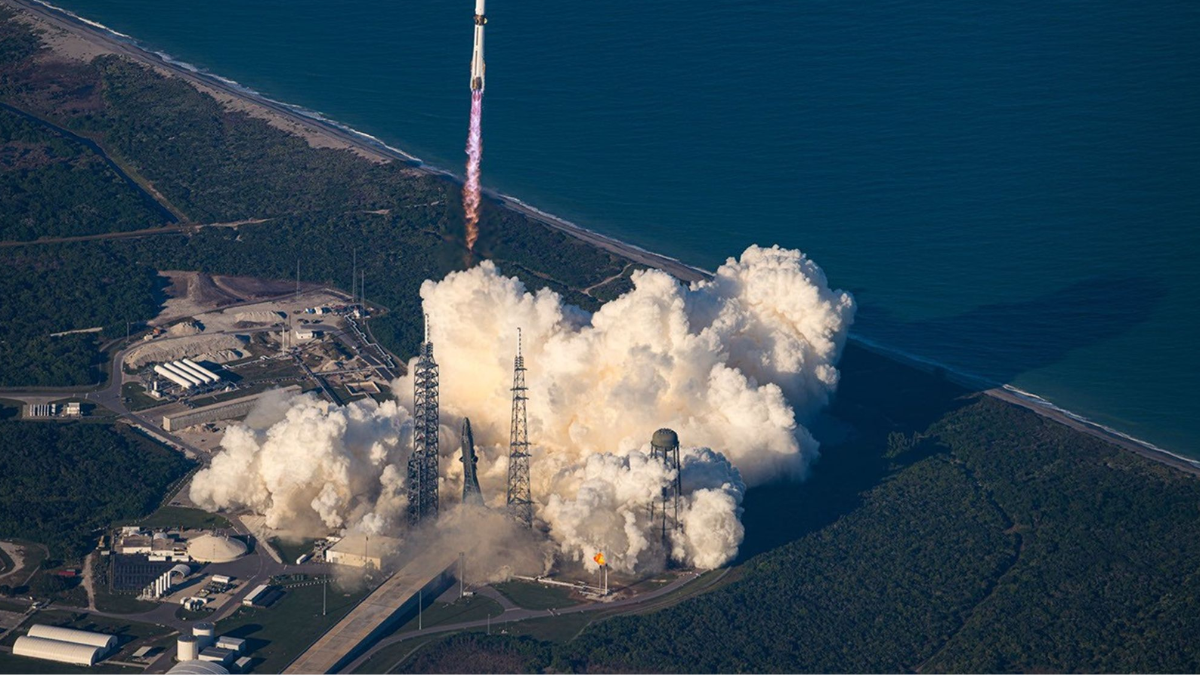
Photo Credit: NASA
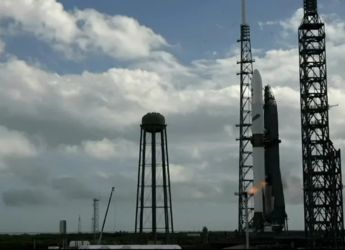
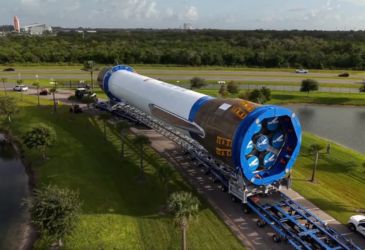
NASA’s ESCAPADE mission launches aboard Blue Origin’s New Glenn from Cape Canaveral.
Click Here to Add Gadgets360 As A Trusted Source


Advertisement
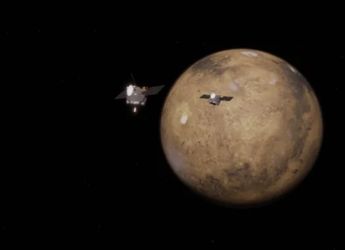
NASA's ESCAPADE mission will use two identical satellites to study space weather from Earth to Mars. Scheduled to launch in 2025, it will observe how the Sun's charged particles (the solar wind) interact with Mars's magnetic field and atmosphere. By tracking these interactions, ESCAPADE aims to learn why Mars lost its once-thick atmosphere (which may have supported liquid water and life) and how solar storms shape the planet's environment.
NASA's Twin-Satellite Mars Mission
According to NASA, ESCAPADE is the first mission to pair two orbiters around Mars. The two spacecraft will orbit Mars side by side, giving a stereo image of the Martian magnetosphere. They will follow each other in the same orbit and then change to different orbits, enabling scientists to establish cause and effect. For example, one spacecraft can measure the solar wind conditions while the other spacecraft measures the atmospheric response. The two-point sampling will show how solar wind causes atmospheric escape and climate change on Mars. ESCAPADE is a UC Berkeley mission that is scheduled to arrive at Mars in 2027.
Why Space Weather Matters
Space weather is a term that describes conditions caused by the Sun, such as solar flares, coronal mass ejections, and the solar wind. Solar storms can affect Earth's technology, causing currents that destroy power grids or disrupt communications and GPS. Solar storms also increase the radiation exposure of astronauts. Mars, on the other hand, is more affected by space weather because it does not have a magnetic shield to protect it from the solar wind, which has stripped Mars of its atmosphere, making it the planet it is today.
Comments
Get your daily dose of tech news, reviews, and insights, in under 80 characters on Gadgets 360 Turbo. Connect with fellow tech lovers on our Forum. Follow us on X, Facebook, WhatsApp, Threads and Google News for instant updates. Catch all the action on our YouTube channel.
Further reading:
ESCAPADE, NASA, Mars, Solar Wind, Space Weather, Atmospheric Escape, UC Berkeley, Planetary Science
Related Stories



Advertisement
Follow Us




-
04:49
Realme 16 Review: Air Design, 7000mAh, And More | Best Phone Under 35000 In 2026? -
05:05
Goboult Mustang Racer Smartwatch Review: Should You Get This Mustang Smartwatch? -
04:58
OnePlus Nord Buds 4 Pro Review: Specs, Sound Quality, ANC, and Battery Backup Tested -
02:29
[Sponsored] Samsung Galaxy S26 Ultra First Look: AI Smartphone for Creators, Gaming & Productivity -
04:25
Vivo X200T Review - Full Camera, Gaming & Battery Test | Worth Buying?
-
50MP कैमरा वाले Google Pixel फोन पर 49 हजार रुपये का गजब डिस्काउंट, देखें
-
LPG के लिए घर बैठे ऑनलाइन कैसे करें ई-केवाईसी, नहीं रुकेगा सिलेंडर
-
Infinix Note 60 Pro vs Realme 16 5G vs Vivo V60e: कौन सा फोन है बेस्ट
-
भारत में लॉन्च के बाद छाया Realme 16 5G, पुराने मॉडल से 150% ज्यादा बिक्री!
-
10 हजार सस्ता से खरीदें Vivo का लेटेस्ट फोन, 7200mAh बैटरी, 50MP कैमरा
Advertisement
Popular on Gadgets
- Samsung Galaxy Unpacked 2026
- iPhone 17 Pro Max
- ChatGPT
- iOS 26
- Laptop Under 50000
- Smartwatch Under 10000
- Apple Vision Pro
- Oneplus 12
- OnePlus Nord CE 3 Lite 5G
- iPhone 13
- Xiaomi 14 Pro
- Oppo Find N3
- Tecno Spark Go (2023)
- Realme V30
- Best Phones Under 25000
- Samsung Galaxy S24 Series
- Cryptocurrency
- iQoo 12
- Samsung Galaxy S24 Ultra
- Giottus
- Samsung Galaxy Z Flip 5
- Apple 'Scary Fast'
- Housefull 5
- GoPro Hero 12 Black Review
- Invincible Season 2
- JioGlass
- HD Ready TV
- Latest Mobile Phones
- Compare Phones
Latest Gadgets
- Vivo T5 Pro 5G
- OPPO F33 5G
- OPPO F33 Pro 5G
- Redmi A7 Pro 5G
- Redmi R70m 5G
- Redmi R70 5G
- OPPO A6s Pro
- Realme Narzo 100 Lite 5G
- Asus Zenbook S14
- Asus Vivobook 16 (2026)
- Moto Pad (2026)
- Vivo Pad 6 Pro
- boAt Valour Watch 1R
- Xiaomi Watch S5
- Xiaomi QLED TV X Pro 75
- Haier H5E Series
- Asus ROG Ally
- Nintendo Switch Lite
- Haier 1.6 Ton 5 Star Inverter Split AC (HSU19G-MZAID5BN-INV)
- Haier 1.6 Ton 5 Star Inverter Split AC (HSU19G-MZAIM5BN-INV)

- About Us
- Sitemaps
- Feedback
- Archives
- Contact Us
- RSS
- Advertise
- Career
- Privacy Policy
- Ethics
- Editorial Policy
- Terms & Conditions
- Complaint Redressal
Download Our Apps
Available in Hindi
© Copyright Red Pixels Ventures Limited 2026. All rights reserved.