-
 Artemis 2: Astronauts Aboard Orion Spacecraft Begin Journey Towards the Moon on Day 23 April 2026
 -
iPhones in Deep Space: NASA Breaks Rules for Artemis 2 Crew; 5 Key Facts2 April 2026
-
Artemis II Launched: NASA’s First Crewed Mission in 50 Years Aims for the Moon2 April 2026
-
Artemis 2: NASA's Astronaut Moon Mission Explained in Five Points1 April 2026
-
Hubble Telescope Captures Comet Reversing Its Rotation for the First Time27 March 2026
- Home
- Science
- Science News
- New Study Predicts Cosmic ‘Big Crunch’ Could End Everything in 20 Billion Years
New Study Predicts Cosmic ‘Big Crunch’ Could End Everything in 20 Billion Years
The expansion could stop in about 11 billion years, with the universe then contracting to a final collapse 20 billion years from now.
Written by Gadgets 360 Staff | Updated: 17 February 2026 18:14 IST
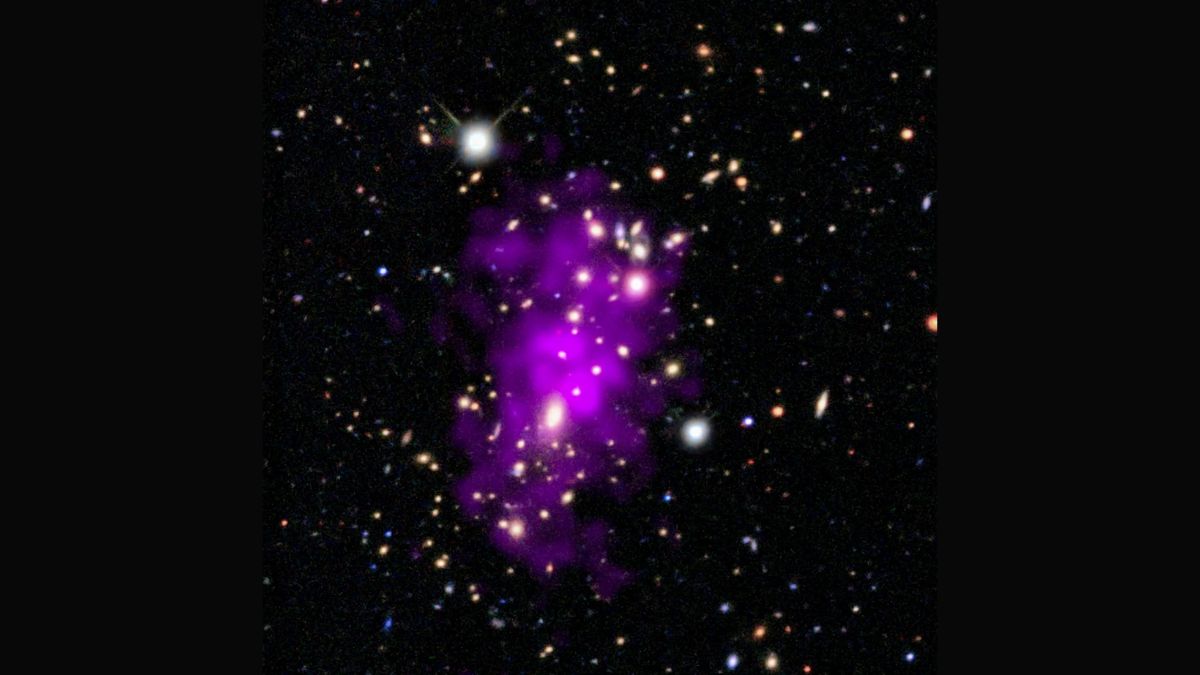
Photo Credit: NASA
The universe may not fade forever, but it could snap back in a Big Crunch in 20 billion years
Click Here to Add Gadgets360 As A Trusted Source


Advertisement
Recent research suggests that our universe could eventually reverse its expansion and collapse in a "Big Crunch." In a new study, astrophysicists (including Cornell's Henry Tye) analyzed data from major dark energy surveys and proposed that dark energy may weaken over time. They estimate that expansion will stop in about 11 billion years, with the universe then contracting to a final collapse 20 billion years from now.
Big Crunch Predicted by New Model
According to the news sources, a group of researchers, led by Cornell physicist Henry Tye, with co-authors Hoang Luu and Yu-Cheng Qiu, has proposed a model that incorporates data from the Dark Energy Survey and the DESI telescope. Their model involves the existence of a very light new particle (an axion) and a “negative” cosmological constant.
By matching their model to observations, they have found that the expansion of the universe will slow down, reach a maximum in about 11 billion years, and then reverse. Consequently, the universe would eventually collapse in a "Big Crunch" about 33.3 billion years after the Big Bang, or approximately 20 billion years from now.
Context and Future Tests
Standard cosmology considers dark energy to be a constant. The new model, on the other hand, allows dark energy to vary over time. In fact, new data from DES (Dark Energy Survey) and DESI (Dark Energy Spectroscopic Instrument) indicate that dark energy could be more complex than a simple cosmological constant. However, other scientists advise caution regarding these findings.
“Extraordinary claims require extraordinary evidence,” and the authors of the study themselves admit to large uncertainties.
Future surveys, such as the ESA Euclid mission, NASA's SPHEREx, or the Vera Rubin Observatory, will provide more accurate data on dark energy to test these predictions.
Comments
Get your daily dose of tech news, reviews, and insights, in under 80 characters on Gadgets 360 Turbo. Connect with fellow tech lovers on our Forum. Follow us on X, Facebook, WhatsApp, Threads and Google News for instant updates. Catch all the action on our YouTube channel.
Related Stories



Advertisement
Follow Us




-
05:05
Goboult Mustang Racer Smartwatch Review: Should You Get This Mustang Smartwatch? -
04:58
OnePlus Nord Buds 4 Pro Review: Specs, Sound Quality, ANC, and Battery Backup Tested -
02:29
[Sponsored] Samsung Galaxy S26 Ultra First Look: AI Smartphone for Creators, Gaming & Productivity -
04:25
Vivo X200T Review - Full Camera, Gaming & Battery Test | Worth Buying? -
28:31
The Future of Productivity: Logitech's Anatoliy Polyanker On AI, Hybrid Work, And India's Tech Boom
-
Redmi 15A 5G की सेल शुरू, जानें कितने में मिल रहा 6300mAh बैटरी वाला फोन
-
7300mAh बैटरी, 50MP कैमरा वाले OnePlus फोन पर बंपर डिस्काउंट, जानें
-
Zepto बेच रहा 24 हजार रुपये सस्ता iPhone 17 Pro Max, सबसे तगड़ा डिस्काउंट
-
क्या AI आपको गलत बातों पर यकीन दिला रहा है? ये नई रिसर्च आपके होश उड़ा देगी!
-
महंगे हो रहे स्मार्टफोन! Xiaomi ने बताई असली वजह
Advertisement
Popular on Gadgets
- Samsung Galaxy Unpacked 2026
- iPhone 17 Pro Max
- ChatGPT
- iOS 26
- Laptop Under 50000
- Smartwatch Under 10000
- Apple Vision Pro
- Oneplus 12
- OnePlus Nord CE 3 Lite 5G
- iPhone 13
- Xiaomi 14 Pro
- Oppo Find N3
- Tecno Spark Go (2023)
- Realme V30
- Best Phones Under 25000
- Samsung Galaxy S24 Series
- Cryptocurrency
- iQoo 12
- Samsung Galaxy S24 Ultra
- Giottus
- Samsung Galaxy Z Flip 5
- Apple 'Scary Fast'
- Housefull 5
- GoPro Hero 12 Black Review
- Invincible Season 2
- JioGlass
- HD Ready TV
- Latest Mobile Phones
- Compare Phones
Latest Gadgets
- Honor Play 80
- Nord 6
- Honor X80i
- Honor Play 80 Pro
- Redmi Note 15 SE 5G
- Redmi A7 Pro
- OPPO K15 Pro
- OPPO K15 Pro+
- Xiaomi Book Pro 14
- MacBook Neo
- Vivo Pad 6 Pro
- Lenovo Legion Y700 Gen 5
- boAt Valour Watch 1R
- Xiaomi Watch S5
- Xiaomi QLED TV X Pro 75
- Haier H5E Series
- Asus ROG Ally
- Nintendo Switch Lite
- Haier 1.6 Ton 5 Star Inverter Split AC (HSU19G-MZAID5BN-INV)
- Haier 1.6 Ton 5 Star Inverter Split AC (HSU19G-MZAIM5BN-INV)

- About Us
- Sitemaps
- Feedback
- Archives
- Contact Us
- RSS
- Advertise
- Career
- Privacy Policy
- Ethics
- Editorial Policy
- Terms & Conditions
- Complaint Redressal
Download Our Apps
Available in Hindi
© Copyright Red Pixels Ventures Limited 2026. All rights reserved.