-
 Google Maps’ New Gemini Feature to Reportedly Let You Chat About Places and Routes11 February 2026
 -
Google Maps Could Soon Let Users Edit Listings Using Gemini: Report4 February 2026
-
Google Maps Is Adding Gemini Support for Walking and Cycling Navigation30 January 2026
-
Google Maps Audio Navigation Problems Could Affect Driver Safety, Make Navigation Confusing: Report12 January 2026
-
Google Maps Updated With Power Saving Mode; Know How to Use It on Your Pixel 10 Series Smartphone28 November 2025
Google Maps Gets Gemini-Powered ‘Ask Maps’ Feature; Adds Immersive Navigation for Driving
The AI-powered experience is claimed to be built on information about more than 300 million places available on Google Maps.
Written by Shaurya Tomer, Edited by Ketan Pratap | Updated: 13 March 2026 09:24 IST
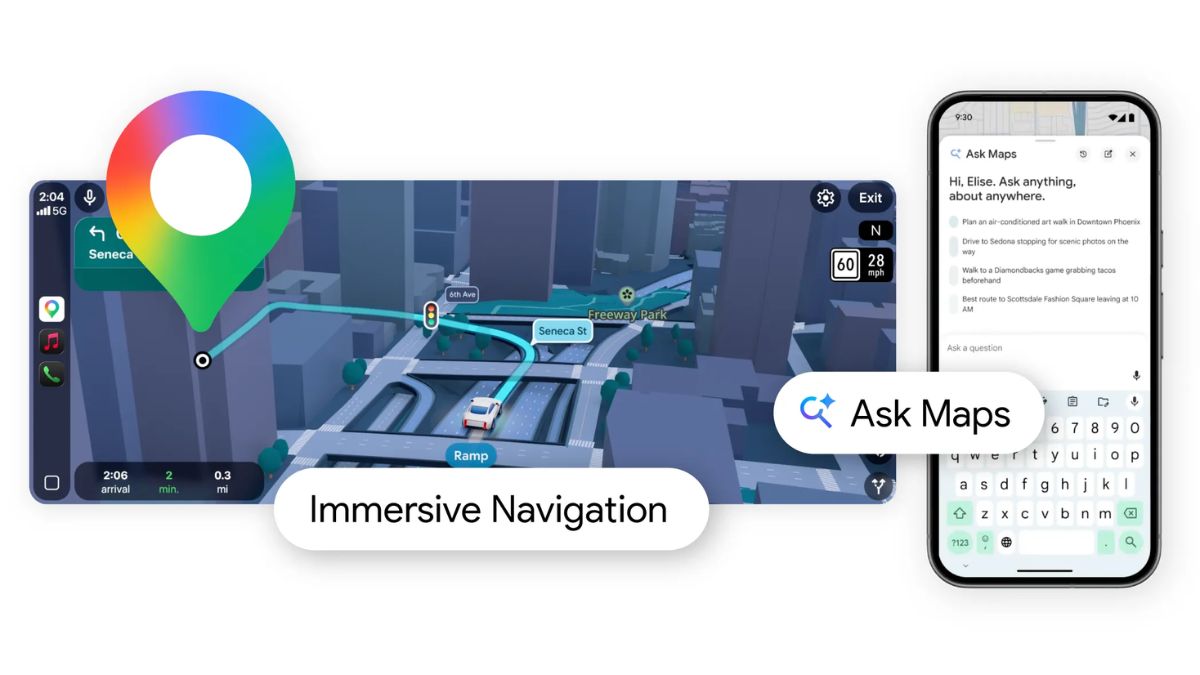
Photo Credit: Google
Both features are powered by Google's Gemini AI models
Click Here to Add Gadgets360 As A Trusted Source

Advertisement
Google on Thursday announced a new feature for Google Maps, which lets users ask complex, real-world questions about places directly within the app. The feature, dubbed Ask Maps, allows users to ask natural language queries and receive AI-generated answers grounded in Maps data. Alongside, the tech giant also rolled out Immersive Navigation, calling it the as the biggest update to driving in Google Maps in more than a decade.
New Google Maps Features
The Ask Maps feature combines the Mountain View-based tech giant's Gemini AI models with the platform's extensive mapping database to help users get answers that traditional maps could not provide before. There is a new Ask Maps button within the app, which allows users to ask questions using either text or voice, Google explained in a blog post.
For example, users can ask queries such as whether it is better to drive or take the metro to a destination at a particular time, or where they can grab a coffee along the way. The company claims Google Maps analyses traffic conditions, estimated travel time, and nearby locations to provide suggestions along with navigation directions.
Apart from this, it can also help with trip planning and location discovery. For instance, users planning a night out can ask questions such as where they can watch a live sports match while enjoying vegetarian appetisers. Ask Maps then scans available data to surface relevant suggestions and insights, such as popular menu items, atmosphere during match days, or whether valet parking is available.
The feature can personalise responses based on a user's activity in the app, too. It takes into account the places users have previously searched for or saved in Maps. Giving an example, Google explained that if a user typically looks for vegetarian restaurants, the AI feature can prioritise similar options when suggesting places to eat in a new city, providing recommendations that better match the user's preferences.
The conversational interface also supports follow-up questions, as per Google. Users can refine their search by asking additional queries, such as which venue offers easier parking or better accessibility.
The AI-powered experience is claimed to be built on information about more than 300 million places available on Google Maps. The system is also said to leverage insights from a global community of more than 500 million contributors who provide reviews, photos, ratings, and updates about places.
The Ask Maps feature has begun rolling out in India and the US on Android and iOS versions of Google Maps. It is currently available in English, with Hindi support expected to arrive soon.
Immersive Navigation for Driving
Alongside Ask Maps, Google has also announced Immersive Navigation. It is touted as the biggest update to driving in Google Maps in more than a decade. As per the company, the app gets redesigned visuals that make driving guidance clearer and more intuitive. Following the update, Google Maps can display a 3D representation of the surrounding environment, showing buildings, terrain, and overpasses along the route.
The app also highlights key road details such as lanes, crosswalks, traffic lights, and stop signs when they are relevant, as per the company. This spatial understanding of routes is also powered by Gemini models, which analyse real-world imagery from Street View and aerial photographs.
Google Maps will also provide a broader preview of the route ahead to help drivers better anticipate upcoming turns or lane changes. Voice navigation instructions have also been updated to sound more conversational.
Apart from this, the app will help drivers understand trade-offs between alternate routes by showing options such as a faster route that includes tolls or a slightly longer route with less traffic. Maps will also notify them about disruptions such as road construction or crashes, using reports contributed by its community of drivers.
Google says Immersive Navigation is starting to roll out in the US and will expand over the coming months to supported Android and iOS devices, as well as vehicles that support CarPlay, Android Auto, and cars with Google built-in.
Comments
Get your daily dose of tech news, reviews, and insights, in under 80 characters on Gadgets 360 Turbo. Connect with fellow tech lovers on our Forum. Follow us on X, Facebook, WhatsApp, Threads and Google News for instant updates. Catch all the action on our YouTube channel.
Related Stories


Advertisement
Follow Us




-

04:54
Redmi Note 15 Review: Features, Specifications, Pros, Cons, And Everything Else -
04:38
Realme 16 Pro Review | Camera, Performance & Battery Test | Best Mid-Range Phone? -
02:14
Inside Amazon's Big AI Play at AI Impact Summit 2026 -
00:34
[Sponsored] Why Startup Founders Are Choosing AI Laptops? -
00:30
[Sponsored] Why Galaxy Tab S10 FE Is the Perfect Tablet for Students?
Advertisement
Popular on Gadgets
- Samsung Galaxy Unpacked 2026
- iPhone 17 Pro Max
- ChatGPT
- iOS 26
- Laptop Under 50000
- Smartwatch Under 10000
- Apple Vision Pro
- Oneplus 12
- OnePlus Nord CE 3 Lite 5G
- iPhone 13
- Xiaomi 14 Pro
- Oppo Find N3
- Tecno Spark Go (2023)
- Realme V30
- Best Phones Under 25000
- Samsung Galaxy S24 Series
- Cryptocurrency
- iQoo 12
- Samsung Galaxy S24 Ultra
- Giottus
- Samsung Galaxy Z Flip 5
- Apple 'Scary Fast'
- Housefull 5
- GoPro Hero 12 Black Review
- Invincible Season 2
- JioGlass
- HD Ready TV
- Latest Mobile Phones
- Compare Phones
Latest Gadgets
- Motorola Edge 70 Fusion+
- iQOO Z11x 5G
- Vivo Y51 Pro 5G
- Itel Zeno 100
- Poco C85x 5G
- Realme Note 80
- Vivo V70 FE
- Realme C83 5G
- MacBook Neo
- MacBook Pro 16-Inch (M5 Max, 2026)
- Tecno Megapad 2
- Apple iPad Air 13-Inch (2026) Wi-Fi + Cellular
- Tecno Watch GT 1S
- Huawei Watch GT Runner 2
- Xiaomi QLED TV X Pro 75
- Haier H5E Series
- Asus ROG Ally
- Nintendo Switch Lite
- Haier 1.6 Ton 5 Star Inverter Split AC (HSU19G-MZAID5BN-INV)
- Haier 1.6 Ton 5 Star Inverter Split AC (HSU19G-MZAIM5BN-INV)

- About Us
- Sitemaps
- Feedback
- Archives
- Contact Us
- RSS
- Advertise
- Career
- Privacy Policy
- Ethics
- Editorial Policy
- Terms & Conditions
- Complaint Redressal
Download Our Apps
Available in Hindi
© Copyright Red Pixels Ventures Limited 2026. All rights reserved.