-
 Scientists Say the Milky Way Might Sit Inside a Massive Dark Matter Sheet8 March 2026
 -
James Webb Telescope Finds Galaxies Nearly as Old as the Early Universe11 February 2026
-
Dark Matter May Not Exist, Study Suggests Gravity Works Differently at Cosmic Scales9 February 2026
-
Impossible Neutrino Detected on Earth May Come From an Exploding Primordial Black Hole6 February 2026
-
James Webb Helps Astronomers Chart the Universe’s Hidden Dark Matter27 January 2026
- Home
- Science
- Science News
- Astronomers Find ‘Impossible’ Galaxy ACDG 2 With Virtually No Stars and a Massive Dark Matter Core
Astronomers Find ‘Impossible’ Galaxy ACDG-2 With Virtually No Stars and a Massive Dark Matter Core
Detected through its globular clusters, the galaxy contains just six million suns’ worth of starlight and is composed of about 99% dark matter.
Written by Gadgets 360 Staff | Updated: 20 February 2026 20:57 IST
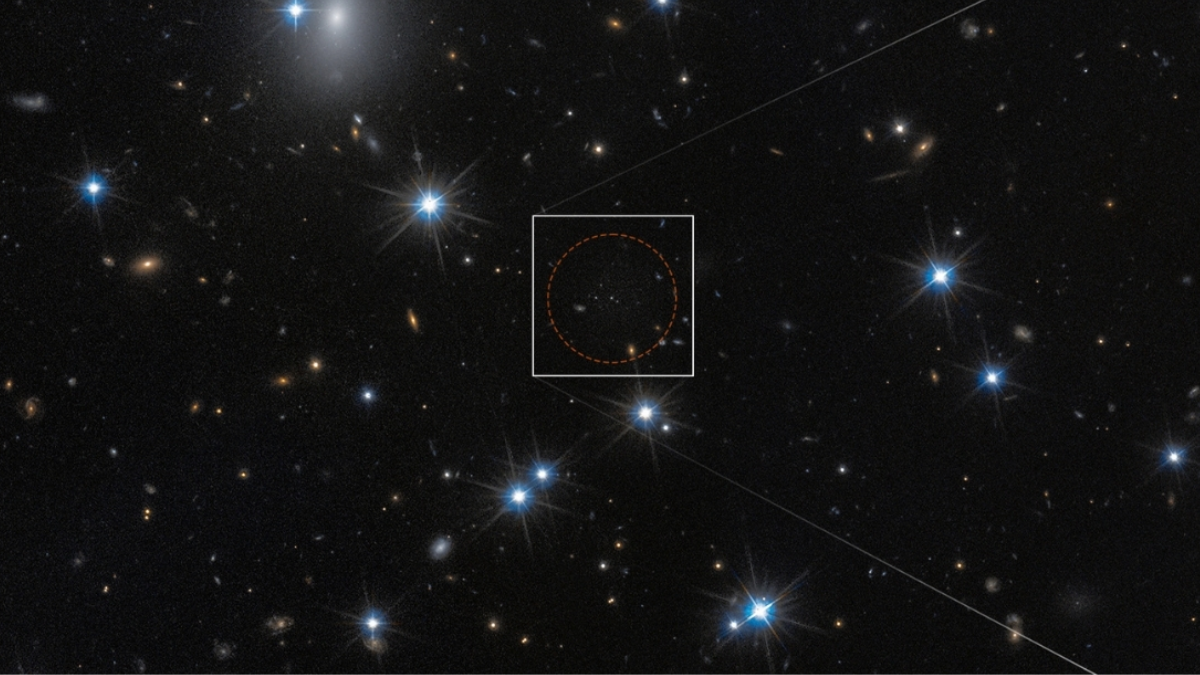
Photo Credit: NASA / ESA
Hubble, Euclid, Subaru spot CDG-2, faint Perseus galaxy of 99% dark matter.
Click Here to Add Gadgets360 As A Trusted Source


Advertisement
Astronomers have found a faint galaxy that consists almost entirely of dark matter. The object CDG-2 is located in the Perseus galaxy cluster and is 300 million light-years away from Earth. It could be the most dark-matter-dominated galaxy that has ever been found. The discovery was made by a group of researchers led by Dayi (David) Li of the University of Toronto using data from the Hubble Space Telescope, Euclid, and Subaru telescopes.
Detecting an Invisible Galaxy
According to NASA, the search for the “hidden” galaxy was not conducted by looking for the stars, but rather by looking for the globular star clusters, which are spherical concentrations of stars orbiting galaxies.
The researchers used data from the Hubble Space Telescope, the Euclid telescope from the European Space Agency, and the Subaru telescope from Japan to identify four dense globular star clusters in the Perseus cluster, which is 300 million light-years away.
The researchers combined images from the Hubble, Euclid, and Subaru telescopes to reveal a faint glow around the clusters.
A Dark-Matter Dominated Galaxy
Analysis indicates that CDG-2 has a total starlight of only six million suns (16% of which is in its star clusters), and that 99% of its total mass is dark matter. According to the lead author, Li, this is the first galaxy to be discovered solely on the basis of its globular clusters.
The researchers hypothesize that CDG-2 probably lost most of its gas due to gravitational interactions within the Perseus cluster, resulting in a galaxy composed almost entirely of dark matter and star clusters. Future surveys using telescopes such as NASA's Roman Space Telescope or the Vera C. Rubin Observatory might detect additional dark galaxies.
Comments
Get your daily dose of tech news, reviews, and insights, in under 80 characters on Gadgets 360 Turbo. Connect with fellow tech lovers on our Forum. Follow us on X, Facebook, WhatsApp, Threads and Google News for instant updates. Catch all the action on our YouTube channel.
Further reading:
Dark Matter, Perseus Galaxy Cluster, CDG-2, Hubble Space Telescope, Euclid Telescope, Subaru Telescope, Globular Clusters, Galaxy Discovery
Related Stories
Astronomers Find ‘Impossible’ Galaxy ACDG-2 With Virtually No Stars and a Massive Dark Matter Core


Advertisement
Follow Us




-
05:05
Goboult Mustang Racer Smartwatch Review: Should You Get This Mustang Smartwatch? -
04:58
OnePlus Nord Buds 4 Pro Review: Specs, Sound Quality, ANC, and Battery Backup Tested -
02:29
[Sponsored] Samsung Galaxy S26 Ultra First Look: AI Smartphone for Creators, Gaming & Productivity -
04:25
Vivo X200T Review - Full Camera, Gaming & Battery Test | Worth Buying? -
28:31
The Future of Productivity: Logitech's Anatoliy Polyanker On AI, Hybrid Work, And India's Tech Boom
-
9 हजार रुपये सस्ता मिल रहा Samsung का 200MP कैमरा वाला फ्लैगशिप फोन
-
PF में अपनी एग्जिट तारीख कैसे करें अपडेट, तभी निकाल पाएंगे पैसा
-
iQOO 15 Apex की सेल शुरू, 6 हजार का डिस्काउंट, जानें फीचर्स और कीमत
-
Apple के फोल्डेबल आईफोन में क्रीज घटाने के लिए हो सकता है 3D प्रिंटेड हिंज का इस्तेमाल
-
एक चार्जर से लैपटॉप, फोन, टैबलेट सब चार्ज! Stuffcool Zeno 100W चार्जिंग स्टेशन भारत में लॉन्च
Advertisement
Popular on Gadgets
- Samsung Galaxy Unpacked 2026
- iPhone 17 Pro Max
- ChatGPT
- iOS 26
- Laptop Under 50000
- Smartwatch Under 10000
- Apple Vision Pro
- Oneplus 12
- OnePlus Nord CE 3 Lite 5G
- iPhone 13
- Xiaomi 14 Pro
- Oppo Find N3
- Tecno Spark Go (2023)
- Realme V30
- Best Phones Under 25000
- Samsung Galaxy S24 Series
- Cryptocurrency
- iQoo 12
- Samsung Galaxy S24 Ultra
- Giottus
- Samsung Galaxy Z Flip 5
- Apple 'Scary Fast'
- Housefull 5
- GoPro Hero 12 Black Review
- Invincible Season 2
- JioGlass
- HD Ready TV
- Latest Mobile Phones
- Compare Phones
Latest Gadgets
- Honor Play 80
- Nord 6
- Honor X80i
- Honor Play 80 Pro
- Redmi Note 15 SE 5G
- Redmi A7 Pro
- OPPO K15 Pro
- OPPO K15 Pro+
- Xiaomi Book Pro 14
- MacBook Neo
- Vivo Pad 6 Pro
- Lenovo Legion Y700 Gen 5
- boAt Valour Watch 1R
- Xiaomi Watch S5
- Xiaomi QLED TV X Pro 75
- Haier H5E Series
- Asus ROG Ally
- Nintendo Switch Lite
- Haier 1.6 Ton 5 Star Inverter Split AC (HSU19G-MZAID5BN-INV)
- Haier 1.6 Ton 5 Star Inverter Split AC (HSU19G-MZAIM5BN-INV)

- About Us
- Sitemaps
- Feedback
- Archives
- Contact Us
- RSS
- Advertise
- Career
- Privacy Policy
- Ethics
- Editorial Policy
- Terms & Conditions
- Complaint Redressal
Download Our Apps
Available in Hindi
© Copyright Red Pixels Ventures Limited 2026. All rights reserved.