-
 James Webb Telescope Captures Rare Infrared Footprints of Io and Ganymede Inside Jupiter’s Auroras11 March 2026
 -
NASA’s Webb Telescope Confirms Asteroid 2024 YR4 Will Safely Pass the Moon in 20329 March 2026
-
NASA's James Webb Space Telescope Confirms Asteroid 2024 YR4 Will Not Strike the Moon6 March 2026
-
James Webb Telescope Captures Stunning Infrared View of Exposed Cranium Nebula26 February 2026
-
James Webb Telescope Maps Uranus in 3D for the First Time; Data Reveals Hidden Storms, Methane Clouds25 February 2026
- Home
- Science
- Science News
- James Webb Captures Stunning Infrared Image of the Helix Nebula Eye of God
James Webb Captures Stunning Infrared Image of the Helix Nebula Eye of God
NASA’s James Webb Space Telescope has captured a striking infrared image of the Helix Nebula, revealing glowing filaments and comet-like knots around a dead Sun-like star. The view offers a preview of how our own Sun may look billions of years from now.
Written by Gadgets 360 Staff | Updated: 23 January 2026 23:00 IST
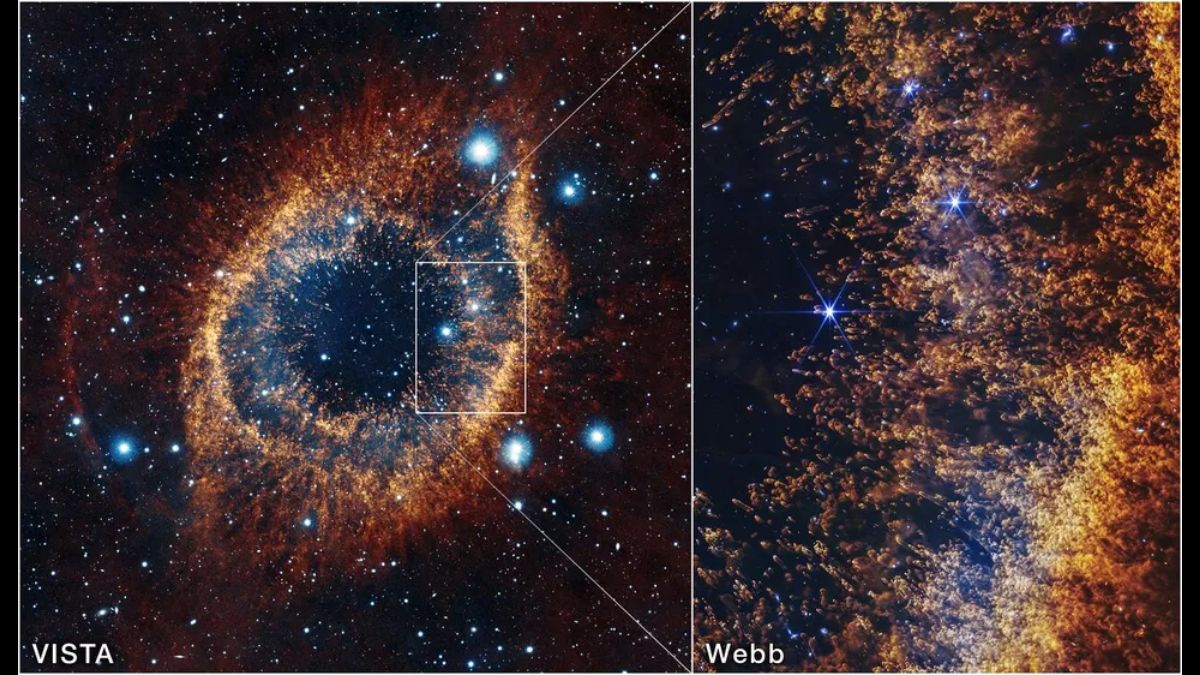
Photo Credit: NASA, ESA, CSA, STScI, A. Pagan (STScI)
James Webb reveals Helix Nebula filaments, knots, previewing fate of Sun-like stars
Click Here to Add Gadgets360 As A Trusted Source


Advertisement
Scientists were able to capture a clear infrared image of the Helix Nebula, commonly known as the “Eye of God,” using NASA's James Webb Space Telescope. This glowing ring is what envelops a dead Sun-like star (turned white dwarf) located 650 light-years away. The image shows highlights such as filaments and bubble-like structures that some observers have likened to a “cosmic lava lamp,” giving a preview of our Sun's eventual death in glory.
Webb Reveals Nebula's Fiery Filaments
According to the reports, Webb's new infrared image reveals the Helix Nebula's structure in detail. The telescope's near-infrared camera captured thousands of glowing knots and pillar-like streamers of gas (sometimes called cometary knots) radiating from the nebula's inner ring. These fiery filaments form where stellar winds, fast, hot gas from the dying star, slam into cooler, slower shells of gas and dust ejected earlier in the star's life. In the image's colour scheme, blue marks the hottest gas near the star, yellow shows warm molecular gas, and red highlights the coolest, dust-rich regions.
The Fate of Sun-Like Stars
Our Sun will go through the same process in about 5 billion years' time, shedding its outer layers to become a white dwarf star. As NASA describes, the close-up image provided by the launch of the Webb Telescope tells us how “stars recycle their material back into the cosmos, seeding new stars and planets”. Essentially, the “Eye of God” above stands as a cosmic crystal ball in which the layers of gas illustrate the final sighs of a dying star, as well as the building blocks of brand-new stars and planets.
Comments
Get your daily dose of tech news, reviews, and insights, in under 80 characters on Gadgets 360 Turbo. Connect with fellow tech lovers on our Forum. Follow us on X, Facebook, WhatsApp, Threads and Google News for instant updates. Catch all the action on our YouTube channel.
Further reading:
James Webb Space Telescope, Helix Nebula, Eye of God, planetary nebula, white dwarf
Related Stories





Advertisement
Follow Us




-
05:05
Goboult Mustang Racer Smartwatch Review: Should You Get This Mustang Smartwatch? -
04:58
OnePlus Nord Buds 4 Pro Review: Specs, Sound Quality, ANC, and Battery Backup Tested -
02:29
[Sponsored] Samsung Galaxy S26 Ultra First Look: AI Smartphone for Creators, Gaming & Productivity -
04:25
Vivo X200T Review - Full Camera, Gaming & Battery Test | Worth Buying? -
28:31
The Future of Productivity: Logitech's Anatoliy Polyanker On AI, Hybrid Work, And India's Tech Boom
Advertisement
Popular on Gadgets
- Samsung Galaxy Unpacked 2026
- iPhone 17 Pro Max
- ChatGPT
- iOS 26
- Laptop Under 50000
- Smartwatch Under 10000
- Apple Vision Pro
- Oneplus 12
- OnePlus Nord CE 3 Lite 5G
- iPhone 13
- Xiaomi 14 Pro
- Oppo Find N3
- Tecno Spark Go (2023)
- Realme V30
- Best Phones Under 25000
- Samsung Galaxy S24 Series
- Cryptocurrency
- iQoo 12
- Samsung Galaxy S24 Ultra
- Giottus
- Samsung Galaxy Z Flip 5
- Apple 'Scary Fast'
- Housefull 5
- GoPro Hero 12 Black Review
- Invincible Season 2
- JioGlass
- HD Ready TV
- Latest Mobile Phones
- Compare Phones
Latest Gadgets
- Honor Play 80
- Nord 6
- Honor X80i
- Honor Play 80 Pro
- Redmi Note 15 SE 5G
- Redmi A7 Pro
- OPPO K15 Pro
- OPPO K15 Pro+
- Xiaomi Book Pro 14
- MacBook Neo
- Vivo Pad 6 Pro
- Lenovo Legion Y700 Gen 5
- boAt Valour Watch 1R
- Xiaomi Watch S5
- Xiaomi QLED TV X Pro 75
- Haier H5E Series
- Asus ROG Ally
- Nintendo Switch Lite
- Haier 1.6 Ton 5 Star Inverter Split AC (HSU19G-MZAID5BN-INV)
- Haier 1.6 Ton 5 Star Inverter Split AC (HSU19G-MZAIM5BN-INV)

- About Us
- Sitemaps
- Feedback
- Archives
- Contact Us
- RSS
- Advertise
- Career
- Privacy Policy
- Ethics
- Editorial Policy
- Terms & Conditions
- Complaint Redressal
Download Our Apps
Available in Hindi
© Copyright Red Pixels Ventures Limited 2026. All rights reserved.