-
 Video: Self-Driving Tesla Car Fails to Detect Child-Sized Dummy on Road10 August 2022
 -
Last Minute Issues: Elon Musk On Delay In Tesla's Next FSD Update16 August 2021
-
Elon Musk Tweets on Full Self-Driving Beta V9 as Tesla Releases New Software Update13 July 2021
-
Tesla Settles Lawsuit Over Autopilot Source Code of Electric Vehicles With Ex-Employee16 April 2021
-
Honda to Sell Limited Batch of Level 3 Self-Driving Car Legend in Japan4 March 2021
- Home
- Science
- Science News
- Self Driving Cars Could Prevent Over 1 Million Road Injuries Across the U.S. by 2035
Self-Driving Cars Could Prevent Over 1 Million Road Injuries Across the U.S. by 2035
Self-driving cars could prevent over 1 million injuries in the U.S. by 2035, reducing traffic accidents significantly.
Written by Gadgets 360 Staff | Updated: 6 January 2026 23:30 IST
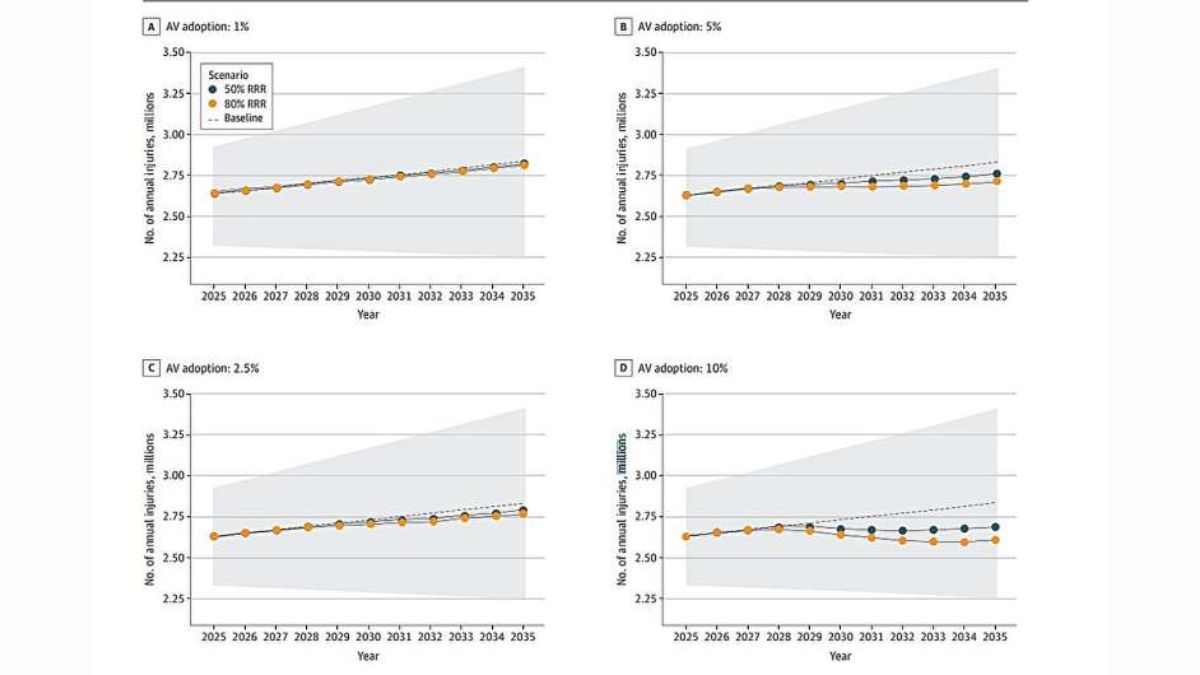
Photo Credit: JAMA Surgery (2025)
Autonomous vehicles may cut U.S. road injuries by over 1 million by 2035, study suggests.
Click Here to Add Gadgets360 As A Trusted Source


Advertisement
In the next decade, self-driving cars could help eliminate road accidents and injuries all over the United States. A new study in JAMA Surgery suggests that self-driving cars (AVs) could prevent more than a million injuries between 2025 and 2035, or about one-third of all road-related injuries during this time. Car crashes remain a public health epidemic, claiming over 120 lives per day in the U.S. and responsible for more than 2.6 million ER visits in 2022. Aside from human tragedy, the nation loses more than $470 billion in medical costs and lost productivity due to crashes, so road safety is an urgent issue.
Autonomous Vehicles Could Prevent Over One Million U.S. Road Injuries by 2035, Study Finds
According to the JAMA Surgery report, the researchers analysed U.S. national road traffic injury data from 2009 to 2023 and projected trends for 2025–2035 with a linear regression model. They looked at the number of collective miles AVs would travel and how much safer such vehicles were than humans. The proportion of AV penetration varied from 1% to 10%, while the safety benefit ranged from 50% to 80%. Best-case scenario, AVs could eliminate more than 1 million injuries nationally.
Self-Driving Cars Could Cut Accidents Up to 80%, But More Real-World Data Needed, Researchers Say
The majority of crashes are caused by human errors of distraction or impairment, and self-driving cars can mitigate them. As per early data from companies such as Waymo, AVs could reduce accident rates by as much as 80% compared with those for human drivers.
Additional real-world data would be needed to fine-tune these estimates, researchers emphasized. Further work will be required to focus on highways, as these types of roads represent the location of most severe injury and fatal crashes, in order to more comprehensively understand the public health burden associated with AVs.
Comments
Get your daily dose of tech news, reviews, and insights, in under 80 characters on Gadgets 360 Turbo. Connect with fellow tech lovers on our Forum. Follow us on X, Facebook, WhatsApp, Threads and Google News for instant updates. Catch all the action on our YouTube channel.
Further reading:
Self-driving cars, Autonomous vehicles, Road safety, traffic injuries, Public health, JAMA Surgery, AV adoption
Related Stories


Advertisement
Follow Us




-
04:25
Vivo X200T Review - Full Camera, Gaming & Battery Test | Worth Buying? -
28:31
The Future of Productivity: Logitech's Anatoliy Polyanker On AI, Hybrid Work, And India's Tech Boom -
04:46
Infinix Note Edge 5G Review | Budget 5G Phone With Premium Features? -
04:54
Redmi Note 15 Review: Features, Specifications, Pros, Cons, And Everything Else -
04:38
Realme 16 Pro Review | Camera, Performance & Battery Test | Best Mid-Range Phone?
-
50MP कैमरा, 7200mAh बैटरी के साथ Vivo T5x 5G भारत में लॉन्च, जानें
-
दुनिया का पहला रोबोट गिरफ्तार? महिला को डराया, फिर पुलिस ने क्या किया
-
Samsung Galaxy M17e 5G भारत में लॉन्च: 6000mAh बैटरी के साथ गजब फीचर्स
-
Google Maps पर Ask Maps फीचर कैसे करें उपयोग
-
Oppo K14 5G भारत में लॉन्च: 7000mAh बैटरी और 120Hz डिस्प्ले के साथ आया नया बजट फोन
Advertisement
Popular on Gadgets
- Samsung Galaxy Unpacked 2026
- iPhone 17 Pro Max
- ChatGPT
- iOS 26
- Laptop Under 50000
- Smartwatch Under 10000
- Apple Vision Pro
- Oneplus 12
- OnePlus Nord CE 3 Lite 5G
- iPhone 13
- Xiaomi 14 Pro
- Oppo Find N3
- Tecno Spark Go (2023)
- Realme V30
- Best Phones Under 25000
- Samsung Galaxy S24 Series
- Cryptocurrency
- iQoo 12
- Samsung Galaxy S24 Ultra
- Giottus
- Samsung Galaxy Z Flip 5
- Apple 'Scary Fast'
- Housefull 5
- GoPro Hero 12 Black Review
- Invincible Season 2
- JioGlass
- HD Ready TV
- Latest Mobile Phones
- Compare Phones
Latest Gadgets
- Poco X8 Pro 5G
- Poco X8 Pro Max 5G
- OPPO K14 5G
- OPPO Find N6
- Vivo T5x 5G
- Samsung Galaxy M17e 5G
- Lava Bold 2 5G
- Motorola Edge 70 Fusion+
- MacBook Neo
- MacBook Pro 16-Inch (M5 Max, 2026)
- Tecno Megapad 2
- Apple iPad Air 13-Inch (2026) Wi-Fi + Cellular
- OPPO Watch X3
- Tecno Watch GT 1S
- Xiaomi QLED TV X Pro 75
- Haier H5E Series
- Asus ROG Ally
- Nintendo Switch Lite
- Haier 1.6 Ton 5 Star Inverter Split AC (HSU19G-MZAID5BN-INV)
- Haier 1.6 Ton 5 Star Inverter Split AC (HSU19G-MZAIM5BN-INV)

- About Us
- Sitemaps
- Feedback
- Archives
- Contact Us
- RSS
- Advertise
- Career
- Privacy Policy
- Ethics
- Editorial Policy
- Terms & Conditions
- Complaint Redressal
Download Our Apps
Available in Hindi
© Copyright Red Pixels Ventures Limited 2026. All rights reserved.