-
 Adobe to Offer Free Express, AI Skill-Building Resources Across Government Schools in India27 August 2026
 -
Adobe Express Premium Is Now Free for One Year for All Airtel Users29 January 2026
-
Adobe Photoshop, Express and Acrobat Can Now Be Accessed Within ChatGPT11 December 2025
-
Adobe Introduces AI Assistant in Photoshop, New AI Audio and Video Tools in Firefly28 October 2025
-
Adobe Previews Agentic AI Tools Across Acrobat, Photoshop and Premiere Pro11 April 2025
- Home
- Apps
- Apps Features
- Exclusive: Adobe’s Govind Balakrishnan on Why Adoption Trumps Profit for Adobe Express
Exclusive: Adobe’s Govind Balakrishnan on Why Adoption Trumps Profit for Adobe Express
Adobe is offering one year free subscription to Adobe Express to all Airtel users.
Written by Akash Dutta, Edited by Ketan Pratap | Updated: 3 February 2026 09:00 IST
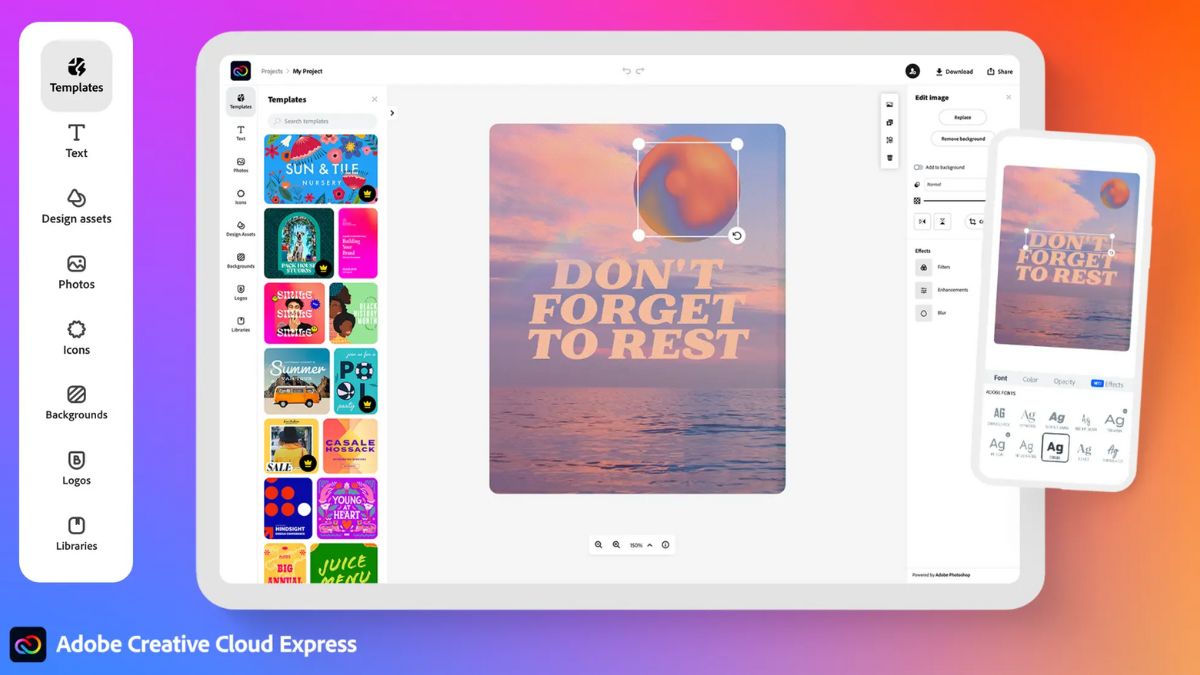
Photo Credit: Adobe
The focus of Adobe Express’ free subscription is user acquisition
Click Here to Add Gadgets360 As A Trusted Source

Advertisement
Adobe partnered with Airtel on Thursday to offer 12 months of Adobe Express Premium to Bharti Airtel users in India. On paper, that opens up Adobe's “create-anything” platform to nearly 360 million people, giving them access to its design tools, artificial intelligence (AI) features, and a large library of stock assets for a year. Adobe pegs the retail value of this bundle at around Rs. 4,000 per user. Taken at scale, that works out to roughly Rs. 1.44 lakh crore, or $15.65 billion, a number that stands out when placed next to Adobe's FY2025 revenue of $23.77 billion (about Rs. 2.18 lakh crore).
To be clear, these are headline retail figures, not a reflection of what Adobe will actually spend. But Adobe Express is a cloud-based service with AI-powered features, which means the company will still carry infrastructure and operating costs. So, even if the company runs the promotion as a localised event for Indian users, the ambition is clear as day.
During an exclusive conversation with Govind Balakrishnan, Senior Vice President and General Manager at Adobe Express, the discussion moved beyond the announcement and into the underlying mechanics: how does a company built on high-margin professional software justify a massive free-access play?
What Is Adobe Express' North Star?
The financial logic behind offering premium software for free to millions of mobile subscribers is often questioned. However, for the software giant, the move sheds light on what truly is the product's North Star metric. For the unaware, the North Star metric is the single, most critical measurement that best captures the core value a product delivers to customers. It is essentially the guiding compass for long-term, sustainable growth.
"Our focus for all intents and purposes right now is to drive adoption," Balakrishnan said, when asked about the infrastructure costs and financial viability of such a large-scale free offer, adding, "We believe that as we get more users into the product and get them to be successful, the monetisation will take care of itself over time."
So, for Adobe, the move is less about immediate revenue and more about ecosystem lock-in. The goal is to make the tool indispensable to small Indian businesses, students, and content creators before the question of payment even arises.
The Adobe Express Package
When it comes to the country's creator economy, India has witnessed a Cambrian explosion over the last half a decade. With the rise of short video platforms, such as Instagram Reels and YouTube Shorts, and increased access to AI tools, the barrier to content creation has significantly lowered. The Union Budget 2026 also reflects this trend, with Finance Minister Nirmala Sitharaman announcing the setting up of Animation, Visual Effects, Gaming and Comics (AVGC) Content Creator Labs in 15,000 secondary schools and 500 colleges.
According to a 2025 report by the Boston Consulting Group (BCG), India's creators currently influence more than $350 billion (roughly Rs. 32 lakh crore) of consumer spending annually, and the figure is expected to cross $1 trillion (roughly Rs. 91.51 lakh crore) by 2030. This is a massive opportunity, and companies are beginning to realise this.
For instance, Canva has released its platform in Hindi and introduced short-term daily and weekly plans. Similarly, Apple has recently released its Creator Studio with localised pricing. Adobe is not new to this, with its flagship products, such as Acrobat, Photoshop, Illustrator, and Premiere Pro, being used by millions of creators and professionals. But Adobe Express is new, and it is trying to make a mark in an area which is new for the company — the “create-anything” space.

Govind Balakrishnan, SVP and GM, Adobe Express
Photo Credit: Adobe
To capture this exponentially growing market and to compete with existing players, Balakrishnan pitches Adobe Express as a democratisation tool. “Our mission is to democratise creativity and make it as accessible as possible for everyone. We realised that the complexity of our existing products made it difficult to deliver on this mission. That's where the idea of Adobe Express came.”
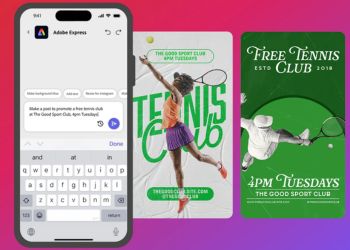
“We wanted to bring the best of Adobe's creativity and productivity capabilities into one quick, easy and powerful application that basically enables everyone to create standout content in minutes,” he added. Currently, Adobe Express offers a range of tools and AI features to create, edit, and enhance content across images, text, and videos.
On Fears of Cannibalisation
A common concern for long-time Adobe users is whether "quick and easy" tools like Express will eventually cannibalise the power of Photoshop or Illustrator. Balakrishnan argues that these platforms are designed to coexist, targeting different "intent levels" of the same creator.
"Think of Adobe Express as the collection of tools and capabilities from the breadth of Adobe's suite," he explained. The strategy is to build a "seamless transition" where a user can start a complex asset in Photoshop and move it to Express for a quick social media animation. It's an attempt to solve the "friction" of professional workflows for people who need high-quality results without the professional learning curve.
The Role of AI in Reducing Friction
While AI is the buzzword of the year, Adobe is focusing its implementation on time-consuming creative tasks. Balakrishnan, who has a background in complex animation tools like Maya, pointed to "Animate All" as the standout example.
By using AI to apply physics-based effects (like wind or bounce) in seconds, Adobe is attempting to lower the barrier to entry for motion graphics. "Animation was something that used to take people hours or days... to now be able to do it in a couple of seconds is truly mind-blowing,” Balakrishnan added.
Comments
Get your daily dose of tech news, reviews, and insights, in under 80 characters on Gadgets 360 Turbo. Connect with fellow tech lovers on our Forum. Follow us on X, Facebook, WhatsApp, Threads and Google News for instant updates. Catch all the action on our YouTube channel.
Further reading:
Adobe Express, Adobe
Related Stories



Advertisement
Follow Us




-

06:32
Google Pixel 11 Pro XL Review: The Most Exciting Pixel Yet? | 120X Zoom + Tensor G6 -
05:20
Samsung Galaxy Watch Ultra 2 Review: Is This the Best Android Smartwatch? -
07:01
Samsung Galaxy Z Fold 8 Review: Is This the Best Foldable Phone? -
06:39
Samsung Galaxy Z Fold8 Ultra Review: Cameras, Battery, Performance Tested -
04:33
[Sponsored] JBL Live 780NC: Great Sound, Perfect Comfort, Smart ANC & 80-Hour Battery
Advertisement
Popular on Gadgets
- Samsung Galaxy S26 Ultra
- Motorola Razr Fold
- ChatGPT
- OPPO Find N6
- Mobiles Under Rs. 40,000
- Vivo X300 Ultra
- Asus Zenbook S14
- iQOO 15
- Vivo X300 Pro
- Lenovo Yoga Slim 7i Aura Edition
- iQOO 15R
- Vivo X Fold 5
- Sony PlayStation 5
- HP OmniPad 12
- OnePlus Nord CE 6 Lite
- OnePlus Pad 4
- OPPO F33 Pro 5G
- Cryptocurrency
- HP OmniBook Ultra 14 (2026)
- iPhone 17
- Eureka Forbes AP 355 Room Air Purifier
- Latest Mobile Phones
- Compare Phones
Latest Gadgets
- Samsung Galaxy A08
- Itel Muzik 450L
- OPPO K14 Lite
- Samsung Galaxy A18 4G
- iPhone Duo
- OPPO A7 Pro
- Huawei Mate XT 2 Ultimate Design
- Realme 16 Pro Harry Potter Edition
- Asus Vivobook S14 (S5452MA)
- Acer Aspire G 3D 16
- Xiaomi Pad 9 Pro
- Xiaomi Pad 9
- Apple Watch Ultra 4
- Apple Watch Series 12
- Haier M70 Mini LED 65-inch
- Xiaomi TV FX Mini LED 65
- Acer Predator Atlas 8
- Asus ROG Ally
- Blue Star 1.5 Ton 5 Star Inverter Split AC (IE518ZNURS)
- Blue Star 2 Ton 3 Star Inverter Window AC (WIE324L)

- About Us
- Sitemaps
- Feedback
- Archives
- Contact Us
- RSS
- Advertise
- Career
- Privacy Policy
- Ethics
- Editorial Policy
- Terms & Conditions
- Complaint Redressal
Download Our Apps
Available in Hindi
© Copyright Red Pixels Ventures Limited 2026. All rights reserved.