-
 Astronomers Detect Rare Rogue Planet Drifting Alone 10,000 Light-Years from Earth7 January 2026
 -
Astronomers Spot Rapidly Growing Rogue Planet Feeding on Surrounding Gas5 October 2025
-
New Rogue Planet Discovered in Hubble Data Using Einstein’s Gravity Theory1 August 2025
-
Mysterious Planetary-Mass Objects May Form in Young Star System Clashes12 March 2025
-
James Webb Space Telescope Observes Mysterious Rogue Planet-Like Object6 March 2025
- Home
- Science
- Science News
- Astronomers Measure Mass and Distance of a Rogue Planet for the First Time in History
Astronomers Measure Mass and Distance of a Rogue Planet for the First Time in History
Astronomers measure a rogue planet’s mass and distance for the first time, revealing new free-floating planets.
Written by Gadgets 360 Staff | Updated: 6 January 2026 23:15 IST
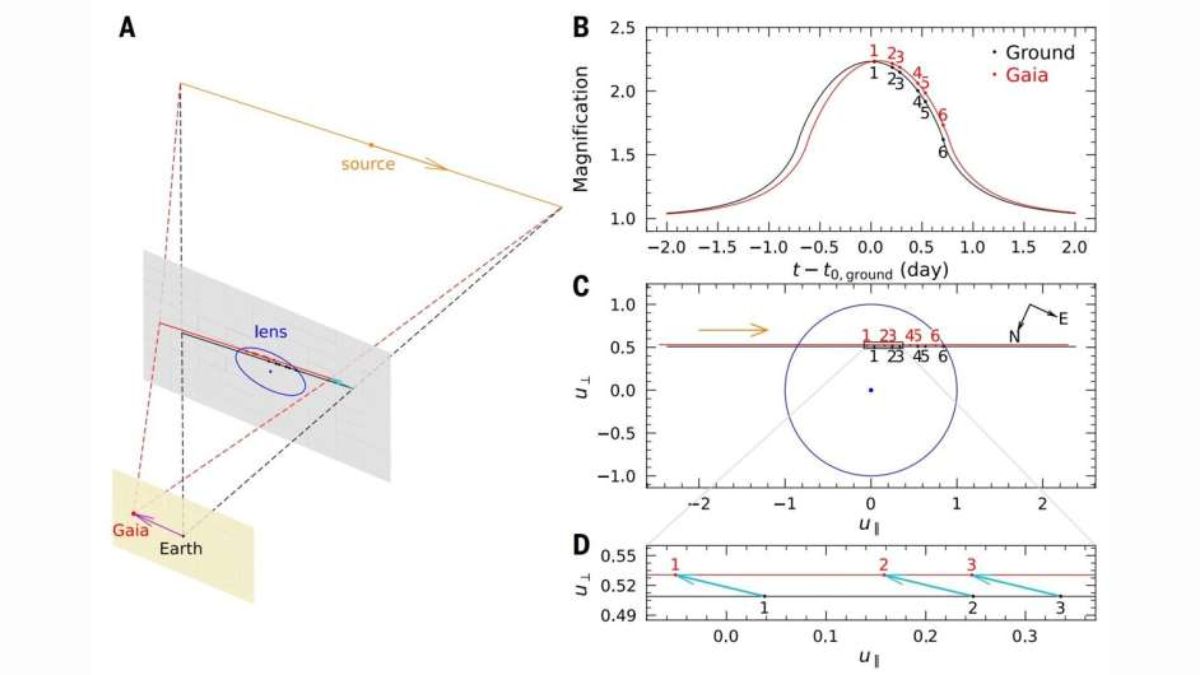
Photo Credit: Science (2026)
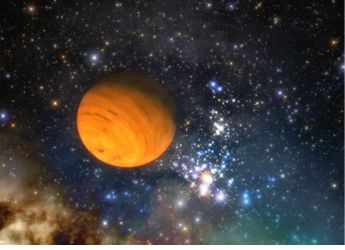
Rogue planet’s mass and distance measured for the first time, confirming its starless trajectory.
Click Here to Add Gadgets360 As A Trusted Source


Advertisement
For the first time, astronomers have measured both the mass and distance of a starless planet wandering through space on its own. Unlike regular planets, which orbit a star, rogue planets hurtle around their galaxy — providing an undeniably tougher detection challenge. A study in Science reports how observations from several ground-based telescopes combined with Gaia data made it possible to estimate its mass and distance. By witnessing the microlensing effect from two positions, they were able to break the “mass-distance degeneracy”, providing never-before-seen insight into these starless planets.
Microlensing Event Reveals Rogue Planet Just Under Saturn's Mass, 10,000 Light-Years Away
According to the study, the microlensing event, denoted as KMT-2024-BLG-0792/OGLE-2024-BLG-0516, was seen close to perpendicular, a direction running from Gaia's precession axis with six measurements during 16 h. This allowed the team to estimate that the planet is only about 22 per cent of Jupiter's mass, a little less than Saturn's, and that it sits roughly 3,000 parsecs away from Earth, or nearly 10,000 light-years. Spectral analysis revealed that the background star it had intercepted was a red giant.
Study of Rogue Planets Reveals Violent Planetary Dynamics and Offers Clues on System Evolution
The protoplanetary disk is thought to produce rogue planets that are then ejected from the disk through gravitational interactions, and larger objects are typically worlds like brown dwarfs. Though other free-floating planet finds haven't had direct mass measurements, this new one offers important proof that violent dynamics can influence the lives of planetary systems, the scientists say.
Future studies of rogue planets could shed light on how planetary systems evolve, why some planets go rogue, and the frequency of these wandering worlds in our galaxy.
Comments
Get your daily dose of tech news, reviews, and insights, in under 80 characters on Gadgets 360 Turbo. Connect with fellow tech lovers on our Forum. Follow us on X, Facebook, WhatsApp, Threads and Google News for instant updates. Catch all the action on our YouTube channel.
Further reading:
Rogue planets, Free-floating planets, Microlensing, Gaia Telescope, Exoplanets, Planetary Science
Related Stories



Advertisement
Follow Us




-
04:25
Vivo X200T Review - Full Camera, Gaming & Battery Test | Worth Buying? -
28:31
The Future of Productivity: Logitech's Anatoliy Polyanker On AI, Hybrid Work, And India's Tech Boom -
04:46
Infinix Note Edge 5G Review | Budget 5G Phone With Premium Features? -
04:54
Redmi Note 15 Review: Features, Specifications, Pros, Cons, And Everything Else -
04:38
Realme 16 Pro Review | Camera, Performance & Battery Test | Best Mid-Range Phone?
-
50MP कैमरा, 7200mAh बैटरी के साथ Vivo T5x 5G भारत में लॉन्च, जानें
-
दुनिया का पहला रोबोट गिरफ्तार? महिला को डराया, फिर पुलिस ने क्या किया
-
Samsung Galaxy M17e 5G भारत में लॉन्च: 6000mAh बैटरी के साथ गजब फीचर्स
-
Oppo K14 5G भारत में लॉन्च: 7000mAh बैटरी और 120Hz डिस्प्ले के साथ आया नया बजट फोन
-
अनलिमिटेड इंटरनेट, 22 से ज्यादा OTT और कॉलिंग वाले ब्रॉडबैंड प्लान, सिर्फ 1 रिचार्ज में मिलेगा सबकुछ
Advertisement
Popular on Gadgets
- Samsung Galaxy Unpacked 2026
- iPhone 17 Pro Max
- ChatGPT
- iOS 26
- Laptop Under 50000
- Smartwatch Under 10000
- Apple Vision Pro
- Oneplus 12
- OnePlus Nord CE 3 Lite 5G
- iPhone 13
- Xiaomi 14 Pro
- Oppo Find N3
- Tecno Spark Go (2023)
- Realme V30
- Best Phones Under 25000
- Samsung Galaxy S24 Series
- Cryptocurrency
- iQoo 12
- Samsung Galaxy S24 Ultra
- Giottus
- Samsung Galaxy Z Flip 5
- Apple 'Scary Fast'
- Housefull 5
- GoPro Hero 12 Black Review
- Invincible Season 2
- JioGlass
- HD Ready TV
- Latest Mobile Phones
- Compare Phones
Latest Gadgets
- Poco X8 Pro 5G
- Poco X8 Pro Max 5G
- OPPO K14 5G
- OPPO Find N6
- Vivo T5x 5G
- Samsung Galaxy M17e 5G
- Lava Bold 2 5G
- Motorola Edge 70 Fusion+
- MacBook Neo
- MacBook Pro 16-Inch (M5 Max, 2026)
- Tecno Megapad 2
- Apple iPad Air 13-Inch (2026) Wi-Fi + Cellular
- OPPO Watch X3
- Tecno Watch GT 1S
- Xiaomi QLED TV X Pro 75
- Haier H5E Series
- Asus ROG Ally
- Nintendo Switch Lite
- Haier 1.6 Ton 5 Star Inverter Split AC (HSU19G-MZAID5BN-INV)
- Haier 1.6 Ton 5 Star Inverter Split AC (HSU19G-MZAIM5BN-INV)

- About Us
- Sitemaps
- Feedback
- Archives
- Contact Us
- RSS
- Advertise
- Career
- Privacy Policy
- Ethics
- Editorial Policy
- Terms & Conditions
- Complaint Redressal
Download Our Apps
Available in Hindi
© Copyright Red Pixels Ventures Limited 2026. All rights reserved.